

Value Delivered
An apparently incomplete reference became a defensible technical match for the claim’s decisive geometric limitation.
The client received a stronger, evidence-backed prior-art position against the most difficult limitation: conductive elements extending across the full width of a supporting base. The finding converted a reference that initially appeared incomplete into a high-value candidate supported by the reference’s own technical disclosure.
The client could use the work to:
- Strengthen claim analysis. Support an element-by-element invalidity or validity assessment with a reasoned basis for the geometric relationship.
- Prioritize review. Direct counsel and technical experts to a focused reference instead of spending time on broadly similar but incomplete sensor art.
- Reduce interpretive risk. Distinguish what the reference states expressly from what is established through technical validation.
- Preserve a valuable lead. Avoid discarding strong prior art merely because the decisive relationship was not described using the claim’s exact words.
Problem Solved
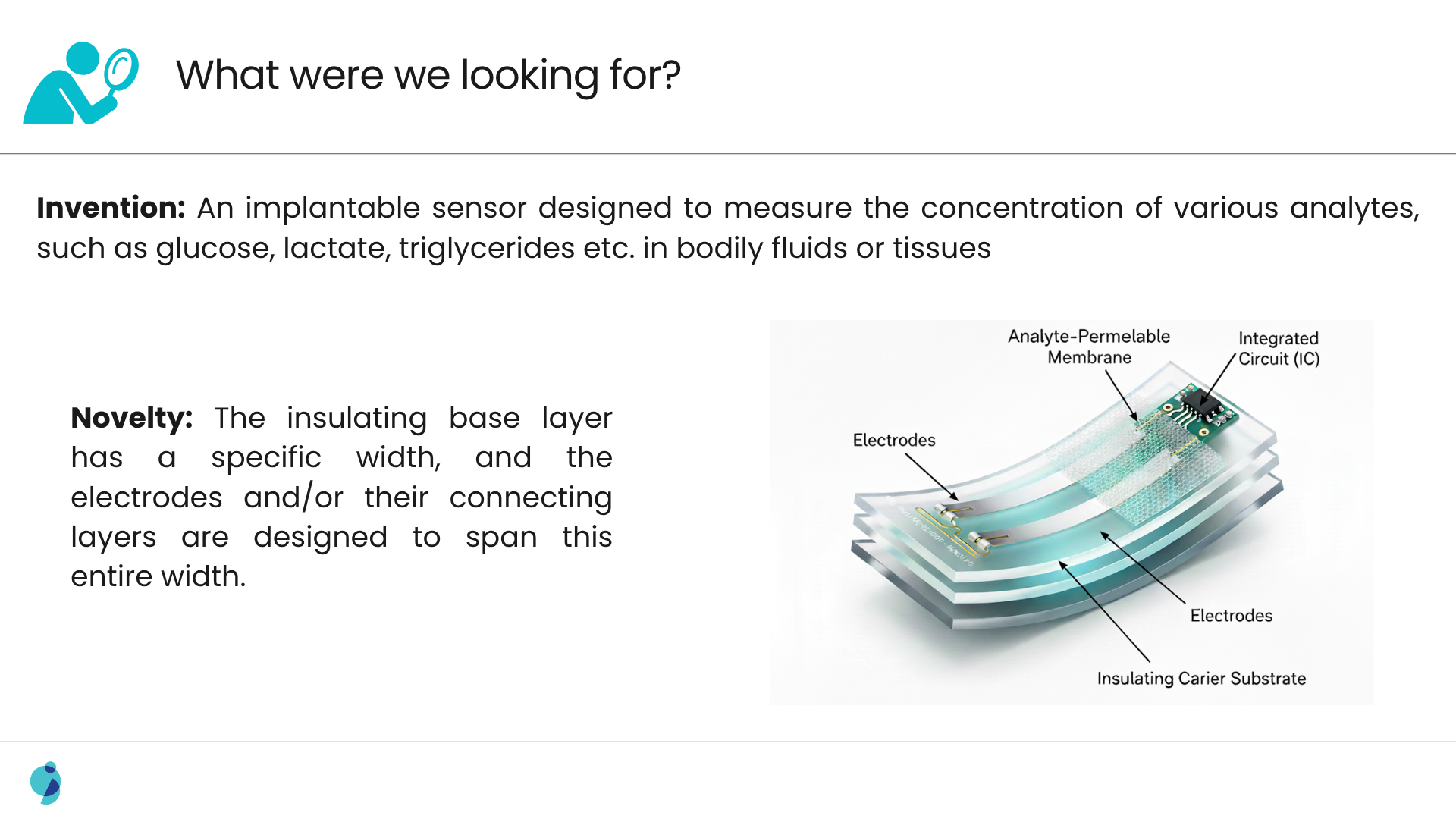
The search concerned an implantable sensor for measuring analytes in bodily fluids or tissue. The relevant claim required both a layered electrode arrangement and a specific spatial relationship in which the electrodes, or their connecting layers, extended across the full width of the carrier or insulating base.
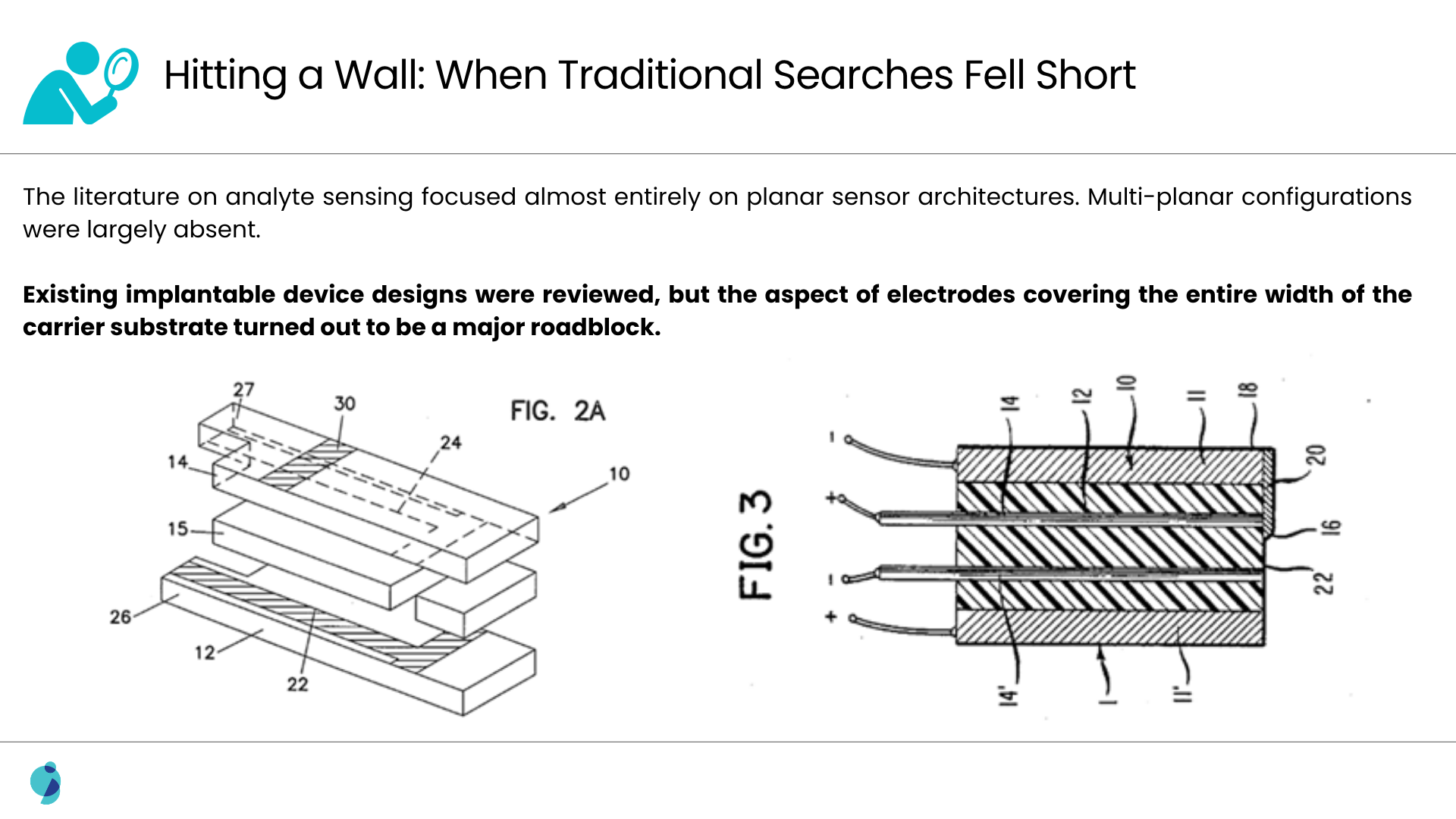
Initial searching reached a practical wall. The literature emphasized planar designs, while multi-layer configurations were scarce. Relevant implantable-sensor references disclosed stacked electrodes but not the full-width relationship, and ambiguous drawings could not establish it. Because this was a dimensional relationship rather than a keyword, the challenge was to prove it without overstatement.

Solution Offered
The research identified a pre-existing technical reference within the broader fields of implantable analyte sensing, continuous monitoring, layered electrode assemblies, dielectric structures, and carrier-substrate geometry. The reference disclosed the core sensor concept and the layered arrangement, while also providing technical information relevant to the disputed width limitation.
Using a confidential technical-validation approach, the team tested the disclosed dimensional relationships against the written description and figures. That validation supported the conclusion that the electrode arrangement could span the full width of the carrier substrate. The exact calculations, search path, source identifiers, and organization names have been intentionally withheld.
The client received:
- A focused prior-art candidate covering the implantable analyte sensor and layered electrode architecture.
- A limitation-specific rationale addressing the full-width relationship through source-grounded technical evidence.
- A clear evidence boundary separating express disclosure, validated conclusion, and any remaining assumptions.
- A review-ready narrative that counsel or a technical expert could assess and incorporate into the broader case strategy.
Get the full case study to discover how technical evidence strengthened a difficult invalidity search in implantable sensing technology