

A pharmaceutical company wanted to improve the performance and usability of needle caps used with its prefilled syringe platforms. The objective was to make the caps easier to remove while ensuring they remained securely attached throughout the product lifecycle.
However, improving one parameter could adversely affect another. Reducing interference or friction could decrease pull-off force but potentially weaken retention. Changing cap materials could improve flexibility but affect dimensional stability after sterilization. Structural modifications could improve usability but require changes to molding or assembly processes.
GreyB helped the client identify and evaluate different engineering routes to balance five requirements: secure retention, controlled pull-off force, sterility protection, manufacturing compatibility, and user experience.
1. Eight Design Areas Were Investigated to Understand Needle-Cap Removal and Retention Forces
Multiple physical mechanisms can influence the force required to remove a needle cap.
Instead of treating the needle cap as a single component, the team decomposed its performance into the underlying engineering variables affecting retention and removal.
The assessment covered:
| Design Area | Technical Parameters Investigated |
| Geometry | Interference fit, engagement length, taper angle, contact area, wall thickness, ribs/grooves |
| Material | Hardness, elastic modulus, coefficient of friction, elastic recovery, compression behavior |
| Surface Interface | Surface roughness, lubricity, friction characteristics, coatings |
| Structural Design | Flexible sections, deformable regions, segmented contact, controlled disengagement |
| Pressure Behavior | Venting, pressure equalization, air pathways |
| Human Factors | Grip diameter, gripping texture, removal direction, effective user force |
| Manufacturing | Moldability, dimensional tolerance, assembly compatibility |
| Sterilization | Dimensional stability and property retention following relevant sterilization conditions |
This decomposition expanded the search beyond conventional needle-cap designs.
Technologies addressing similar problems involving interference fit, controlled disengagement, friction reduction, sealing, pressure management, and mechanical leverage were investigated across patents, literature, suppliers, products, and adjacent technical domains.
2. Six Engineering Approaches Were Identified to Balance Pull-Off Force and Cap Retention
Rather than producing a long list of individual technologies, the team organized identified solutions into six distinct engineering strategies based on how they influence pull-off and retention forces.
Geometry Optimization
Changes to contact geometry, interference, taper, engagement length, or contact distribution could alter the mechanical resistance generated between the cap and syringe assembly.
Material Optimization
Alternative polymers, elastomers, and material configurations were evaluated to understand whether differences in hardness, elasticity, friction, and recovery could provide the required retention while reducing removal effort.
Surface and Friction Engineering
Surface treatments, low-friction interfaces, and localized modifications were investigated as routes to reduce resistance without substantially redesigning the overall cap.
Controlled-Deformation Structures
Flexible or deformable sections could allow the cap to remain mechanically secure during transportation and storage but change configuration when removal force is applied.
Pressure-Management Features
Vents, air channels, and pressure-equalization features were assessed where pressure differentials could contribute to removal resistance.
External Removal Mechanisms
The team also investigated whether the user-experienced removal force could be reduced through gripping aids or mechanical-leverage concepts without fundamentally changing the existing cap architecture.
3. Six Candidate Concepts Were Compared Across Nine Performance and Implementation Parameters
Each solution was evaluated across mechanical, material, manufacturing, and usability parameters.

✓ = favorable potential | △ = requires further validation | – = not directly applicable
Defining a Quantitative Design Window for Pull-Off Force and Retention
The client did not only need to know which technologies existed. Its R&D team needed a technical window within which a redesigned cap should operate.
Available evidence and benchmark solutions were analyzed to define target ranges for two parameters:
- Pull-off force: Force required for intentional cap removal.
- Retention force: Mechanical security required to minimize unintended cap displacement during handling, transportation, and storage.
These targets were then connected to controllable design variables:
Material hardness / modulus
↓
Interference + contact geometry
↓
Friction + deformation behavior
↓
Retention force ↔ Pull-off force
This linked material and structural design choices to the two mechanical performance requirements the client needed to balance.
4. Five Material Candidates Were Compared for Friction, Elastic Recovery, and Manufacturing Suitability
The assessment went beyond basic polymer selection to examine how candidate cap materials could influence removal effort, mechanical retention, and compatibility with existing manufacturing processes.

The comparison provided a basis for assessing material configurations against the client’s performance requirements rather than focusing on individual polymer properties alone.
5. Six Potential Development Partners Were Classified into Three Supplier Tiers
A multi-parameter scoring framework separated potential development partners into three tiers based on their ability to support development.
Potential companies were evaluated across seven parameters:
- Relevant material portfolio
- Medical-device experience
- Customization
- Sterilization expertise
- Manufacturing scale
- Proprietary technology
- Co-development potential

The tiered assessment helped distinguish companies with broader development capabilities from those requiring further evaluation against the client’s specific technical and manufacturing needs.
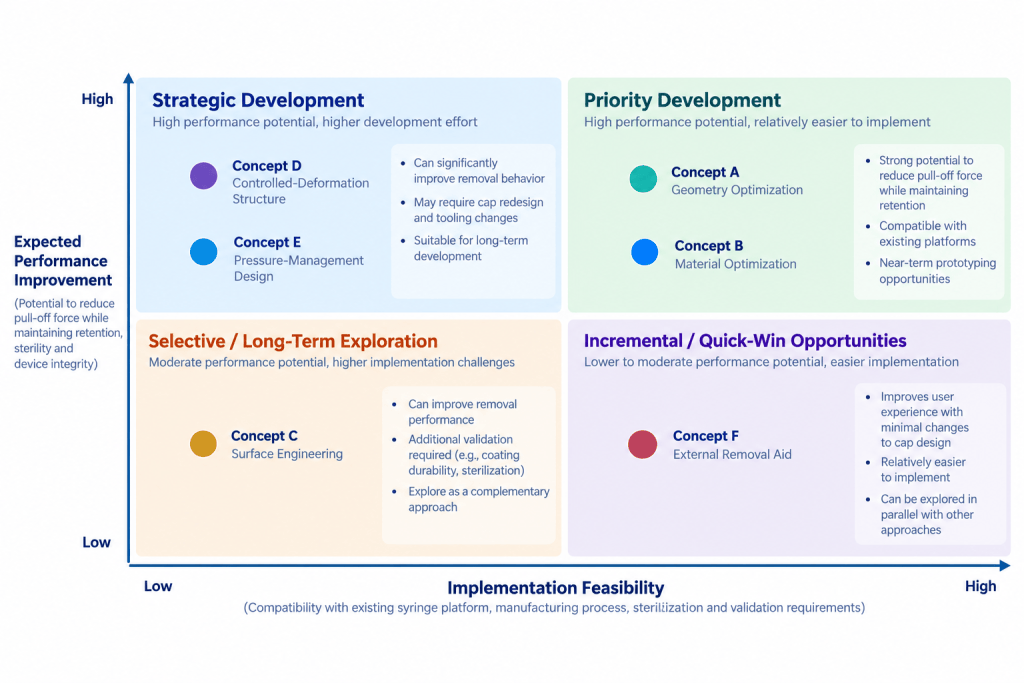
6. Six Concepts Were Mapped into Four Development Pathways to Prioritize R&D Investments
Following the broader assessment, the most promising approaches were selected for deeper technical evaluation.
Each approach was assessed based on how it could influence cap retention and removal mechanics, as well as its compatibility with the client’s existing syringe platform, manufacturing processes, and usability requirements.
To translate these findings into actionable R&D directions, the team mapped the approaches against two dimensions:
Expected Performance Improvement: Potential to reduce pull-off force while maintaining retention, sterility protection, and device integrity.
Implementation Feasibility: Compatibility with existing syringe architecture, manufacturing, materials, sterilization, tooling, and validation requirements.
This separated the opportunities into four development pathways:
From Opportunity Mapping to an R&D Roadmap
The resulting analysis gave the client multiple routes rather than a single design recommendation.
Near-term: Optimize geometry × material properties against the target pull-off and retention-force window.
Mid-term: Investigate surface engineering and controlled-deformation structures where greater control over friction and disengagement could justify additional development.
Longer-term: Explore pressure-management and advanced structural concepts for more differentiated future cap designs.
Parallel usability route: Assess external removal mechanisms where improving user experience without substantially modifying the existing cap architecture could be advantageous.
This allowed the client to determine not only which concepts were technically promising, but which should be prototyped first, which required further validation, and which represented longer-term innovation opportunities.
How Can Pharmaceutical Companies Identify the Most Feasible Needle-Cap Designs for Prefilled Syringes?
Improving needle-cap performance requires more than finding a material with lower friction or modifying the cap geometry. Pharmaceutical companies need to evaluate how each design change affects pull-off force, retention, sterility protection, dimensional stability, manufacturing compatibility, and usability. Comparing these factors helps distinguish approaches suitable for near-term prototyping from concepts that require further technical validation.
Through its open innovation and technology scouting services, GreyB helps companies move from broad technology research and supplier screening to technically evaluated options, development partners, and prioritized R&D directions.
Fill out the form below and connect with our expert today.