
Webinar | Women’s Nutrition: Nourishing Womanhood From Pregnancy To Menopause
11 September | 12 PM ET: Register Now
Q3 shows a PTAB process where the important decision often happens before the petition reaches the merits. Filings recovered, but discretion remained the main gate. Venue risk shifted within Texas, and patent owners gave back much of the trial-stage gain reported in Q2.
IPR filings rose 71.9% to 98. The Q3 institution-stage rate was 57.3%, while discretion accounted for 68.3% of IPR denials. The report treats the denial mix and venue distribution as more useful signals than a headline rate comparison with Q2.
West Texas instituted 68.2% of its 22 IPR institution-stage decisions, while East Texas instituted 35.3% of 34. The report shows why the actual parallel case, scheduling order, trial posture, and judge record matter more than a state-level rule.
Patent owners held every challenged claim in 17.1% of IPR final written decisions, down from 36% in Q2. Petitioners won every claim in 62.9%. The report treats institution as the leverage peak again.
Seven denials turned on prior art already considered during prosecution or an Advanced Bionics problem. A clean Fintiv profile no longer clears the discretionary gate on its own.
Fish & Richardson and Paul Hastings went 0 for 12 when East Texas was on the parallel docket and 10 for 13 without it. The report uses this split to show why counsel performance needs to be read against the litigation footprint.
Reexamination took 74.7% of post-grant filings in the first half of 2026. The report argues that the choice between IPR, PGR, and reexamination, and the parallel docket attached to that choice, is becoming the first strategic decision.
The report follows the full validity challenge path, from the forum selected before a PTAB petition is filed to institution, trial, settlement, counsel performance, technology movement, and the forward outlook.
IPR filings rose from 57 in Q2 to 98 in Q3, ending four consecutive quarters of decline. July brought 32 petitions, August 29, and September 37. The recovery spread across the quarter rather than arriving in a single spike.
The report pairs that recovery with continued use of other post-grant routes. Reexamination accounted for 74.7% of post-grant filings nationally in the first half of 2026, while the PTAB pool began to refill in Q3.
Stacking remained normal. 82.6% of cases with a recorded value were part of a multi-petition dispute. Petitions in a stack instituted at 63.7%, against 40.0% for standalone filings.
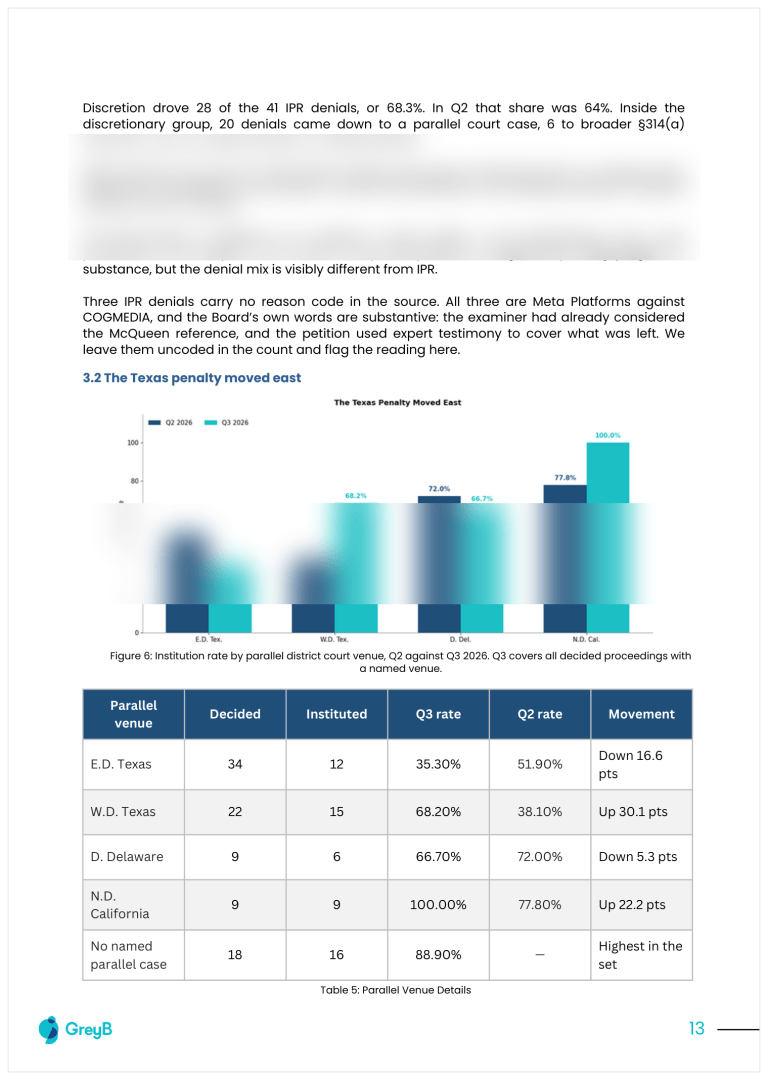
Q2 treated West Texas as the hardest venue. Q3 reversed that signal. West Texas instituted 68.2% of its 22 IPR institution-stage decisions, while East Texas instituted 35.3% of 34.
East Texas-linked cases had a 64.7% denial rate. The denials clustered into four campaigns involving Uber, Microsoft, Cisco, and Google. The report also notes that East Texas is not automatically fatal. The court granted Cisco’s petition against Zugara, with East Texas on the docket.
The useful unit is therefore the actual docket. Trial date, scheduling order, judge’s record on stays, and Sotera stipulation matter more than a state-level label.
Discretion drove 28 of 41 IPR denials, or 68.3%. Twenty of those 28 denials came down to a parallel court case. But a second denial lane also became visible.
Seven denials involved prior art that was already in front of the examiner or raised an Advanced Bionics issue. The Board described the problem as cumulative art, previously considered art, or substantially the same arguments.
Two Q3 denials also named the absence of a Sotera stipulation directly. The report treats this as a real change from Q2, when the stipulation was framed as a useful lever.
Fintiv risk and section 325(d) risk are separate checks. A petition with no parallel case can still fail because the examiner already saw the reference.

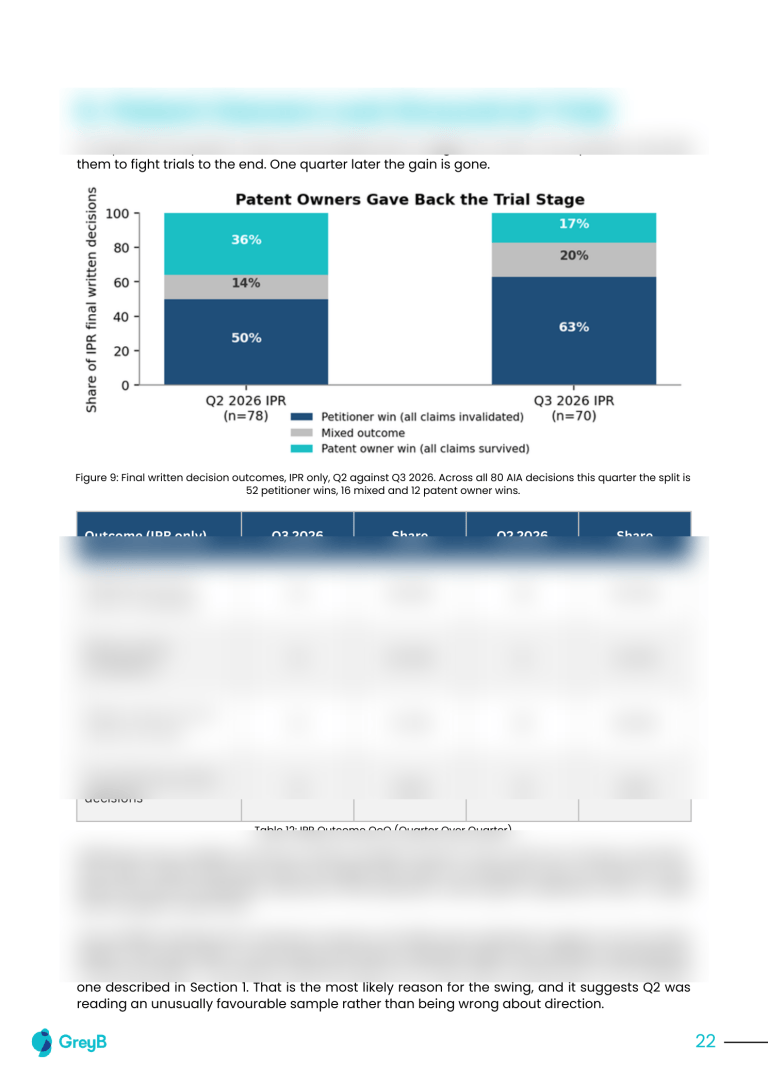
Patent owners held every claim in 12 of 70 Q3 IPR final written decisions, or 17.1%. Q2 had been 36%. Petitioners won every challenged claim in 44 decisions, or 62.9%, while mixed outcomes accounted for 20%.
The report places this change in context. Q3 final decisions came from petitions instituted roughly 12 to 18 months earlier, before the heaviest discretionary screening. The trial cohort therefore reflects an older and broader set of petitions than the institution cohort.
Case duration did not predict the outcome. Across 39 decisions with a recorded duration, the median filing-to-final-decision time was 19 months, with a range of 10 to 56 months.
The report first scores the calls made in Q2. Four of six were confirmed, while the patent-owner trial-win prediction failed in the opposite direction.
It then sets out six predictions, each with the reasoning, confidence level, and result that would prove it wrong.
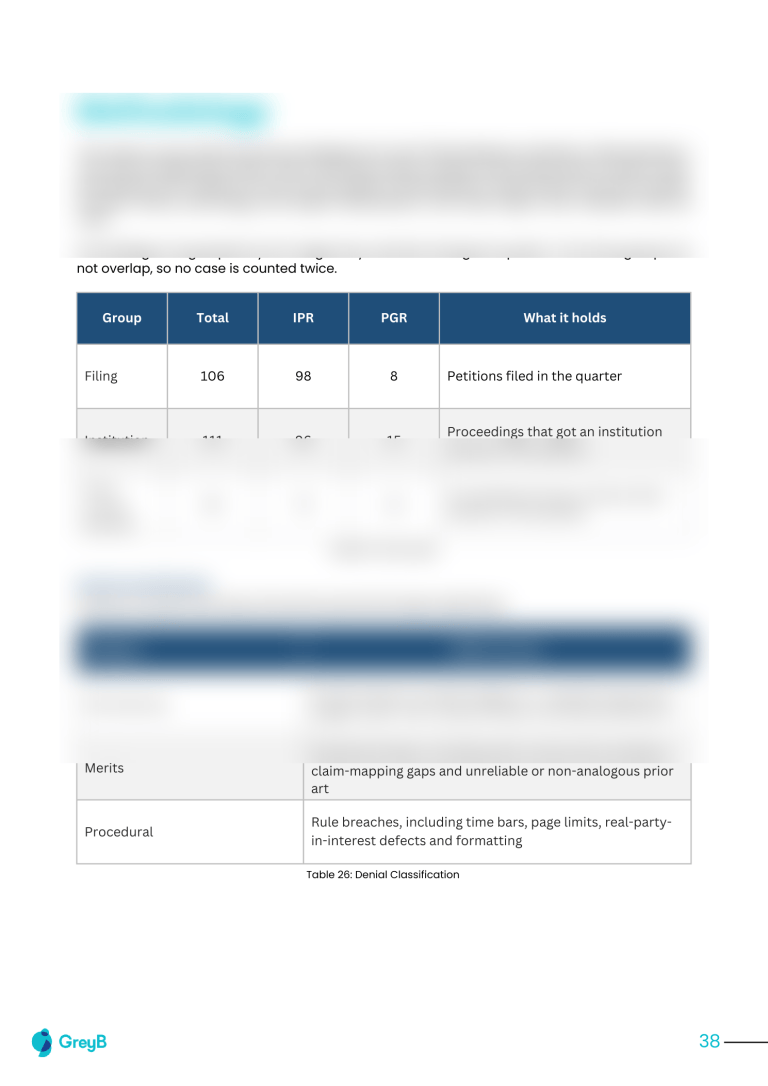
The report covers 299 AIA trial proceedings from 1 July through 30 September 2026, including 265 IPRs and 34 PGRs. Proceedings are grouped by the stage reached during the quarter, so no case is counted twice.
Each proceeding was coded across petition characteristics, denial basis, outcome, parties, counsel, venue, technology, and expert declarations.
Sections 2 to 11 use GreyB’s Q3 2026 tracker. Cross-forum figures in Section 1 and Q2 comparison figures use the external sources listed in the report.
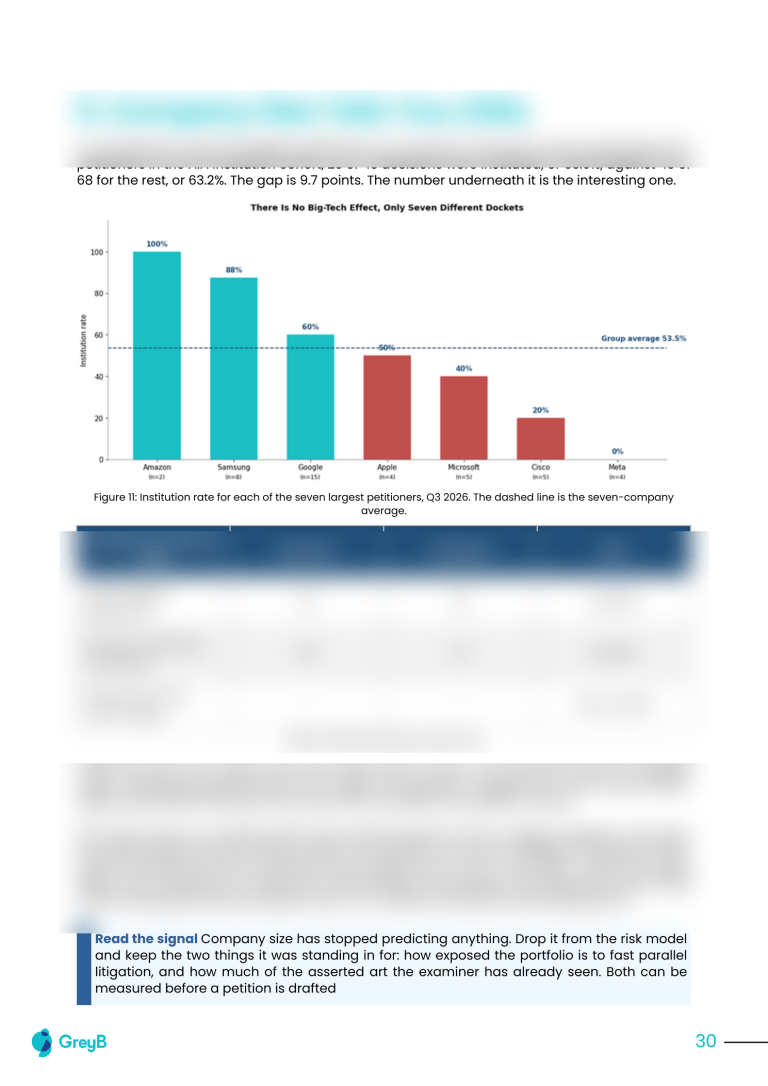
The seven largest Big Tech petitioners instituted 53.5% of 43 AIA institution decisions, compared with 63.2% for other operating companies. Within the seven largest, the range ran from 0% to 100%.
Meta’s denials were tied to examiner history and merits. Cisco’s were mostly tied to East Texas. Samsung and Amazon filed where parallel cases were absent, slow, or in districts where institution was more favourable.
The full report covers cross-forum activity, filing recovery, denial reasons, venue, institution predictors, technology, trial outcomes, petitioner and patent-owner strategy, counsel performance, portfolio attacks, methodology, and six forward predictions.