



5G standard-essential patent litigation is running in at least five courts at the same time.
InterDigital announced on 1 April 2026 that a Rio de Janeiro court blocked Transsion’s 5G device sales in Brazil in a preliminary order that is open to appeal. On 1 July, the Delhi High Court ordered Transsion to deposit security while InterDigital’s case continues. In January, Geely asked a Chinese court to set a global FRAND rate for Nokia’s cellular SEPs. On 27 July, the UK Supreme Court ruled in Tesla v InterDigital and Avanci that a patent owner’s FRAND obligation continues when it licenses through a pool. The Court found a serious issue to be tried on whether the Avanci 5G platform rate, about $32 per vehicle, is FRAND. InterDigital’s cellular cases against Transsion are also pending at the UPC and in Germany.
Each court pressures one party in a different way. Brazil can stop sales. India can order a deposit. China lets an implementer start the rate-setting itself. The UK can review the rate for an entire pool. Licensing pools are moving at the same pace. Sisvel’s point-of-sale pool grew from 3 licensors on 1 April to 44 on 2 July, and it published rates on 20 August, from €1.20 to €8 per device.
Most of these disputes turn on how much of a declared portfolio a product uses, and declaration counts do not answer that. GreyB’s 5G SEP Implementation 2026 study measured the difference. It took about 31,000 families from roughly 100,000 declared 5G families and mapped them to 425 5G NR features. In smartphones, 91.5% of declared families are relevant, but 39.8% map to features that phones implement.

Across the four product areas the study covered, an average of 44.65% of declared families map to implemented features. Of all declared families, 28.7% are foundational, which means they map to implemented features in all four areas.
Brazil tested essentiality through a court expert, and India ordered a deposit without full technical findings
The forums differ in how much technical proof a party must supply before a court grants relief. That difference decides where implementation evidence matters first.
| Forum | 2026 event | Relief | Technical proof required |
| Brazil | Rio de Janeiro 3rd Regional Business Court, preliminary injunction announced 1 April | Ban on 5G-compliant device sales in Brazil | A court-appointed expert found two 5G patents essential and infringed, and found the offer FRAND |
| India | Delhi High Court, order of 1 July | Deposit of security while the suit continues | A prima facie assessment, with no full technical findings on the six Indian patents in suit |
| UK | UK Supreme Court, judgment of 27 July | Trial on whether the Avanci 5G platform rate is FRAND | None yet, because the ruling decided that the claim can proceed |
| China | Geely’s request for a global FRAND rate for Nokia’s cellular SEPs, reported 26 January | Rate set by a court at the implementer’s request | Pending |
| UPC and Germany | InterDigital’s cellular cases against Transsion | Cross-border enforcement | Patent-by-patent infringement and validity findings |
Brazil shows the closest link to implementation. The injunction rested on an expert finding that the patents are essential to 5G and that Transsion infringes them. India shows the loosest link. The Delhi court treated pro tem security as an equitable remedy, set the amount based on Transsion’s last counter-offer, and did not require comparable licenses on the record.
The companies under pressure span handsets, cars and payment terminals. Transsion faced Ericsson and still faces InterDigital. Tesla and Geely are in court with licensors in the car market. Makers of point-of-sale devices face a new pool. IAM reported in May that Brazil’s SEP dockets are growing.
The UK ruling moves the question from one portfolio to a whole platform. A platform is where a portfolio-level measure of use becomes necessary, and it is where the volume of declared patents becomes a practical problem.
A platform rate puts about 170,000 SEPs in front of a court at once
The Avanci 5G platform licenses about 170,000 5G SEPs, counted as patents, from 89 owners for a single fee per vehicle. Tesla argued that the fee, about $32 per vehicle, exceeds what FRAND is. Licenses signed before 16 February 2024 carried an early rate of $29.
The Supreme Court allowed Tesla’s appeal in a unanimous judgment. It held that a patent owner’s FRAND commitment to ETSI does not lapse because the patents are licensed through a pool. It also held that Tesla has a real prospect of showing that the only FRAND license of InterDigital’s UK SEPs on the platform is a global license to the whole platform at a FRAND rate. Avanci owes no FRAND obligation of its own, but the Court treated it as a proper party because it acts as the licensing agent.
The judgment did not set a rate. It decided that the claim can go to trial, and it opened the English courts to implementers who want to challenge a pool rate without waiting to be sued.
A platform rate covers unevenly weighted portfolios. A court asked whether $32 per vehicle is FRAND needs a way to measure how much of the pooled inventory a connected car uses. Avanci’s growth makes that measurement more pressing. On 1 September, Avanci said that more than 175 automotive brands and more than 325 million connected vehicles are covered, with more than 90 licensors in its programs. Its president said many automakers joined the 5G program before selling a single 5G vehicle. Those licenses are in place before vehicles with 5G features reach the market.
That raises the question of what a declared count measures in the first place.
Declared 5G families passed 100,000, and no one reviews a declaration when it is filed
The ETSI IPR database holds more than 100,000 declared 5G patent families. That is more than the combined declared portfolios of 2G, 3G and 4G at comparable points in their lifecycles. ETSI’s declaration regime requires no independent review at the time of filing, so any patent owner may declare any patent as potentially essential.
Ownership is concentrated. The top 20 declared holders account for about 88% of declared 5G families, and the top five account for about 43%.
| Rank | Holder | Headquarters | Pool or licensing route |
| 1 | Huawei | China | Sisvel POS pool, Avanci 5G Vehicle, direct licensing |
| 2 | Qualcomm | USA | Avanci 5G Vehicle, direct licensing |
| 3 | LG Electronics | South Korea | Avanci 5G Vehicle |
| 4 | Samsung | South Korea | Avanci 5G Vehicle |
| 5 | Ericsson | Sweden | Avanci 5G Vehicle |
Rankings count declared families that are active and granted, as reported in the ETSI IPR database in January 2026.
Signing the five largest holders addresses about 43% of declared families. It does not address 43% of genuine SEP exposure, because declared share and essential share are different measures. The same holders sit in the pools whose rates courts are now being asked to review.
Declared share shows who holds the most declarations. It does not show how many of those families a product uses. GreyB’s 2026 study set out to measure that.
More than half of the smartphone-relevant families map to no implemented feature
GreyB’s 2026 study draws on ETSI and 3GPP data through 31 January 2026. It starts with about 100,000 declared 5G families and draws a stratified sample of roughly 31,000. It builds a taxonomy of 425 5G NR features across 3GPP Releases 15 to 19. It then maps the sampled families to those features and checks which features appear in products across four groups: smartphone-related applications, automotive, IoT, and non-terrestrial networks.
For each group, the study separates families that relate to the group’s use cases from families that map to features the group’s products implement.
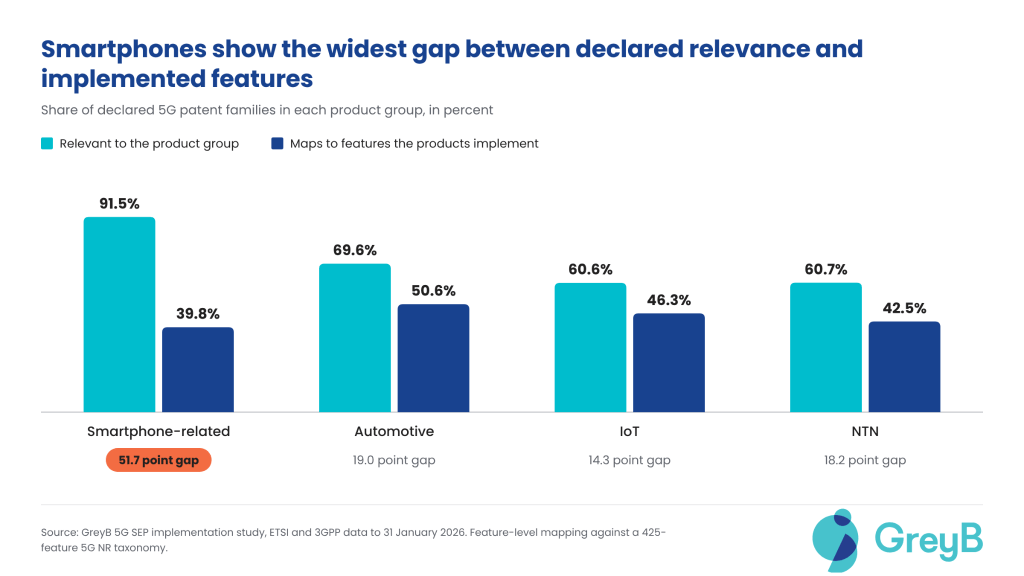
In the most mature 5G market, more than half of the families that look relevant sit outside the implemented set. Automotive has the highest implemented share, and IoT has the smallest gap. Across the four groups, an average of 44.65% of declared families map to implemented features, and the rest carry no technical footprint in those products today.
This is feature-level mapping. It narrows the royalty base, and it does not show that any single patent is essential. A claim chart against the standard remains the test for that, and the five-step framework later in this article places the two side by side.
Foundational families and Release 15 carry most of the licensing weight
The gap is not uniform inside a product group. The study separates baseline features, which every domain reuses, from core features, which one domain builds for itself. Automotive implements baseline features at about 80%, IoT at 78.1%, and NTN at 70%. In automotive, 30.7% of core features are implemented.
Of all declared families, 28.7% cover foundational features that appear in every domain. The other 71.3% cover enhancements, optional features, or extensions for a single domain. A patent on a foundational feature carries more licensing weight than one on a single-release, single-domain extension, even when both are genuine SEPs. Most foundational families trace to Release 15, in areas such as uplink power control, the measurement framework, and cell selection and reselection.
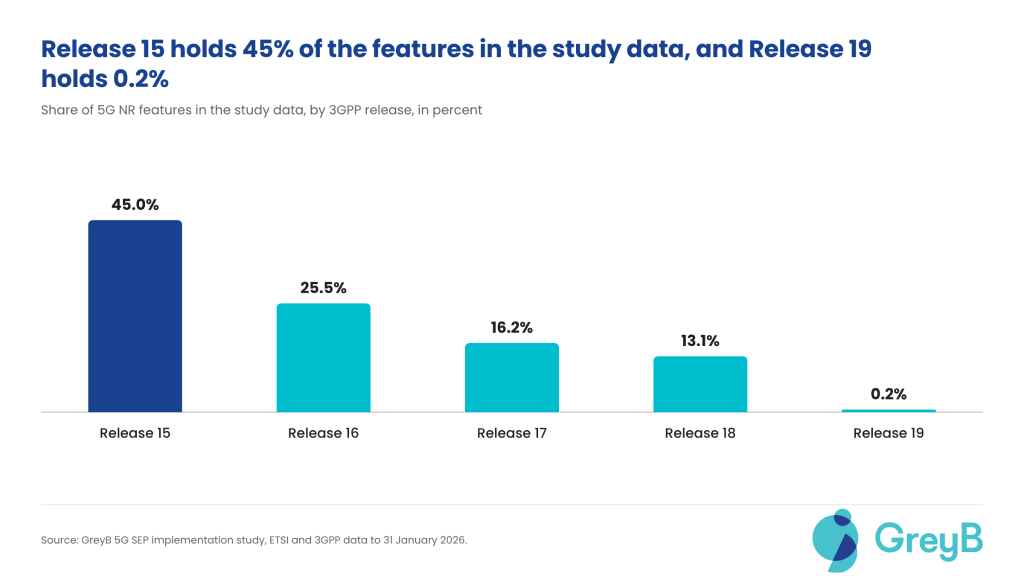
A product built on Releases 15 and 16 has little exposure to Release 18 and 19 declarations. A negotiation can test later-release declarations against the release the product ships, and set aside features that no shipped device in scope implements.
Cars and payment terminals show where the gap meets a pool offer
Automotive has the highest implemented share of the four groups, and licensing there is furthest along. Avanci’s programs cover more than 325 million connected vehicles, and the 5G Vehicle program prices its bundle at about $32 per vehicle. That rate covers baseline and core automotive features alike. A court asked whether it is FRAND will need to know how the pooled families divide between the two.
Sisvel’s point-of-sale pool shows the same step in a newer market. It launched on 1 April with Huawei, LG Electronics and Nokia as founding licensors.
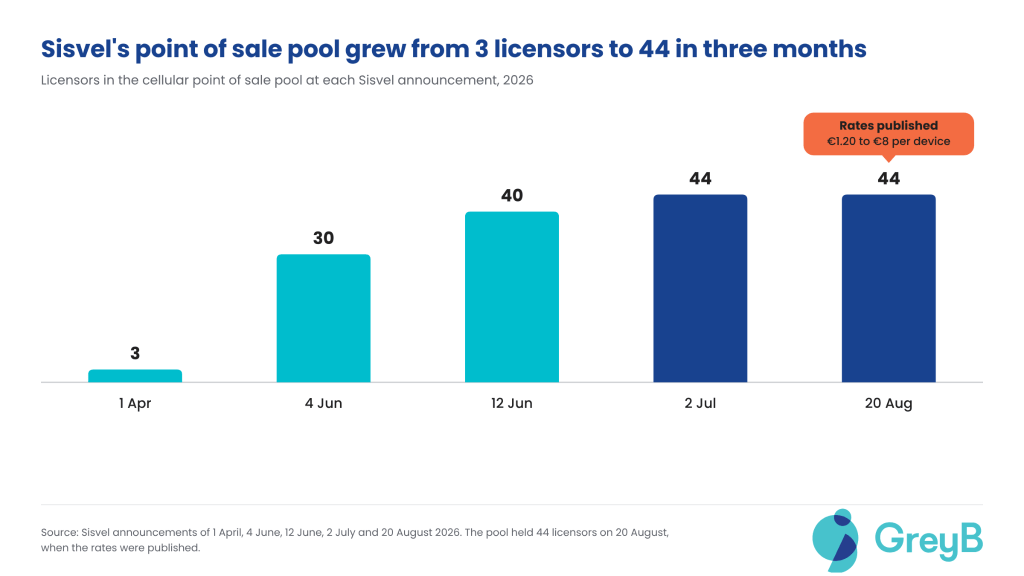
Sisvel says the 44 licensors hold more than half of cellular SEP families. The pool covers 2G to 5G in cellular-connected point-of-sale devices. Smart meters and asset trackers that connect through LTE-M or NB-IoT can be licensed through Sisvel’s separate Cellular IoT pool, so the way a device connects decides which pool applies.
Sisvel published the rates on 20 August. The fee is per unit by device tier, at €1.20 for payment sound boxes, €2 for low-end devices, €5 for mid-end devices, and €8 for high-end devices. As of late August, no licensee had been announced. Device tiers differ in the generations and features they ship, and a feature-level profile records that difference. In the study, point-of-sale devices fall under IoT, the group with the smallest gap. A pool that charges per unit still collects on every device sold.
NTN covers direct-to-device satellite connectivity. Its gap is close to automotive’s, and it is measurable before commercial deployment expands.
| Licensing structure | Public scale or rate | Study product group |
| Avanci 5G Vehicle | About 90 licensors, about $32 per vehicle | Automotive |
| Sisvel POS | 44 licensors, €1.20 to €8 per device | IoT |
| Bilateral licenses, for example Ericsson and Transsion | Terms not public | Smartphone-related |
Ericsson and Transsion went from a multi-region campaign to one global license in eight months
Ericsson launched its enforcement campaign against Transsion in November 2025, with suits in Brazil, India, the UPC and Nigeria. Transsion was the last top-ten smartphone supplier without an Ericsson license.
On 8 July 2026, the two companies settled with a multi-year global cross-license. Transsion took a license to Ericsson’s portfolio, and Ericsson took a license to Transsion’s patents. Ericsson expects the financial benefit to show in its third-quarter 2026 results.
Avanci’s agreements with China-based automakers show a similar pattern in cars. Avanci reported 10 agreements with seven such automakers on 30 March and 20 agreements on 1 September, which include seven of China’s ten largest vehicle exporters by 2025 volume. Of the 12 China-based automakers in its programs, nine are in the 5G program.
Handsets show the same direction. IAM reported on 30 April that InterDigital signed six new licenses in the first quarter, including a Xiaomi renewal, and that its smartphone annual recurring revenue is close to $500 million. Handset licensing is growing alongside the litigation.
The public terms of these agreements do not show how much of each portfolio the products use. Measuring that share follows a defined sequence.
A defensible 5G royalty base takes five steps, and feature mapping covers the first two
GreyB’s 5G SEP Implementation report builds the royalty base on two pillars. Feature-level analysis narrows the declared portfolio to the families that map to features a product implements. Essentiality verification then screens those families for patents that are genuinely essential. Feature mapping alone reduces the base but does not show that any single patent is essential, and a claim chart against the standard remains the test for that.
| Step | Output | Question answered |
| 1. Product implementation profiling | The 3GPP NR features a product category ships, mapped across Releases 15 to 18 | What does the product use? |
| 2. Portfolio scoping | Declared families that cover the implemented feature clusters | Which declared families fall inside that use? |
| 3. Essentiality screening | The scoped families tested against an essentiality threshold | Which of those families are genuinely essential? |
| 4. Proportional share calculation | The licensor’s share of the verified 5G SEP landscape for the product | How large is the licensor’s share? |
| 5. Negotiation engagement | A counter-proposal built on the profile and the essentiality results | What is the other side shown? |
Brazil’s court expert worked at step three. A trial on a platform rate would draw on steps one, two, and four. A deposit order like India’s needs none of the five when it is made, but the same steps decide the final rate.
What should be ready before a pool offer, a platform trial or a deposit order arrives?
A pool offer, a platform rate trial, and a pro tem deposit each put a price on a declared portfolio. The price holds up better when it rests on what the product implements.
The 5G SEP implementation report publishes the 425-feature taxonomy, release-wise breakdowns for the top 15 declared holders, implementation profiles for smartphones, automotive, IoT and satellite systems, and the five-step royalty framework. Portfolios entering a pool, products facing a blanket offer, and negotiations where security has been demanded all need the implementation profile first.
See which declared families map to the features a product implements.