
5G SEP Implementation:
Identifying the Patents That Matter in Licensing
100,000+
Declared 5G patent families now sit in the ETSI IPR database
44.65%
Average share of declared families actually implemented in products
28.7%
Of declared families are classified as foundational to the standard
88%
Share of all declared families held by the top 20 portfolio holders
Key Takeaways
What's Inside the Report
- Scale of current 5G SEP declarations and 3GPP activity, with year-by-year filing trends and geographic distribution of declared families
- An explanation of why declaration-based royalty calculations overstate genuine SEP exposure
- A breakdown of foundational patents, the SEP tier with the broadest licensing reach across products
- Rankings of the top 20 declared 5G portfolio holders, their headquarters, and pool memberships
- Feature-level implementation analysis across smartphone, automobile, IoT, and satellite communication industries
- A five-step framework for calculating a defensible 5G royalty base
The Gap Between Declared and Implemented
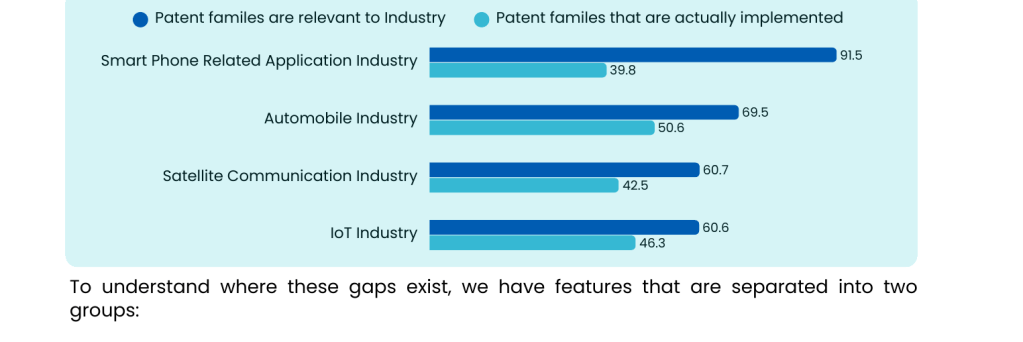
Across the four product categories GreyB analyzed, declared relevance and actual implementation diverge sharply. Smartphone-related applications carry the deepest declared coverage of any domain, 91.5% of families are relevant, yet only 39.8% are implemented. Automobile, satellite communication, and IoT show narrower but still consistent gaps, with implementation rates between 42.5% and 50.6% against declared relevance of 60.6% to 69.5%.
The report separates declared families into baseline features, the building blocks reused across every domain, and core features, built for a single domain with limited use elsewhere. That split explains why implementation rates vary so widely even within the same product category.

Not Every SEP Carries the Same Leverage
GreyB built a 423-feature 5G NR taxonomy spanning Release 15 through Release 19, then identified which features are foundational, meaning they are used across smartphones, automobiles, IoT, and satellite systems rather than a single niche use case.
Of the declared families mapped against this taxonomy, 28.7% cover foundational features. A patent covering one of these features carries structurally greater licensing leverage than one covering a single-release, single-domain extension, even when both are equally genuine SEPs. The majority of foundational patents trace back to Release 15, in areas such as UL power control, the measurement framework, and cell selection and reselection.
The report separates declared families into baseline features, the building blocks reused across every domain, and core features, built for a single domain with limited use elsewhere. That split explains why implementation rates vary so widely even within the same product category.
A Faster Pace of Declaration Than Any Prior Generation
The ETSI IPR database now holds more than 100,000 declared 5G patent families, a volume that exceeds the combined declared portfolios of 2G, 3G, and 4G at comparable points in their lifecycles. ETSI’s declaration regime requires no independent review at the time of filing, so any patent owner may declare any patent as potentially essential.
Declaration activity has continued to climb through 2025, with pending filings consistently outpacing active granted families each year. The United States leads in active granted families. China ranks second in active enforcement footprint, and European filings remain the backbone of German court proceedings.

A Faster Pace of Declaration Than Any Prior Generation
Rank
SEP Holder
Headquarters
Pool Membership
Huawei
China
Sisvel POS pool, Avanci 5G Vehicle, Direct licensing
Qualcomm
USA
Avanci 5G Vehicle, Direct licensing
3
LG Electronics
South Korea
Avanci 5G Vehicle
4
Samsung
South Korea
Avanci 5G Vehicle
5
Ericsson
Sweden
Avanci 5G Vehicle
6
ZTE
China
Avanci 5G Vehicle
A Framework for Defensible 5G Royalty Determination
The report proposes a two-pillar model that replaces declaration-based royalty calculations with a methodology grounded in what is implemented and what is genuinely essential.
Feature-level analysis alone reduces the royalty base but leaves open the risk of paying for declared patents that are not genuinely essential. Essentiality verification alone identifies genuine SEPs but does not account for the fact that not all genuine SEPs are relevant to every product. The report combines both pillars into a royalty base that is technically accurate and product-specific.
For licensing executives and IP counsels managing 5G exposure, the report translates this framework into a five-step process.
Product implementation profiling
Map each product category against 3GPP NR Release 15 through 18 specifications
Portfolio scoping
Narrow declared 5G families to those covering implemented feature clusters
Essentiality screening
Screen the scoped portfolio against a genuine essentiality threshold
Proportional share calculation
Calculate the licensor's share of the verified 5G SEP landscape for the product
Negotiation engagement
Present the implementation profile and essentiality results as the basis for a counter-proposal