

The Challenge: Identifying Clinically Reliable Technologies for At-Home Vision Testing
A healthcare company wanted to identify scalable and reliable technologies that could make vision assessments more accessible and convenient outside conventional clinical settings. The objective was to determine which emerging digital solutions could support at-home vision assessment while demonstrating sufficient clinical reliability and usability.
However, the digital vision assessment landscape was highly fragmented. Available solutions differed in their underlying technology, assessment capabilities, accuracy, validation maturity, and readiness for real-world adoption.
Comparing these technologies required more than reviewing the number of assessments offered or the convenience of their digital interfaces. The client needed to understand their measurement approaches, clinical evidence, repeatability, user dependency, and technology maturity to identify solutions suitable for further evaluation.
GreyB combined technology intelligence, clinical evidence assessment, patent analysis, regulatory review, and hands-on evaluation to identify and prioritize the most promising opportunities.
100+ Digital Vision Testing Solutions Identified Across Three Technology Pathways
The study began with a broad assessment of the remote vision-testing ecosystem, identifying more than 100 solutions across different technology pathways.
Solutions were categorized according to their underlying technology, assessment methodology, intended use, maturity, and deployment model.
The analysis covered three categories:
1. Software-Based Assessment Platforms
Browser- and mobile-based platforms enabling users to complete guided vision assessments through digital interfaces.
These solutions were evaluated across parameters such as test methodology, viewing-distance control, display requirements, user interaction, environmental dependency, workflow complexity, and result generation.
2. AI-Enabled Assessment Platforms
Solutions incorporating computer vision, image processing, machine learning, or automated interpretation into the assessment process.
The analysis considered input data, algorithmic methodology, automated interpretation, training and validation evidence, repeatability, and clinical validation.
3. Digital & Connected Assessment Technologies
Other emerging approaches combining digital interfaces, sensors, computational techniques, or guided testing protocols were assessed for their ability to support reliable vision assessment outside traditional clinical workflows.
This segmentation allowed technologies built around different measurement principles to be evaluated through a common technical framework.
Clinical Evidence, Measurement Accuracy, and Usability Used to Evaluate Technology Claims
Identifying solutions was only the starting point.
The team reviewed clinical studies, scientific publications, patents, regulatory information, company disclosures, and commercial information to understand how individual technologies performed their assessments and whether their reported capabilities were supported by evidence.
Each solution was evaluated across multiple technical, clinical, usability, and commercialization parameters.
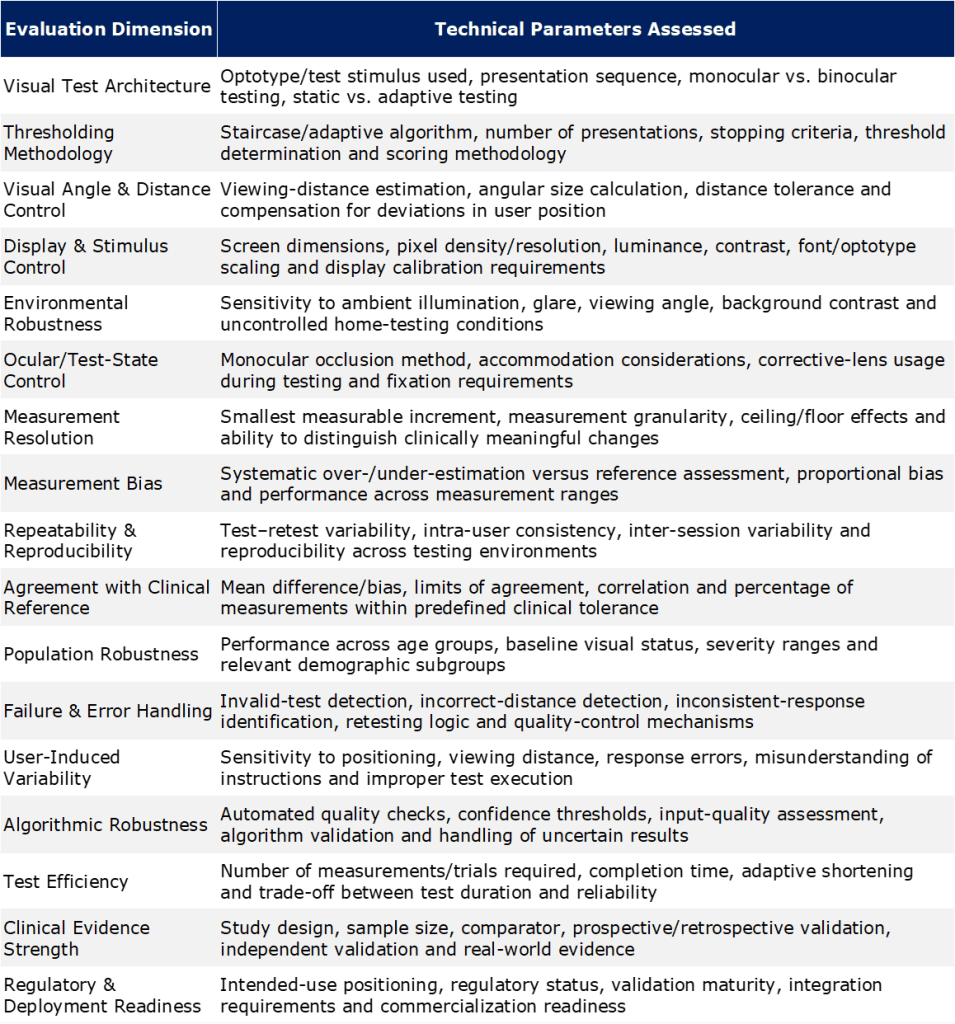
Benchmarking Revealed Differences in Clinical Validation, Reliability, and Commercial Readiness
A standardized benchmarking framework was developed to compare technologies consistently and identify differences that would not be apparent from product descriptions alone.
The framework compared solutions across assessment capabilities, clinical validation, reference-method comparison, accuracy evidence, repeatability, self-administered workflow, setup complexity, regulatory progress, and commercial availability.

100+ Solutions Narrowed to 5–7 Priority Technologies for Strategic Consideration
The initial landscape was progressively narrowed using increasingly stringent technical, clinical, usability, and commercialization criteria.

Companies Prioritized into Three Tiers Based on Evidence and Adoption Readiness
Potential technology partners were further compared based on their ability to combine differentiated technology with clinical evidence, usability, and commercialization readiness.

Tier 1: High-Priority Opportunities
Technologies demonstrating a strong combination of differentiation, clinical evidence, usability, regulatory maturity, and commercialization readiness.
Tier 2: Technically Promising
Differentiated solutions supported by encouraging evidence but requiring additional validation or development before broader adoption.
Tier 3: Emerging Opportunities
Technologies offering interesting capabilities but requiring greater clinical, regulatory, or commercialization maturity.
Mapping Clinical and Technical Readiness Against Adoption Readiness
The shortlisted technologies were finally mapped based on two dimensions: Clinical & Technical Readiness and Adoption Readiness.
Clinical & Technical Readiness considered the strength of clinical validation, repeatability, assessment capability, and overall technology maturity.
Adoption Readiness considers user experience, workflow simplicity, regulatory maturity, scalability, and commercialization readiness.
This separated the landscape into four opportunity areas:
1. Priority Opportunities: Technologies combining stronger technical and clinical readiness with higher adoption potential, making them suitable for further near-term strategic evaluation.
2. Strategic Development Opportunities: Technically promising technologies where additional work could be required to facilitate broader implementation or adoption.
3. Accessible Early Opportunities: Solutions with relatively simple user journeys and promising accessibility, but where further evidence development could strengthen their positioning.
4. Emerging / Watchlist Technologies: Differentiated approaches requiring additional technical, clinical, regulatory, or commercialization maturation.
This prioritization enabled the client to distinguish technologies suitable for immediate consideration from those better suited for continued monitoring or longer-term development.

How Can Healthcare Companies Identify Clinically Reliable At-Home Vision Testing Technologies?
Selecting a digital vision assessment technology requires more than comparing assessment features or ease of use. Healthcare companies need to evaluate measurement accuracy, repeatability, clinical validation, user dependency, regulatory maturity, and commercialization readiness together. A structured technology landscape analysis can help distinguish technically promising solutions from those ready for further strategic evaluation.
As this case study demonstrates, evaluating emerging digital health technologies requires examining clinical evidence, technical capabilities, and practical usability alongside commercial maturity. GreyB’s technology scouting services help R&D and innovation teams move beyond broad research and technology claims to identify, validate, and prioritize solutions aligned with their requirements. A systematic technology scouting approach also helps teams assess potential partners before committing to further development or adoption.
Looking to identify reliable digital healthcare technologies for your next R&D initiative? Fill out the form below and connect with our expert today.