Increased Need for Biodegradable or Bio-Based packaging and manufacturers in Healthcare
The packaging team at a leading healthcare company wanted to identify reliable manufacturers of biodegradable and bio-based plastics for packaging containers. The initiative was driven by the company’s 0sustainability goals and the growing need for environmentally responsible packaging solutions in healthcare applications.
The client was looking for materials that could meet the strict performance and quality requirements of healthcare bottles, including oxygen permeability, durability, compatibility with medical formulations, container stability, labeling suitability, and shelf-life performance.
However, identifying suitable suppliers proved challenging. Most companies identified during the search were material manufacturers that offered biodegradable plastics only as pellets, powders, or resins, rather than as finished healthcare packaging solutions. This meant additional conversion and manufacturing steps would be required to develop a usable container format.
As a result, there was significant uncertainty around supplier suitability. A company could appear relevant at the material level but still face limitations in supporting bottle manufacturing, customization requirements, validation data, or regulatory documentation necessary for healthcare packaging applications.
To address these challenges, GreyB combined secondary research with structured primary reach-outs to evaluate supplier capabilities beyond what was publicly available through websites, brochures, and technical datasheets.
Supplier Reach-outs Helped Identify the Most Suitable Partners for Collaboration in Healthcare Packaging
GreyB began with an extensive search to identify biodegradable or bio-based plastics suitable for manufacturing healthcare bottles. The team assessed potential solutions across technical properties, supplier capabilities, regulatory readiness, and commercial feasibility.
Much of the necessary information, however, was either unavailable online or not publicly disclosed. Suppliers often claimed strong technical performance in datasheets and marketing materials. However, it was unclear whether these materials could practically support healthcare bottle manufacturing.
To fill these gaps, GreyB reached out directly to suppliers and engaged in one-on-one discussions with them to validate their claims and gather other necessary information. For example, the team requested demonstrations and examples of end products from a supplier, focusing on container formats relevant to the application.
During the web meeting, the supplier not only provided a live demonstration of the actual product in which the material was used but also outlined their capabilities to custom-manufacture it for the client’s specific formats and performance needs. Thereby turning a low-priority raw material supplier into a Tier 1 recommended supplier.
In another instance, a supplier provided information that was not available publicly. For example, they explained the type of container formats that could be explored, the processing route required to convert the material, and the level of support they could provide before full-scale manufacturing. They also shared product names, supporting documents, and technical information like barrier properties and shelf-life through email.
By combining technical assessment with supplier validation, solutions that were both sustainable and commercially viable for scalable healthcare bottle production were identified.
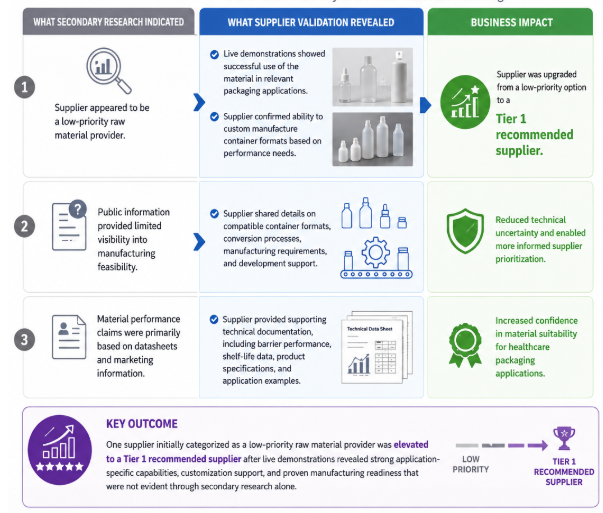
Key Outcome from Supplier Validation
What Secondary Research Indicated
- The supplier appeared to be a low-priority raw material provider.
- Public information provided limited visibility into manufacturing feasibility.
- Material performance claims were primarily based on datasheets and marketing information.
What Supplier Validation Revealed
Live demonstrations showed successful use of the material in relevant packaging applications. The supplier:
- confirmed the ability to custom-manufacture container formats based on performance needs.
- shared details on compatible container formats, conversion processes, manufacturing requirements, and development support.
- provided supporting technical documentation, including barrier performance, shelf-life data, product specifications, and application examples.
Business Impact
The supplier was upgraded from a low-priority option to a Tier 1 recommended supplier. This reduced technical uncertainty and enabled more informed supplier prioritization. It also increased confidence in material suitability for healthcare packaging applications.
One supplier initially categorized as a low-priority raw material provider was elevated to a Tier 1 recommended supplier after live demonstrations revealed strong application-specific capabilities, customization support, and proven manufacturing readiness that were not evident through secondary research alone.
How did GreyB Help?
1. Identifying Relevant Biodegradable or Bio-Based Plastics
GreyB began by conducting an extensive search to identify biodegradable or bio-based plastics suitable for healthcare container manufacturing. The research encompassed supplier websites, technical datasheets, product brochures, and publicly available regulatory information to capture materials that could meet technical, quality, and sustainability requirements.
Through this process, the team identified approximately 25 promising solutions. These included biodegradable polymers, bio-based resins, compostable material systems, and high-performance plastic alternatives that had potential relevance for healthcare packaging applications.
The focus at this stage was on broad coverage, mapping all materials with potential technical and regulatory alignment before assessing their practical feasibility.
Plastic IQ™ additives-based containers by BioBottles USA
BioBottles USA manufactures HDPE and polypropylene containers enhanced with Plastic IQ™ additives that enable biodegradation into biomass, carbon dioxide, and water under suitable conditions while maintaining recyclability within existing HDPE/PP streams.
The company offers pharmaceutical and nutraceutical container formats with reported shelf stability of 5+ years and compliance with FDA, food-grade, and regional biodegradability standards.
Renewable sources-derived packaging by H&K Müller
H&K Müller provides containers, caps, and closures made from biologically based and biodegradable plastics derived from renewable sources such as sugar cane, wood, and hemp.
Its engineering capabilities support standard packaging formats, including containers, vials, and ampoules, with ISCC Plus-certified sustainable materials across healthcare and consumer applications.
2. Ranking and Evaluation Through Supplier Reach-outs
Once potential solutions were identified, GreyB evaluated them across multiple parameters to determine their suitability for healthcare container applications.
Technical Fit: Assessing whether the materials could meet bottle performance requirements such as barrier performance, stability, and compatibility with pharmaceutical formulations.
Container Manufacturing Relevance: Evaluating whether the materials could be adapted for pharmaceutical container formats and whether they could support scalable container production.
Supplier Capability: Understanding whether suppliers could provide finished bottle formats, support customization, work with converters, or provide technical guidance for container development.
Regulatory Readiness: Checking whether suppliers could provide documentation relevant to medical-grade or healthcare packaging use.
Commercial Feasibility: Assessing the material’s cost, market availability, and ease of integration into existing production workflows.
Importantly, GreyB also conducted web meetings with the suppliers, where they provided the information and data related to the above parameters that were not available during the secondary searches.
Following this evaluation, the top 5 solutions were shortlisted for further investigation. For each selected supplier, GreyB outlined strengths, limitations, adoption risks, and actionable next steps.
Closing Insight
As sustainability and regulatory expectations evolve, brands need packaging solutions that go beyond surface-level evaluation.
By leveraging insights from GreyB’s structured supplier reach-outs and primary research, companies can validate materials, confirm production capabilities, identify actual product offerings, and avoid missing out on top-tier suppliers who may not appear relevant from website information alone.
Looking to Validate Reliable and High-Value Suppliers for Your Packaging Applications?
Connect with GreyB’s experts to access actionable insights derived from direct supplier engagements and material feasibility verification for your end goal.