
Value Delivered
The client moved from a claim that looked unprovable on paper to an infringement case backed by spectrometer-verified evidence.
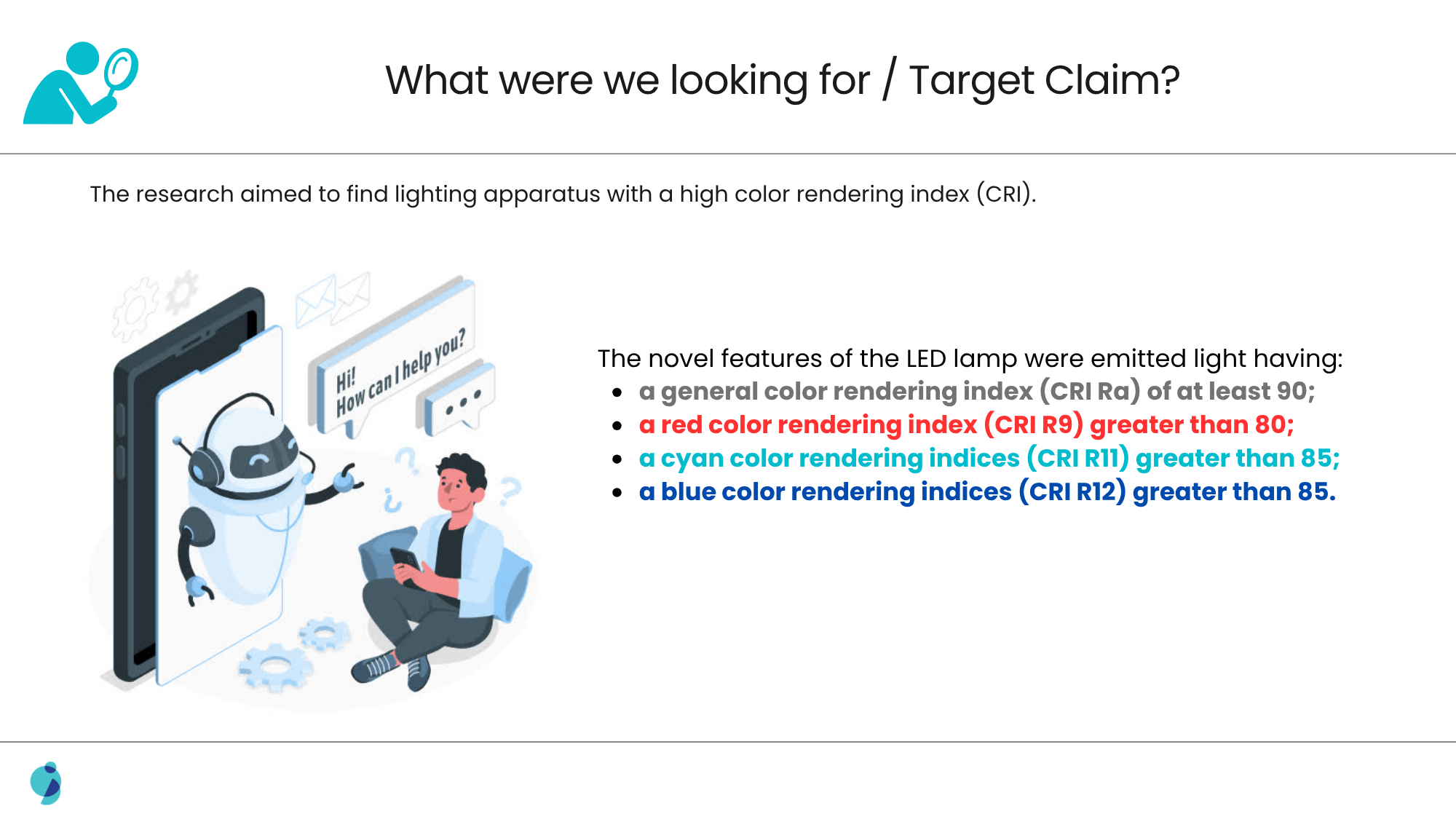
The patent claimed an LED lamp whose emitted light has a general CRI (Ra) of at least 90, a red CRI (R9) above 80, and cyan and blue CRI values (R11 and R12) each above 85. The accused product’s own website listed its CRI as “>80”. On that number alone, the investigation would have ended before it began.
The findings enabled the client to:
- Avoid a false negative: Reopen the claim after the product’s packaging printed CRI 90, ten points above the website.
- Prove every limitation: Show that R9, R11, and R12 all cleared the claim thresholds, so the product met every CRI limitation.
- Rely on measured data: Replace marketing copy with results from a controlled test setup.
- Obtain nonpublic evidence: Produce data similar to the LM-79 reports that few manufacturers release.
- Check every layer of evidence: Cover what was advertised, what was printed, and what was measured, so the case stood on more than one source.
Problem Solved
The claim stacked four color-rendering conditions, which is what makes high CRI hard to achieve in LEDs in the first place. Manufacturers publish only the headline Ra, which is the average of eight color samples (R1 to R8). The individual values for the 15 reference colors (R1 to R15) tend to appear only in LM-79 test reports. Deep red (R9) sits outside the Ra average and is the hardest color to get right, so a product can post a good Ra and still render red poorly. Infringement can hide in that gap.
The accused product’s website listed CRI as “>80”, which would have ruled out a claim needing Ra of at least 90. Many infringement checks stop at this point. Even a matching Ra of 90 could not have proved infringement, because neither the website nor the packaging disclosed the R9, R11, or R12 values the claim turned on.


Solution Offered
GreyB treated the website as one source, not the final word. The team ordered the physical product and read its packaging, which printed CRI 90. That brought the claim’s Ra threshold back into play, and it pointed to a common pattern: web copy lags behind actual product specifications.
A CRI of 90 on the box justified a closer look but could not prove the claim, so GreyB generated the missing data. The team built a controlled dark-room setup to block stray light and used a professional spectrometer to measure the product’s emitted light. It calculated color rendering across all 15 reference colors, R1 to R15, and produced detailed photometric and colorimetric test reports. Those reports revealed values the website and packaging omitted. R9, R11 and R12 all cleared the claim thresholds.
The client ultimately received:
- Evidence of the 10-point gap between the product’s website and its packaging;
- Photometric and colorimetric test reports covering R1 to R15;
- Measured R9, R11 and R12 values confirming each claim threshold; and
- A three-layer record of what was advertised, printed and measured.
The result showed that a number on a marketing page is a starting point, not a verdict. An outdated website, an unread label, or an unmeasured R-value can decide whether a case is closed by mistake or built on solid evidence.
Get the full case study to discover how a 10-point gap between a product’s website and its packaging led to spectrometer-verified evidence of infringement.