
A leading consumer electronics and home appliances manufacturer sought emerging water purification technologies that could strengthen its product portfolio and innovation strategy.
The need arose as the market saw rapid advancements in purification technologies. Consumer demand was also increasing for better-tasting drinking water and an enhanced user experience.
Several commercial water purifiers claimed to improve water taste, provide AI-enabled functions, and offer other advanced features. However, publicly available information made these claims difficult to verify. The client could not easily distinguish genuine technological advances from marketing claims.
The company partnered with GreyB to identify emerging technologies, benchmark commercial products, and validate supplier claims through in-house product testing. The goal was to find credible technologies, assess their applicability, and prioritize options for future product development and technology strategy.
Emerging Technologies and Products Were Identified Across Multiple Innovation Channels
The team conducted an extensive search across patent literature and market sources. This identified more than 100 emerging technologies and products across multiple innovation channels.
The technologies were assessed for purification performance, functional differentiation, usability, and their potential to differentiate the client’s product portfolio.
The assessment combined secondary research with targeted product validation. Selected products were procured for in-house testing to determine whether claimed benefits were observable and technically supported.
Low-TRL Concepts and Commercial Water Purification Technologies Were Assessed Together
The search covered water purification technologies across:
- Patents
- Industry reports
- Trade shows
- Commercial products
The focus was on adaptable solutions that could enhance system performance and provide feature-level differentiation.
Relevant capabilities included taste modification, efficient filtration, and improvements in the overall user experience of next-generation purification systems.
Prototype Developments and Funded Projects Revealed Where Technologies Could Mature
The team also tracked government-funded R&D projects, investments by established water purification technology companies, and ongoing prototype development activities.
This approach helped capture early-stage innovation signals. It also showed where strategic R&D activity and capital allocation were heading.
These signals supported the identification of technologies that were still under development but could mature into commercially relevant solutions.
Two Commercial Systems Demonstrated Different Paths to Product Differentiation
Waterdrop X Series Undersink Reverse Osmosis System
The Waterdrop X Series Undersink Reverse Osmosis System, X16, is a tankless water purification system.
It combines 11-stage filtration with a 0.0001 μm reverse osmosis membrane. The system is designed to remove contaminants including:
- Total dissolved solids
- PFOA
- PFOS
- Chlorine
- Fluoride
- Arsenic
- Lead
The system maintains mineral balance while delivering up to 1,600 gallons per day for continuous flow.
A smart faucet provides real-time TDS monitoring, filter-life tracking, and dispensing control. UV purification and mineral adjustment further enhance usability and the overall drinking water experience.
SMT Water N3 Water Purifier
The SMT Water N3 Water Purifier is an IoT-enabled system that combines real-time water-quality monitoring, filter-health tracking, and self-powered operation within one device.
Conventional systems often rely on fixed filter-replacement schedules. Water N3 continuously analyzes water conditions and provides predictive maintenance alerts through connected applications.
The system can generate its own power from water flow while monitoring purification performance. This makes it a notable development in intelligent and user-focused water treatment systems.
In-House Testing Separated Genuine Innovation from Marketing Claims
Select shortlisted products were procured for testing. The evaluation was completed in two stages:
- Sensory or functional testing to determine whether the claimed benefit was observable
- Technical teardown to understand how the feature was engineered internally
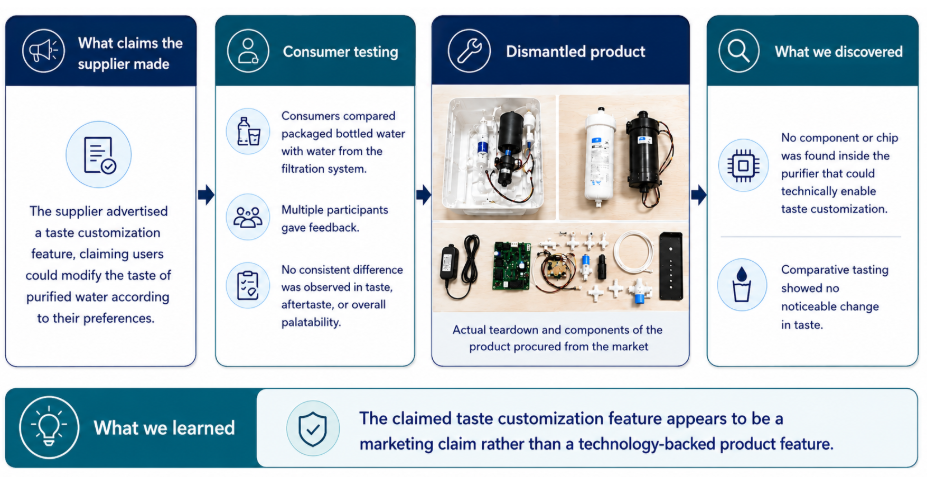
One product claimed that users could adjust the taste of purified water according to personal preferences through a connected application.
The team conducted sensory testing with multiple participants. It then dismantled the product and examined its internal architecture to determine whether the claim was supported by an identifiable technical system.
Phase 1: Consumer Sentiment Analysis Found No Consistent Change in Taste
The first phase involved a comparative sensory evaluation.
Participants consumed standard packaged bottled water and compared it with water processed through the identified filtration system. Multiple participants were included to capture a broader range of sensory feedback.
The assessment recorded perceived differences in:
- Taste
- Aftertaste
- Overall palatability
The results showed no consistent difference in taste, aftertaste, or overall palatability across users. The claimed taste-modification effect could not be observed through comparative testing.
Phase 2: Product Teardown Found No Component Supporting Taste Customization
Following the sensory evaluation, the second phase focused on technical verification.
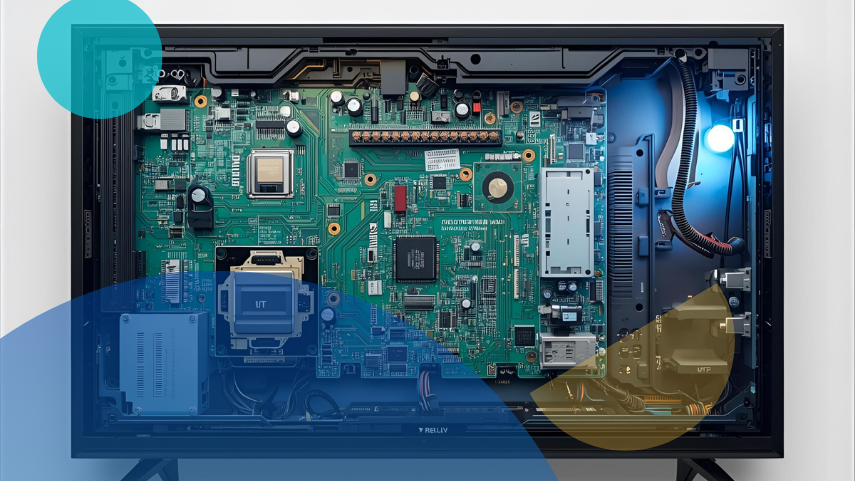
The water purifier was dismantled to examine its internal architecture. The team looked for the specific component that the manufacturer claimed was responsible for modifying the taste of the water.
The teardown aimed to confirm whether the component was physically present and understand its role within the filtration system.
No component or chip was found inside the purifier that could technically enable taste customization. Combined with the sensory results, the teardown indicated that the claimed taste-customization feature was a marketing claim rather than a technology-backed product feature.
This gap between supplier claims and independent testing became an important filtering input. It helped remove technologies that appeared attractive on paper but did not warrant further attention.
Nearly 100 Innovations Were Narrowed to Approximately 15 High-Potential Technologies
The shortlisted water purification technologies were evaluated through secondary research and targeted product validation.
The assessment considered both claimed capabilities and real-world performance using six key parameters:
- Purification performance
Contaminant-removal efficiency, consistency of output quality, and stability under varying water conditions. - Functional features
Differentiating capabilities such as taste modification, remineralization, smart monitoring, and other user-facing enhancements. - System design and integration
Compatibility with existing purifier architectures, form-factor constraints, and ease of integration into residential systems. - Operational efficiency
Filter life, maintenance requirements, water-use efficiency, and energy or resource optimization during operation. - Supplier capability
Technical maturity, scalability, manufacturing readiness, and commercialization potential. - User experience
Ease of use, maintenance simplicity, and perceived improvement in drinking-water quality.
Based on this assessment, nearly 100 innovations were narrowed to approximately 15 high-potential technologies for detailed evaluation.
Additional Validation Helped Prioritize Technologies for Future Product Development
The shortlisted solutions were further assessed using the following factors:
- Technological novelty
- Patent landscape
- Market traction
- Regulatory compliance
- Collaborative development potential
- Ability to address unmet consumer needs
- Advantages over the client’s existing solutions
Selected products were then procured for in-house testing. This helped validate product claims and assess real-world performance.
The testing provided insights into purification performance, functional reliability, smart features, operational efficiency, and user experience. These findings helped identify the technologies with the strongest potential for future product development.
How Can R&D Teams Ensure Water Purification Technologies Perform Reliably in Real-World Conditions?
As demand for advanced purification systems increases, R&D teams need to identify technologies that perform consistently outside controlled demonstrations.
A structured technology scouting process can map low-TRL concepts, commercial products, prototypes, and funded projects against specific product requirements. A complementary technology analysis can compare claimed capabilities with technical maturity, patent activity, regulatory compliance, system compatibility, and real-world performance.
For teams developing their internal discovery and evaluation process, this technology scouting guide provides a broader framework for identifying, filtering, and prioritizing external solutions.
GreyB helps clients move beyond patent noise, supplier literature, and early-stage concepts through integrated scouting and product-level validation. This approach helps identify options that are practically viable, technically validated, and relevant to the existing product portfolio.
Fill out the form below and connect with our expert today