

Value Delivered
The client extended one already-charted asset from a single generation of Wi-Fi to three, without a new filing.
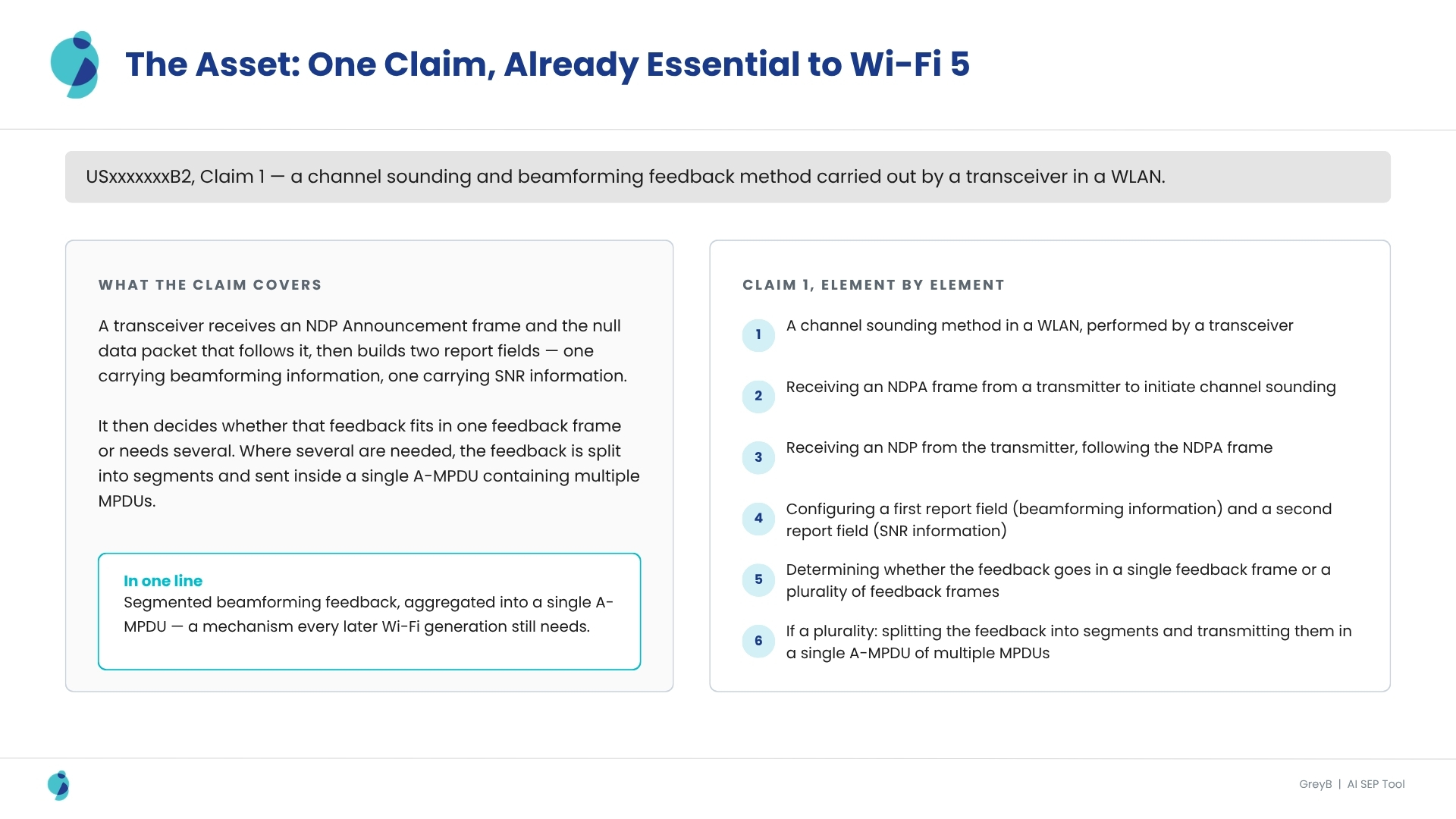
Claim 1 of the patent covers segmented channel sounding feedback aggregated into a single A-MPDU. Its essentiality to Wi-Fi 5 (IEEE 802.11ac) was already established. After testing against IEEE 802.11ax and IEEE 802.11be over 24 minutes, the claim was also found essential to Wi-Fi 6 and Wi-Fi 7, with every element Explicit.
The findings enabled the client to:
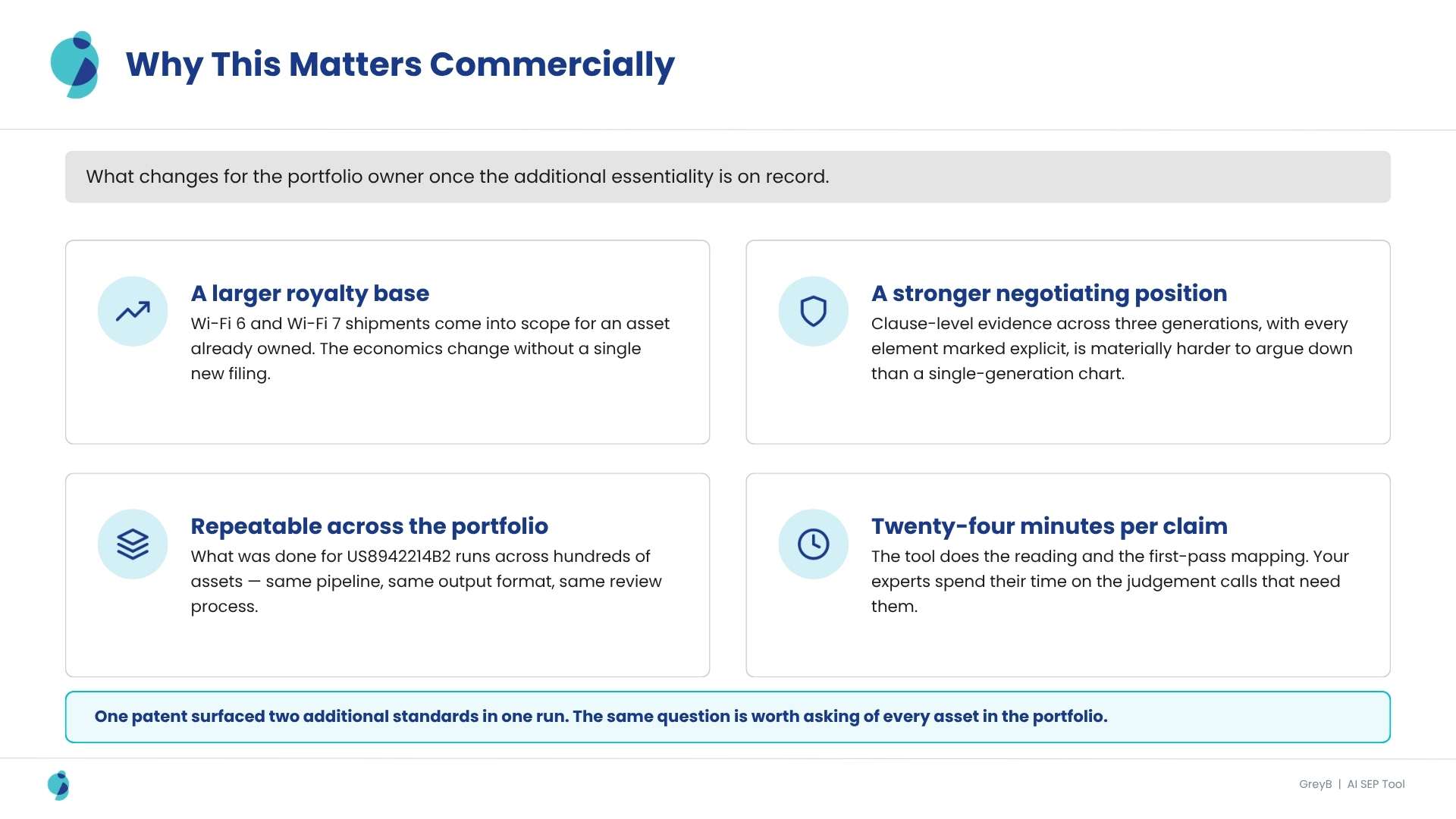
- Widen the royalty base: Bring Wi-Fi 6 and Wi-Fi 7 shipments into scope for an asset the client already owned.
- Add value without new filings: Gain two more standards from an existing patent, with no new prosecution.
- Negotiate from stronger ground: Present clause-level evidence across three generations, with every element Explicit. That is materially harder to argue down than a single-generation chart.
- Move into the Wi-Fi 6 and Wi-Fi 7 pools: Submit the patent as a cross-generation asset, not one limited to the generation it was first charted against.
- Repeat the exercise across the portfolio: Ask the same question of hundreds of assets using the same pipeline and output.
Problem Solved
Essentiality is assessed at a point in time. A chart written against IEEE 802.11ac says nothing about IEEE 802.11ax or IEEE 802.11be, even where the newer amendments re-specify the same mechanism. The patent’s claim required:
- Receiving an NDP Announcement frame and the null data packet that follows it;
- Configuring one report field for beamforming information and one for SNR information;
- Deciding whether the feedback fits in one frame or needs several; and
- Splitting multi-frame feedback into segments sent in a single A-MPDU.
Charting this again by hand for every new generation means rebuilding the mapping from zero, and that cost grows with portfolio size. Keyword search makes it worse. Successive Wi-Fi standards keep, modify or relocate the same mechanisms under new names and structures. The sounding provisions moved from Section 9.31.5 in 802.11ac to Sections 26.7 and 27.3 in 802.11ax and Section 35.7 in 802.11be. A plain-text search for the original claim language therefore misses the equivalent provision. As a result, Wi-Fi 6 and Wi-Fi 7 were never tested and were assumed to sit outside the original analysis.
Solution Offered
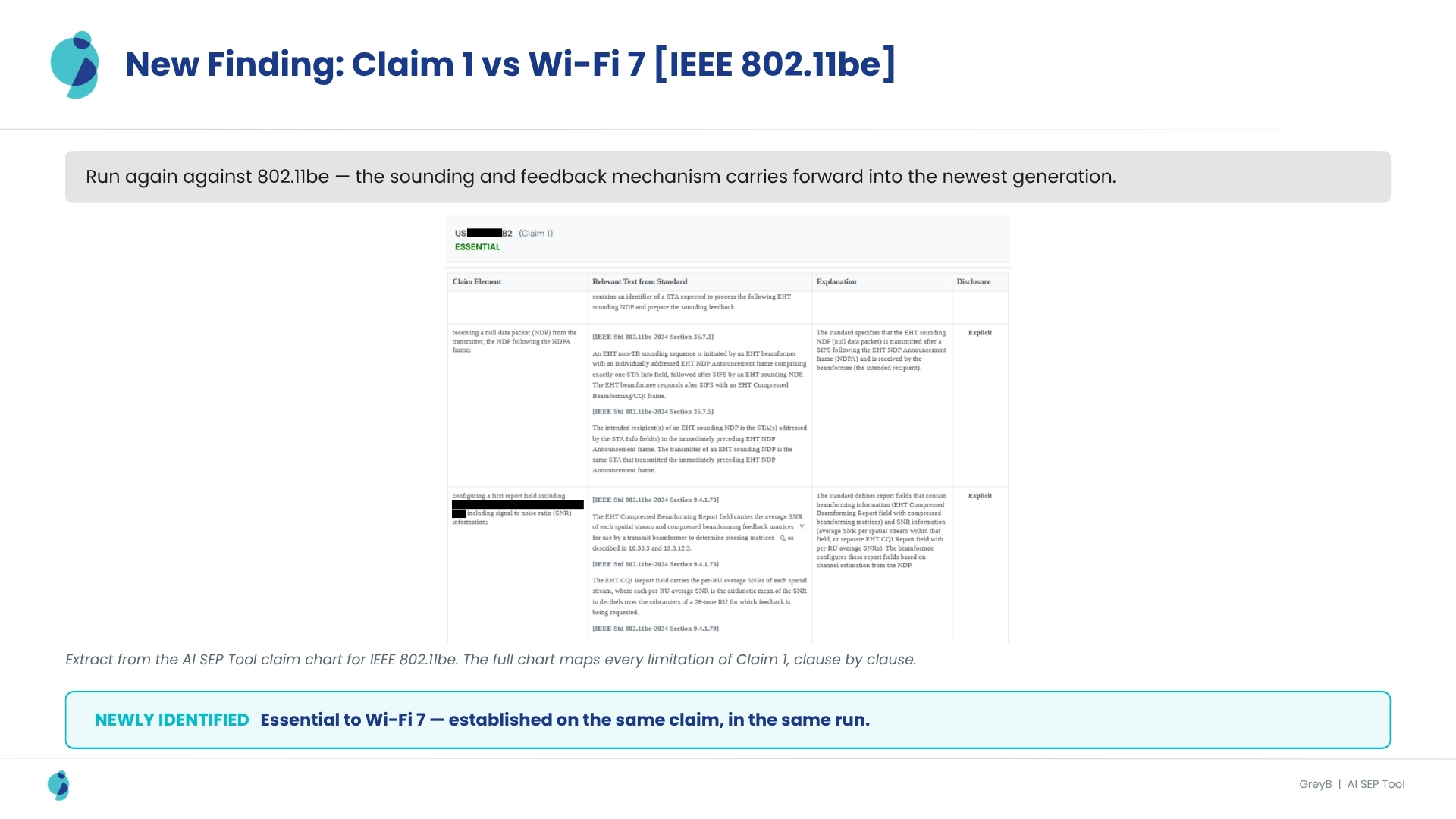
GreyB’s AI SEP Mapping Tool split Claim 1 into its individual limitations and ran each against IEEE 802.11ax and IEEE 802.11be, clause by clause. Every limitation was marked Explicit, Implicit, or Missing, with the reasoning stated, and a separate claim chart was produced for each standard.
The charts showed the same mechanism carried forward, with only the clause numbers changing:
- Sounding sequence (NDPA frame followed by the sounding NDP): Section 9.31.5.1–9.31.5.2 in Wi-Fi 5, Sections 26.7.3 and 27.3.17 in Wi-Fi 6, and Sections 35.7.3 and 35.7.5 in Wi-Fi 7.
- Beamforming and SNR report fields: Section 9.31.5.3 in Wi-Fi 5, Section 9.4.1.65 in Wi-Fi 6, and Sections 9.4.1.73 and 9.4.1.75 in Wi-Fi 7.
After expert review, the mappings confirmed the patent as essential to Wi-Fi 5, Wi-Fi 6, and Wi-Fi 7.
The client ultimately received:
- A new claim chart for Wi-Fi 6 and one for Wi-Fi 7, built on the same claim in the same run;
- Clause-level evidence with every element Explicit for each added generation;
- A comparison showing where the same mechanism sits in each standard; and
- A cross-generation position for an asset first charted against one generation.
The result showed that a claim already proven for one generation can be tested against the next in minutes, without rebuilding the analysis each time a new standard arrives.
Get the full case study to discover how one Wi-Fi 5 claim chart became essentiality evidence for Wi-Fi 6 and Wi-Fi 7 in 24 minutes.