
Value Delivered
The client received a strong prior-art argument by uncovering missing technical details hidden within supplementary research data.
The research established that the claimed protein nanoparticle interaction method was already supported by experimental data showing:
- Formation of nanoparticle coronas using biological samples.
- Comparison of protein coronas formed under different anticoagulant conditions.
- More than 50% overlap of detectable proteins between biomolecule coronas and control biomolecule coronas.
The key value came from identifying that the required claim limitation was not explicitly stated in the main publication but could be demonstrated through detailed supplementary tables containing protein identification and concentration data.
Problem Solved
The challenge was finding prior art that disclosed the complete claimed method for analyzing human samples using nanoparticle coronas.
The target claim required:
- Contacting a sample with nanoparticles to form a nanoparticle corona.
- Contacting an EDTA-stabilized sample with nanoparticles to form a control biomolecule corona.
- Showing that more than 50% of proteins detected in the biomolecule corona were also present in the control biomolecule corona.
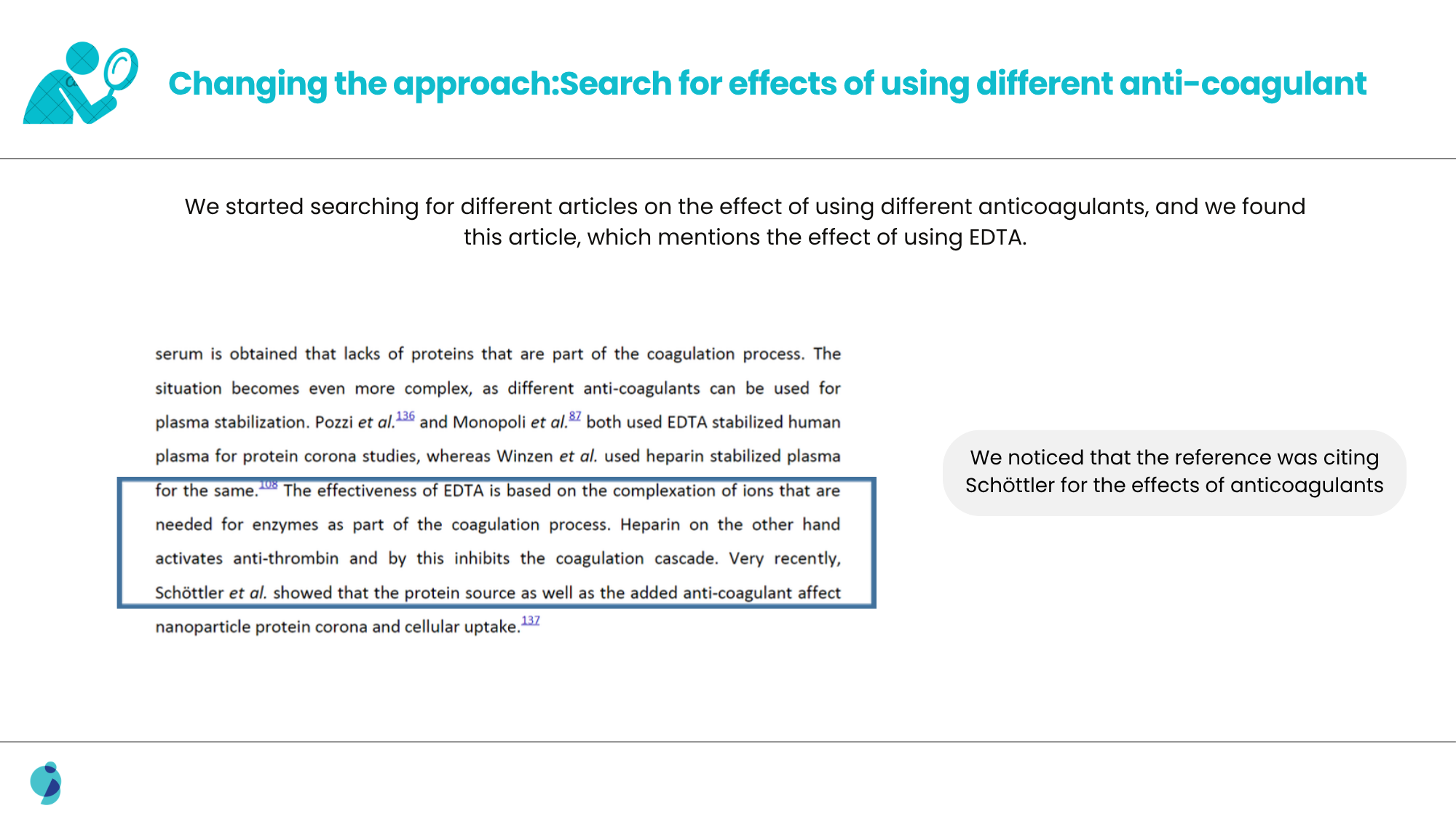
Initial searches focused on nanoparticle corona formation with and without EDTA stabilizing agents. The team identified references discussing different stabilizing agents and anticoagulants, but the critical protein comparison data was missing.
Research articles also discussed the effects of different anticoagulants on protein corona formation, but they did not directly disclose the amount or overlap of proteins required by the claim.
The challenge was locating the hidden experimental evidence needed to bridge the gap between general nanoparticle corona studies and the specific claimed comparison.


Solution Offered
The research team shifted the search strategy from looking only for direct claim language to analyzing supporting experimental data.
The team:
- Investigated research articles discussing the effects of different anticoagulants on nanoparticle protein corona formation.
- Followed citations to identify relevant studies, including Schöttler’s work on anticoagulant effects.
- Reviewed supplementary information associated with the publications.
The breakthrough came from examining supplementary tables that listed:
- Names of proteins detected in different samples.
- Protein concentrations.
- Protein populations associated with different anticoagulant conditions.
By analyzing this supplementary data, the team calculated the common proteins between different protein coronas and demonstrated that the overlap fell within the claimed range.
The identified evidence supported the required claim elements by showing:
- Different anticoagulants affect protein corona formation.
- Protein populations can be compared between different sample conditions.
- The percentage of common proteins can be calculated from experimental data.
The case demonstrated that valuable prior-art evidence can exist beyond the main text of a publication, and supplementary experimental data can reveal the missing details needed for a strong invalidity argument.
Get the full case study to discover how digging into supplementary data revealed missing prior-art evidence