
Value Delivered
The client received a strong obviousness argument by identifying why specific design choices were adopted in a ready-to-use potassium phosphate solution.
The research uncovered prior-art evidence supporting the key claimed features:
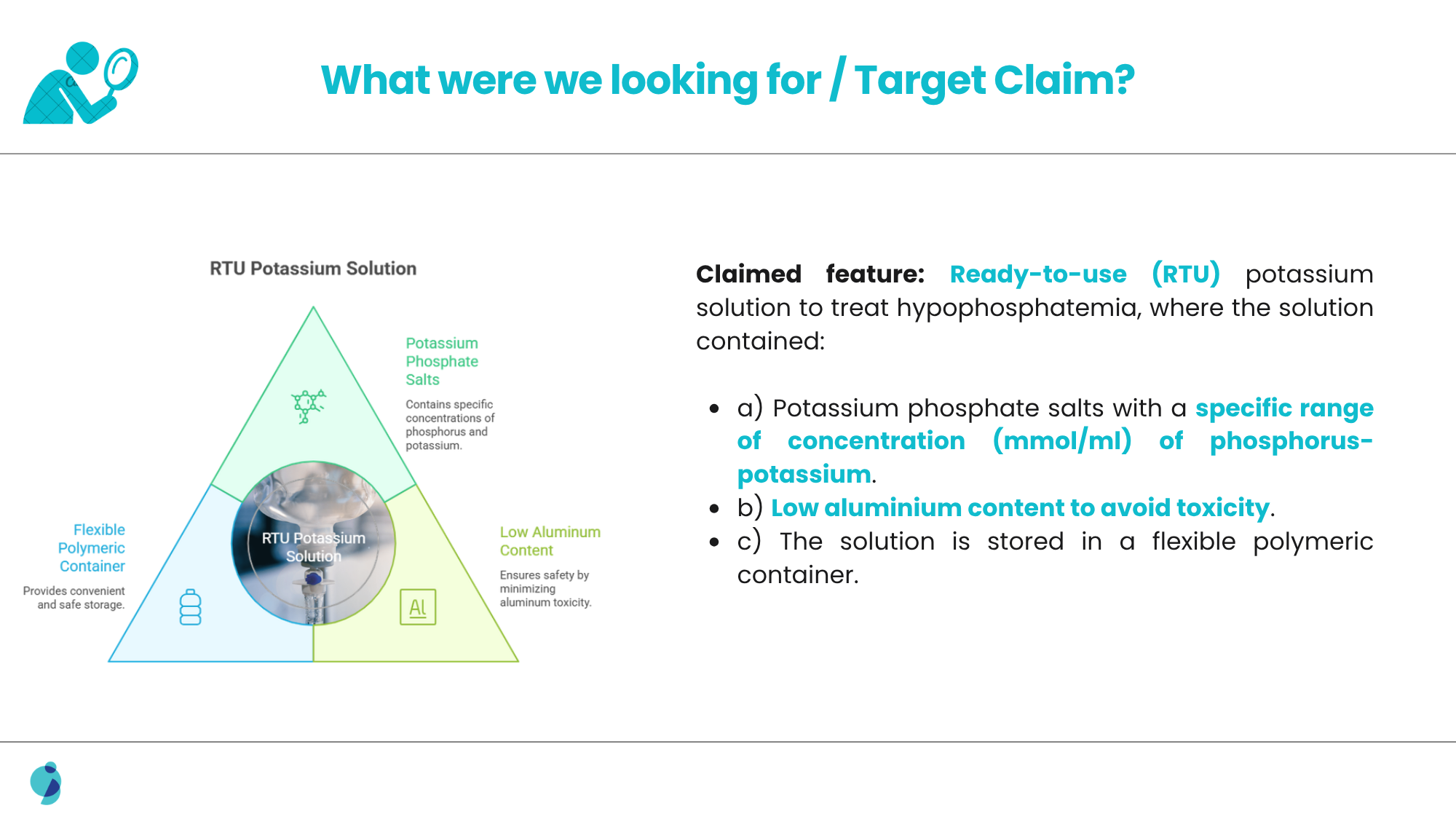
- Ready-to-use potassium phosphate formulation for treating hypophosphatemia.
- Specific potassium and phosphorus concentration ranges.
- Low aluminium content to reduce toxicity.
- Storage in a flexible polymeric container.
The key value came from moving beyond searching for matching formulations and understanding the reasoning behind industry decisions, such as why flexible polymer containers were preferred and why dilution-free formulations were developed. This provided supporting evidence for an obviousness position.
Problem Solved
The challenge was finding prior art that disclosed the complete combination of features in the claimed ready-to-use potassium phosphate solution.
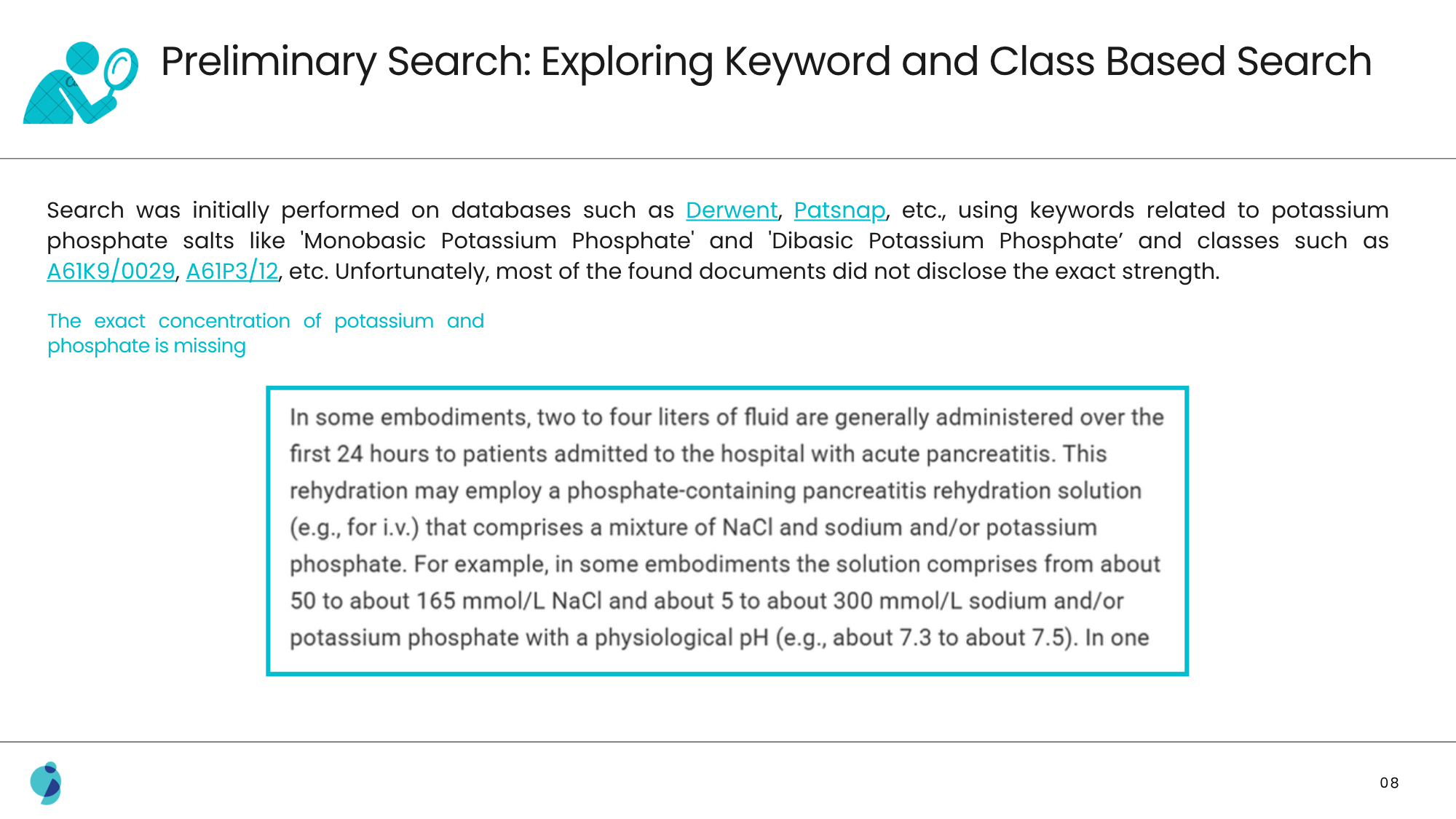
Initial searches were performed using pharmaceutical keywords and classification-based approaches, including terms related to potassium phosphate salts such as “Monobasic Potassium Phosphate” and “Dibasic Potassium Phosphate.” Relevant pharmaceutical classifications were also explored. However, most identified references did not disclose the required concentration strength.
The challenge was not finding potassium phosphate solutions. The difficulty was connecting multiple elements together:
- The exact potassium and phosphorus concentration.
- A ready-to-use formulation.
- A flexible polymer container.
- Low aluminium content.
The research needed to answer not only what was disclosed, but also why the industry selected these formulation and packaging choices.similar physical designs using inconsistent terminology, making traditional text-based searching ineffective.
Solution Offered
The research team shifted from direct patent searching to investigating the industry rationale behind the claimed features.
The team explored:
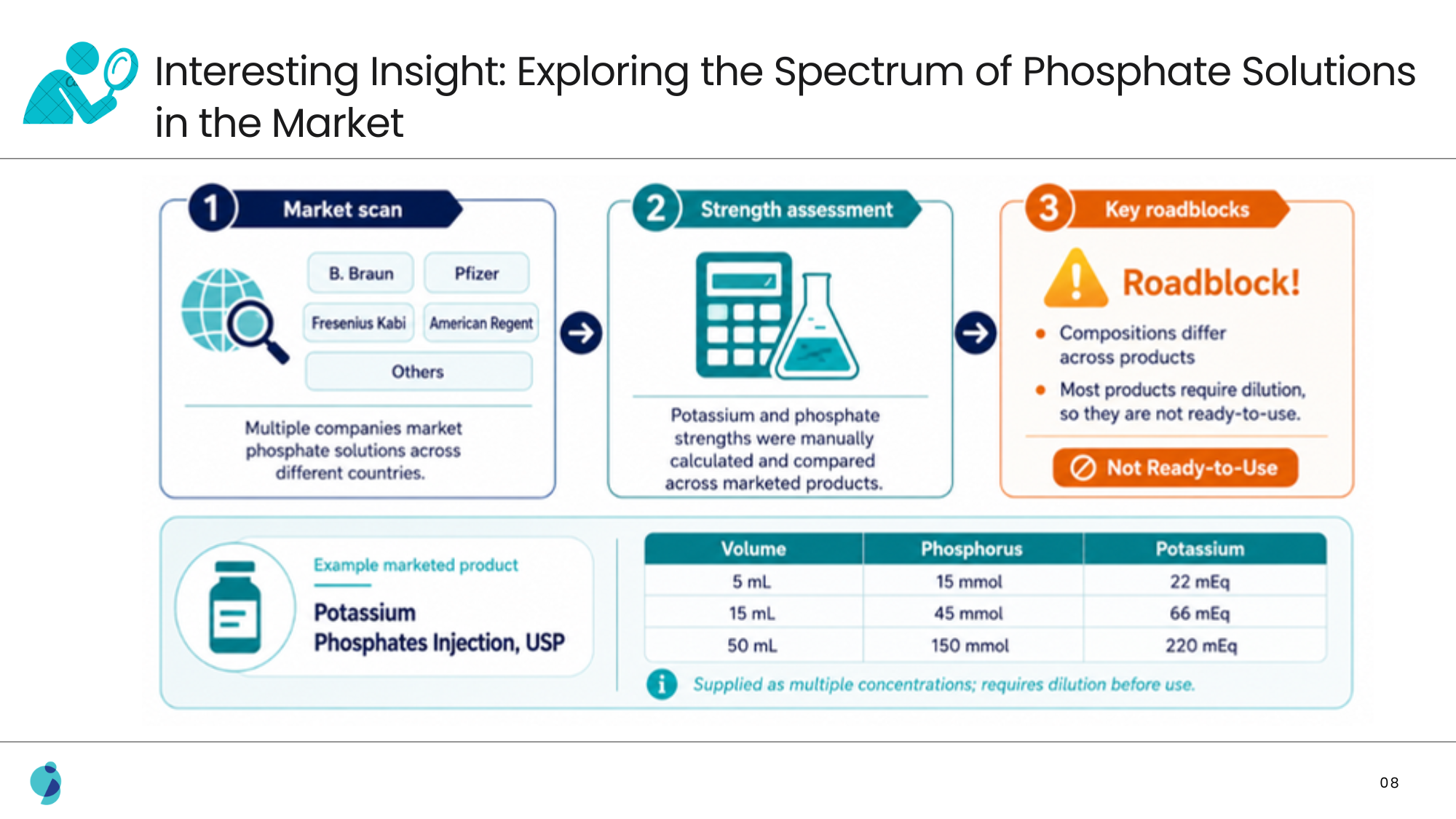
- Marketed potassium phosphate products.
- Compounded products from outsourcing pharmacies.
- Pharmacopoeias and regulatory guidelines from organizations such as the USFDA, EMA, United States Pharmacopoeia, European Pharmacopoeia, and British Pharmacopoeia.
- Global online pharmacy directories.
This investigation revealed that:
- Flexible polymer containers were an industry-adopted solution because aluminium contamination from glass containers could create safety concerns.
- Plastic containers reduced aluminium leaching compared with glass packaging.
- Ready-to-use potassium phosphate formulations existed in bag-packaged products that did not require further dilution before use.
The team connected these findings to the claimed features by:
- Manually calculating potassium and phosphate strength from disclosed product information.
- Establishing that flexible container selection was an obvious industry choice.
- Identifying documentation showing a formulation that could be used without dilution.
The case demonstrated that understanding the motivation behind technical decisions can uncover strong obviousness arguments when direct keyword searches fail.ased approaches can provide structural certainty and uncover prior-art opportunities that text-based methods miss.
Get the full case study to discover how tracing the reason behind design choices strengthened a prior-art argument