The R&D team at a leading global specialty polymer manufacturer wanted to identify technology providers developing advanced color-changing materials for polymer-based applications. The initiative was driven by growing demand for smart materials with dynamic visual functionality.
They needed technologies that could provide reliable stimulus-driven color changes while meeting key requirements such as durability, reversibility, scalability, consistency, and compatibility with polymer processing.
Finding suitable partners proved difficult. The market included thermochromic, electrochromic, photochromic, and chemical-responsive materials with different levels of maturity, performance, and integration capability. Public information offered limited insight into their practical suitability for polymer applications.
A provider could have a promising solution but still lack polymer compatibility, customization capabilities, commercial readiness, or experience supporting industrial applications.
GreyB combined secondary research with structured technology benchmarking to assess technical capabilities, polymer compatibility, IP strength, scalability, commercial readiness, and strategic fit.
Color-Changing Solutions Were Mapped Across Multiple Triggering Mechanisms
The assessment began by mapping commercially available color-changing technologies and identifying providers with solutions compatible with polymer-based materials.
The search covered multiple stimulus-responsive mechanisms, including:
- Temperature-responsive technologies
- Light-responsive technologies
- Chemical-responsive technologies
The team assessed solutions suitable for polymer films, sheets, coatings, and related applications. The search focused on ready-to-integrate formats beyond standalone pigments, including:
- Coatings
- Films
- Inks
- Masterbatches
- Other polymer-compatible formats
The objective was to identify market-ready technologies that could be integrated with minimal internal R&D effort and support the development of advanced color-changing materials.
Multiple Research Channels Built an Initial Repository of Approximately 30 Solutions
The search used several research channels to create an extensive landscape of relevant solutions:
- Company websites
- Technical publications
- Scientific literature
- Industry sources
- Social media platforms
- AI-supported discovery tools
This process created an initial repository of approximately 30 relevant solutions.
At this stage, the focus was on identifying commercially available technologies while capturing details on their working mechanisms, application capabilities, and technology providers. These details formed the basis for further validation and prioritization through direct supplier discussions.
Public Information Could Not Confirm Polymer Fit, Durability, or Integration Feasibility
Websites, technical literature, and marketing materials provided information on technology mechanisms, product features, and potential application areas.
However, critical information was often unavailable, including:
- Polymer compatibility
- Integration feasibility
- Customization capabilities
- Product durability
- Scalability
- Commercial readiness
Public sources also provided limited insight into actual performance, application experience, and the conditions under which a technology could maintain its color-changing functionality.
This made it difficult to compare providers or determine which solutions aligned with the client’s technical and commercialization requirements.
Direct Supplier Discussions Revealed Technical and Commercial Details Not Available Online
Targeted discussions were conducted with shortlisted technology providers to validate publicly available claims and gather additional technical information.
These conversations provided deeper insight into:
- Working mechanisms
- Actual product performance
- Application experience
- Polymer compatibility
- Customization opportunities
- Integration requirements
- Commercialization readiness
The discussions also enabled direct comparisons across competing technologies. They helped validate the most important evaluation parameters and identify providers aligned with the client’s requirements.
Demonstration Videos Helped Validate Color-Changing Performance Under Relevant Stimuli
Direct discussions and demonstration videos helped verify publicly available claims and provided evidence of actual technology capabilities.
Supplier interactions generated additional information on:
- Cost per SKU
- Customization support
- Production capacity
- Application areas
- Triggering mechanisms
- Polymer compatibility
- Case studies involving polymer applications
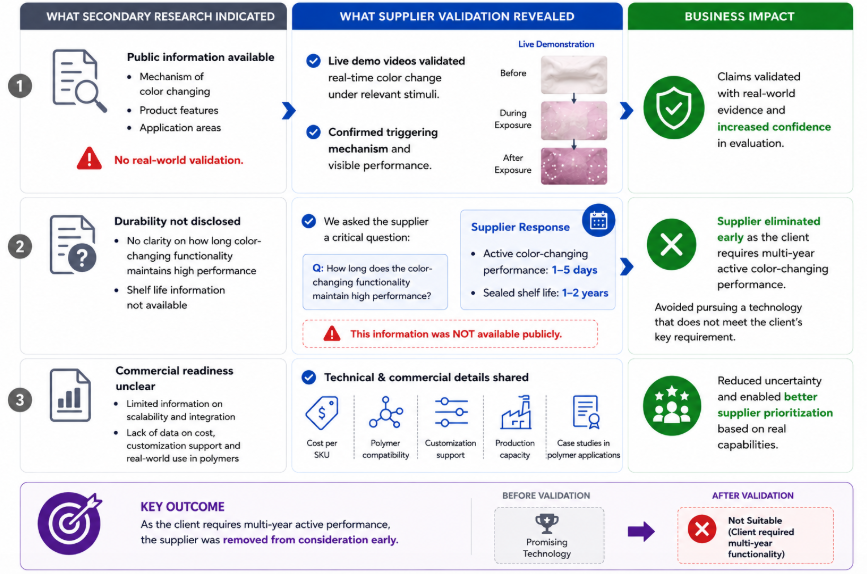
Demonstration videos showed color changes before, during, and after exposure to the relevant stimulus. This allowed the team to confirm the triggering mechanism and compare visible performance.
The videos also helped assess expected product life and how long the color-changing functionality could maintain high performance. These factors were important for prioritizing providers against the client’s durability requirements.
One Initial Recommendation Was Eliminated After Supplier Validation
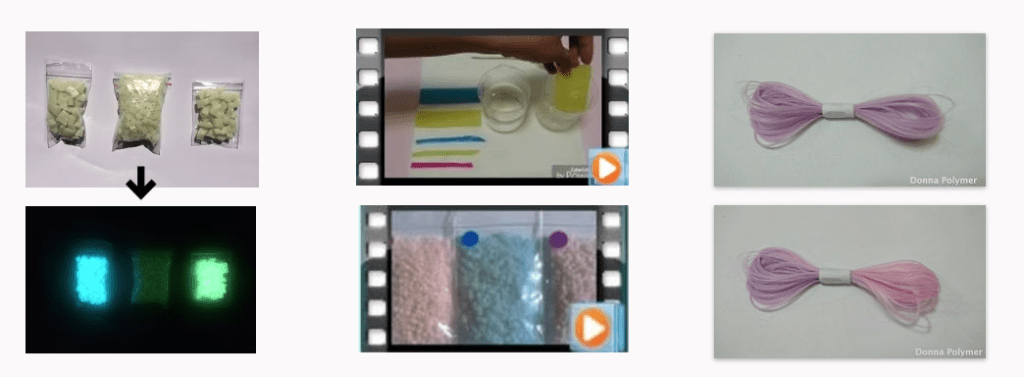
One solution appeared among the top recommendations during secondary research. It was later found to be irrelevant after the supplier disclosed actual performance parameters and shared a live demonstration video.
The supplier confirmed that its active color-changing performance lasted between one and five days. Its sealed shelf life was between one and two years.
The client required active color-changing performance over multiple years. The solution therefore did not meet a critical requirement and was removed from consideration early.
As illustrated in the validation framework on page 3 of the raw case study, this prevented the client from progressing with a technology that appeared suitable through public information but did not meet the required operating life. It also reduced uncertainty and supported better supplier prioritization based on demonstrated capabilities.
Thermochromic Masterbatch Supported Multiple Polymer Formats and Temperature Ranges
Donna Polymer’s thermochromic masterbatch changes color in response to temperature variations. It is available in powder, granule, and slurry formats.
The material becomes transparent when heated and can be integrated into:
- Inks
- Coatings
- Paints
- Plastic applications
It is compatible with several polymers:
- Acrylonitrile butadiene styrene, or ABS
- Thermoplastic polyurethane, or TPU
- Polyvinyl chloride, or PVC
- Polypropylene, or PP
- Polyethylene, or PE
- Polystyrene, or PS
The masterbatch operates across temperature ranges from -17°C to 70°C and supports multi-stage color transitions.
The supplier’s demonstrations included glow-in-the-dark clay polymer, mixed-color thermochromic polymeric plates and sticks, and thermochromic yarn.
Photoluminescent Masterbatch Provided Glow Times of Up to 32 Hours
Chroma Color® Photoluminescent Masterbatch is a glow-in-the-dark color concentrate designed for molded plastic applications.
It uses high-performance photoluminescent pigments that provide rapid activation and extended glow duration. Laboratory testing showed glow times of up to 32 hours.
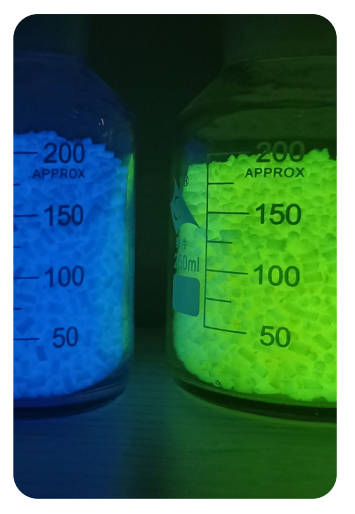
The formulation also offered:
- Light stability
- Customization options
- Suitability for indoor applications
- Suitability for outdoor applications
- Suitability for safety-related applications
This provided another integration route for polymer products requiring extended light-responsive visual functionality.
Direct Supplier Outreach for Validating Solutions
Before beginning the detailed evaluation, the team held a checkpoint discussion with the client to align on which shortlisted entities should progress.
Following this discussion, 15 of the 30 solutions were selected for structured benchmarking and supplier validation.
The 15 solutions were assessed against five parameters:
- Application suitability
Relevance of demonstrated applications, compatibility with the target use cases, and adaptability to existing polymer-processing methods. - Technical performance
Color-changing efficiency, stimulus range, dispersion uniformity, response speed, operating mechanism, and proprietary technology differentiation. - Commercial readiness
Technology maturity, market availability, customization support, cost positioning, and scalability for commercialization. - Supplier capability
Provider scale, manufacturing capacity, geographic reach, industry experience, and ability to support customer requirements. - Compliance and certification
Availability of relevant certifications, regulatory approvals, and compliance documentation for the intended applications.
Web Meetings Validated Application Experience and Commercial Readiness
Web meetings were conducted with shortlisted technology providers to verify information gathered through secondary research.
These discussions generated additional information on:
- Technical capabilities
- Application experience
- Customization support
- Production capabilities
- Commercialization readiness
Much of this information was not publicly available and could not have been confirmed through desk research alone.
The Top Five Solutions Were Prioritized for In-Depth Analysis
Following the evaluation, five solutions were selected for deeper analysis.
For each shortlisted technology, the team outlined:
- Technical strengths
- Limitations
- Adoption risks
- Actionable next steps
Combining secondary research with direct provider validation helped identify commercially viable color-changing technologies and prioritize the partners most suitable for future polymer-material development.
How Can Polymer R&D Teams Identify the Right Color-Changing Technology Partner?
Selecting the right provider requires more than comparing product descriptions. R&D teams need to validate polymer compatibility, triggering mechanisms, active performance life, integration requirements, production capacity, customization support, compliance, and readiness for commercialization.
A structured technology scouting process can map commercially available solutions and filter them against specific polymer formats and performance requirements.
Focused supplier scouting can verify technical claims directly with providers and uncover cost, manufacturing, compliance, and capacity information that is not available through public sources.
A detailed technology analysis can then compare working mechanisms, limitations, adoption risks, and commercial fit before a company commits resources to development or supplier engagement.
GreyB helps companies move from broad research, supplier claims, and early-stage concepts to validated, commercially viable technologies and partners aligned with their product-development goals.
Fill out the form below and connect with our expert today.