A Leading Consumer Tissue Company Needed Compact, Intuitive, and Affordable Dispensing Systems
The Innovation and Business Development team at a leading consumer tissue company was tasked with identifying next-generation tissue-dispensing systems that could meet rising consumer expectations for convenience, affordability, and ease of use.
This need emerged as the market saw growing demand for compact, intuitive dispensers, while many existing solutions continued to fall short on usability and space efficiency.
The team identified a critical gap in the market: current tissue dispensers often lacked intuitive design, were not optimized for small spaces, and were priced above consumer expectations, limiting their widespread adoption. Additionally, many promising innovations remained in the early stages of development, making them unsuitable for immediate commercial deployment.
As a result, the team faced multiple challenges, including aligning new solutions with existing product standards, ensuring scalability and commercial viability, and maintaining competitive pricing without compromising on functionality or design.
To support this effort, the company partnered with GreyB to explore external dispensing innovations that could be acquired, licensed, or adapted for internal R&D. The goal was to identify scalable, cost-effective, and user-friendly dispensing technologies that could accelerate market entry, enhance product appeal, strengthen the company’s portfolio, and drive growth in a competitive market.
In-House Product Testing Helped Separate Usable Formats from On-Paper Concepts
The team identified tissue dispensing technologies across multiple sources, including patents, research-stage developments, and commercial products, to build an extensive understanding of available and near-commercial solutions.
Identified dispensers were assessed against criteria such as dispensing speed, size, compatibility, cost, sustainability, and user-friendliness to select options aligned with functional and safety requirements.
However, the identified tissue dispensing systems appeared suitable on paper but lacked sufficient real-world performance validation. For instance, many suppliers claimed strong performance in moist or humid conditions based on patent data. But there was limited information on the exact humidity ranges in which these systems could operate effectively.
Similarly, suppliers did not highlight potential operational challenges, such as hygiene concerns or user-level issues.
Given that the client’s objective was to first implement a pilot-scale solution and then scale it to full commercialization, understanding these practical aspects was critical to ensure successful adoption and scalability.
To address this, suppliers were engaged directly to collect information unavailable from secondary sources. Tissue dispenser samples were procured from the two key manufacturers without relying on external test reports or revealing the client’s identity.
The samples were tested by multiple consumers across parameters, including physical build, functionality, operational efficiency, and ease of use. Physical testing of both dispensers revealed essential insights that informed the final recommendations.
Consumer Testing Revealed Dispensing, Durability, Refilling, and Hygiene Gaps
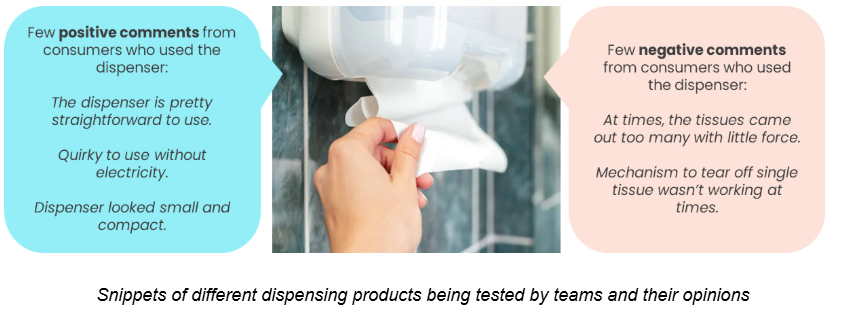
A few positive comments from consumers who used the dispenser included:
“The dispenser is pretty straightforward to use.”
“Quirky to use without electricity.”
“The dispenser looked small and compact.”
A few negative comments from consumers who used the dispenser included:
“At times, the tissues came out too easily with little force.”
“The mechanism to tear off single tissue wasn’t working at times.”
Some other observations included:
- Dispensing Performance & Reliability: A dispenser that claimed to provide smooth, one-at-a-time dispensing showed issues such as multiple sheet pull-out or tearing under regular use.
- Durability & Build Quality: While certain designs appeared sturdy, testing revealed wear and breakage under high-usage conditions, raising concerns about long-term durability.
- Refilling & Maintenance: One dispenser was difficult to refill and required frequent maintenance, affecting ease of use in commercial settings.
- Mismatch with Marketing Claims: Secondary research did not capture issues such as hygiene concerns arising from direct contact with the dispenser, which impact real-world usability.
Mounting-Strength Validation Helped Improve a Promising Dispenser Format
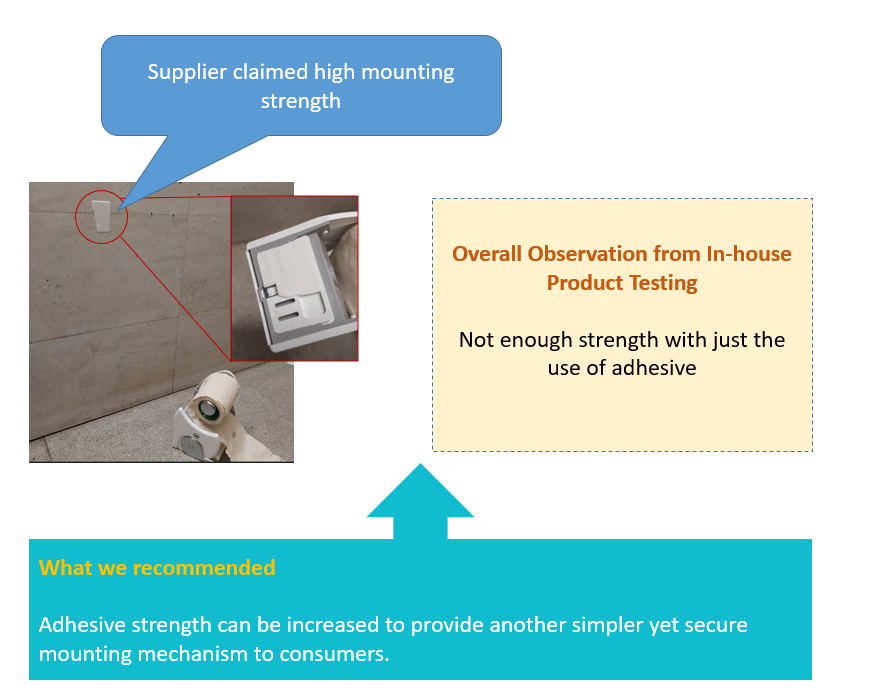
The supplier claimed high mounting strength.
Overall observation from in-house product testing showed that there was not enough strength with just the use of adhesive.
The team recommended that the adhesive strength be increased to provide another simpler yet secure mounting mechanism to consumers.
Assessment Approach
1. Identifying Relevant Tissue Dispenser Systems
Approach 1: Low TRL to Commercial Tissue Dispenser Innovations
The process began with an extensive search for tissue dispensing technologies, including patents, research-level innovations, and commercial products.
The focus was on finding adaptable solutions that could improve sustainability, functionality, and consumer experience.
Approach 2: Multi-Lingual and Social Media Search
The team conducted multi-lingual searches in regional languages to identify solutions specific to different geographies.
Region-specific search engines, such as Naver and Baidu, were leveraged to uncover innovations that might have been missed due to publication in native languages.
2. Relevant Compact Dispenser Concepts
Aulicas Tissue Dispensers by Xiamen Aulicas Pro-Environment & Tech
The China-based manufacturer provides Aulicas dispensers, a compact, electrically driven dispensing unit designed to fit into small spaces.
These models dispense 10-25 units per minute and accommodate tissues of any brand. They feature digital controls and a microcomputer-controlled dispensing mechanism, offering responsive operation with minimal user intervention.
The dispensers have space-efficient housing and are lightweight, suitable for both household and light commercial settings.
Some models include hygiene-oriented features like UV disinfection and temperature control options for cleanliness. Prices for similar units range from $120 to $350.
Lado Cotton Tissue Dispensers by Hangzhou Haisui IoT Technology Co., Ltd.
Another China-based manufacturer offers the Lado Cotton dispenser under the LADOCOTTON brand.
It integrates cloud connectivity, app control, and remote monitoring, allowing real-time management.
The IoT system enables operators to oversee multiple units, track performance, and adjust settings without physical interaction, improving operational efficiency.
The hardware delivers consistent automated operation and is designed for household and light commercial use.
Its compact form factor allows easy placement. Prices range from $45 to $60, offering an affordable, functional solution.
3. Ranking and Evaluation Through Available Information and In-House Product Testing
The shortlisted solutions were evaluated using data from supplier websites, market literature, and product specifications.
Key evaluation parameters included:
- Product Features – Technical maturity, cost, dispensing time, size, and mode of operation.
- Compatibility – Integration with different tissue formats and alignment with existing product offerings.
- Mounting Type – Suitable for countertop and wall-mounted configurations.
- Supplier Capabilities – Production capacity, scalability, openness to customization, IP strength, and compliance readiness.
- End-Use Suitability – Ease of use, intuitiveness, and relevance for household applications.
Based on the above ranking and evaluation, a few of the top solutions were procured for in-house testing to validate marketing claims and assess real-world performance.
Most importantly, consumer testing and product trials provided insights on operational feasibility, efficiency, intuitiveness, overall user experience, and a few of the above-mentioned evaluation parameters.
These findings highlighted each solution’s strengths and limitations.
Based on these insights, the team recommended specific modifications to align the dispensers with the client’s requirements, moving them closer to a scalable, market-ready product.
What Should R&D Teams Consider Before Investing in Tissue Dispensing Systems?
As demand grows for more efficient and user-friendly tissue-dispensing solutions, identifying options that perform well in real-world settings is increasingly important.
For R&D and innovation teams, technology scouting must go beyond patents, research-level innovations, commercial products, and supplier websites to determine whether a dispenser meets operational and user requirements.
When supplier claims do not capture issues such as humidity performance, hygiene concerns, refilling challenges, mounting strength, or user-level issues, supplier claim validation can help move from broad research and on-paper claims to validated, commercially viable solutions.
By combining supplier scouting with hands-on validation, GreyB helps companies address performance gaps and select solutions that meet both operational and user requirements.
Fill out the form below and connect with our expert today.