

Value Delivered
The client gained a deeper prior-art search strategy by moving beyond conventional location-estimation terminology and focusing on the underlying signal relationship.
The research identified that the key inventive aspect was not only using signal-strength differences from multiple base stations, but the specific calculation structure:
(Signal₁ – Signal₂) + (Signal₁ – Signal₃)
where Signal₁ acts as the consistent reference point for both comparisons.
This approach helped refine the search direction and uncover potential prior-art opportunities by connecting signal-strength measurements with equivalent technical parameters across different technical domains.
Problem Solved
The challenge was identifying prior art for a wireless terminal location system that estimates a device’s position using signal-strength measurements from three separate base stations.
The invention relied on comparing relative differences between signal readings from multiple sources to estimate location.
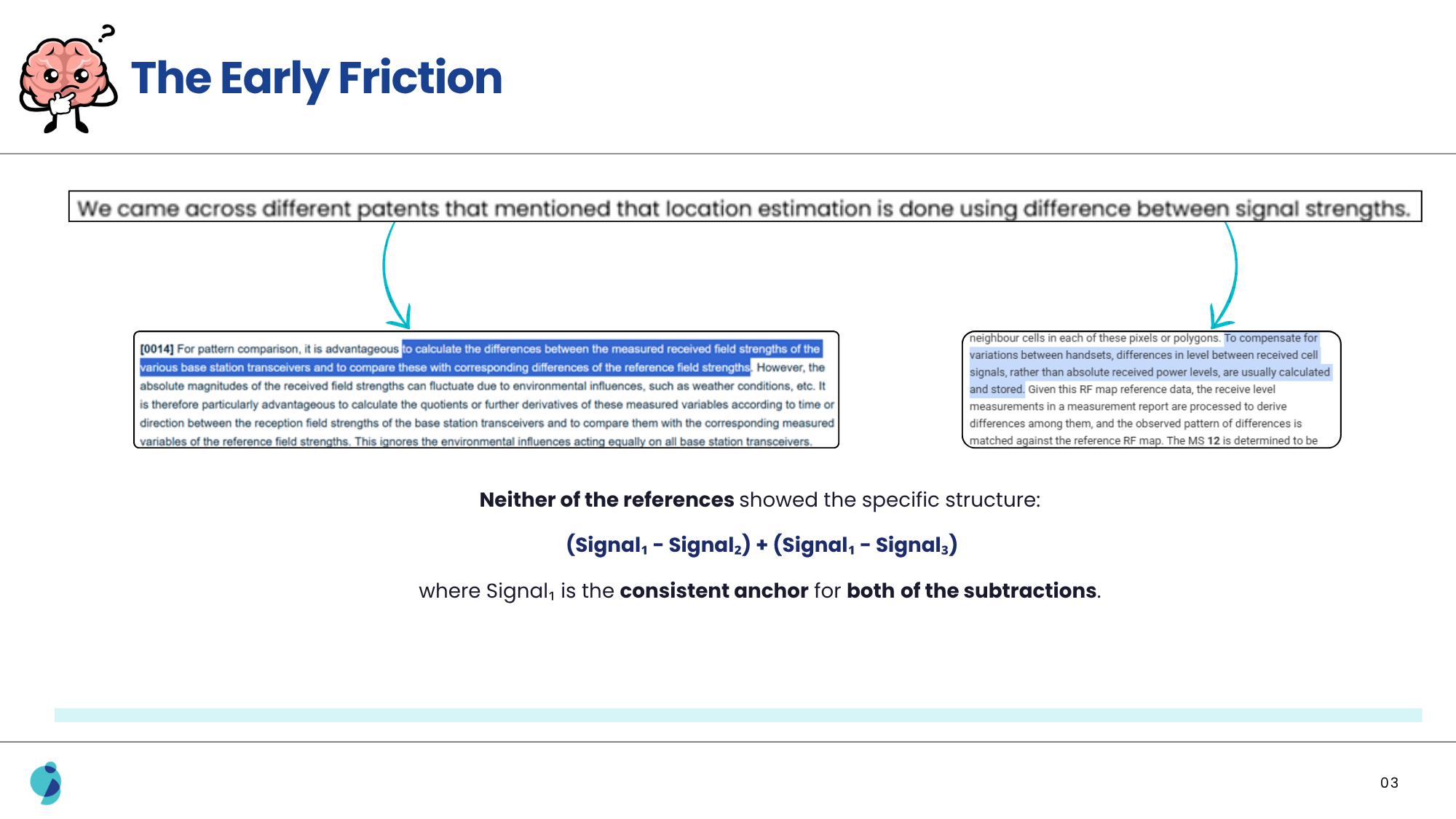
Initial searches found references discussing location estimation using differences between signal strengths. However, the identified references did not disclose the specific mathematical relationship required by the claim:
(Signal₁ – Signal₂) + (Signal₁ – Signal₃)
The missing aspect was the consistent use of one signal measurement as the anchor for both subtraction operations.
The challenge was finding a reference that disclosed this exact signal comparison structure rather than only the broader concept of signal-difference-based positioning.

Solution Offered
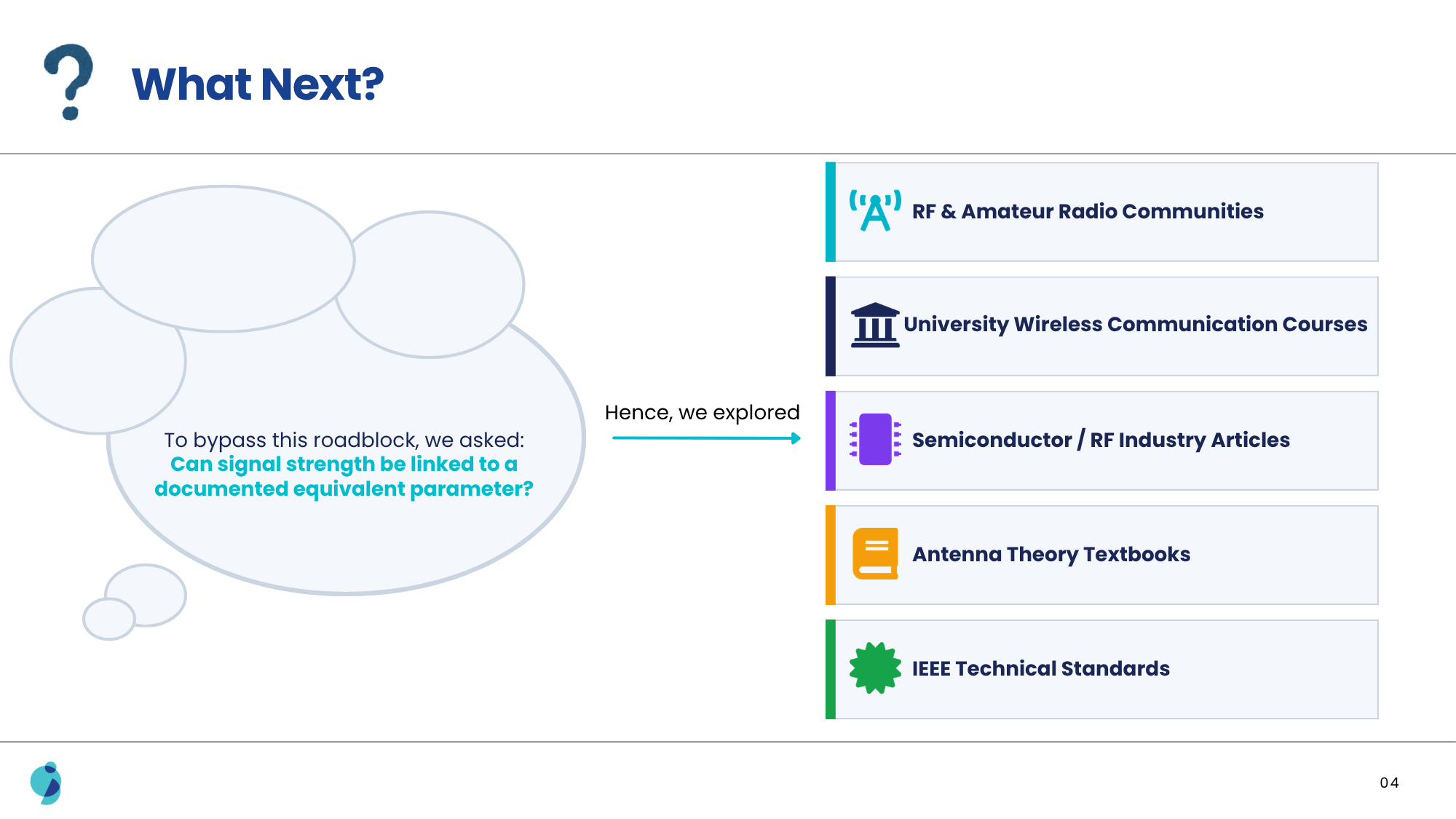
The research team changed the search approach by asking whether signal strength could be linked to an equivalent documented parameter used in other technical fields.
The team expanded the search beyond patent literature and explored:
- RF and amateur radio communities.
- University wireless communication resources.
- Semiconductor and RF industry articles.
- Antenna theory textbooks.
- IEEE technical standards.
This broader technical exploration helped identify alternate ways of describing signal relationships and avoided the limitations of searching only within wireless location terminology.
The case demonstrated that when conventional searches identify the general concept but miss the exact technical relationship, expanding into related technical domains can reveal new prior-art pathways.
Get the full case study to discover how Locarno Classifications uncovered hidden prior art when traditional searches failed