
Value Delivered
The client received strong non-patent literature and system prior art capable of challenging the patent’s key novelty: retaining and reusing portions of an existing media playback pipeline when switching between content of the same type. The identified evidence helped demonstrate that developers had already explored practical techniques for reducing switching delays by avoiding complete reconstruction of the playback pipeline.
By uncovering evidence from open-source developer archives and related real-world implementations, the research provided the client with:
- A stronger basis for invalidating the “faster switching” patent.
- Evidence beyond conventional patent literature.
- Technical documentation showing partial reuse and rapid reconfiguration of media-processing pipelines.
- Additional prior-art directions involving live television, IPTV, multi-channel streaming and low-latency channel zapping.
The findings ultimately transformed an initially weak prior-art position into a stronger invalidity argument supported by previously overlooked system-art evidence.
Problem Solved
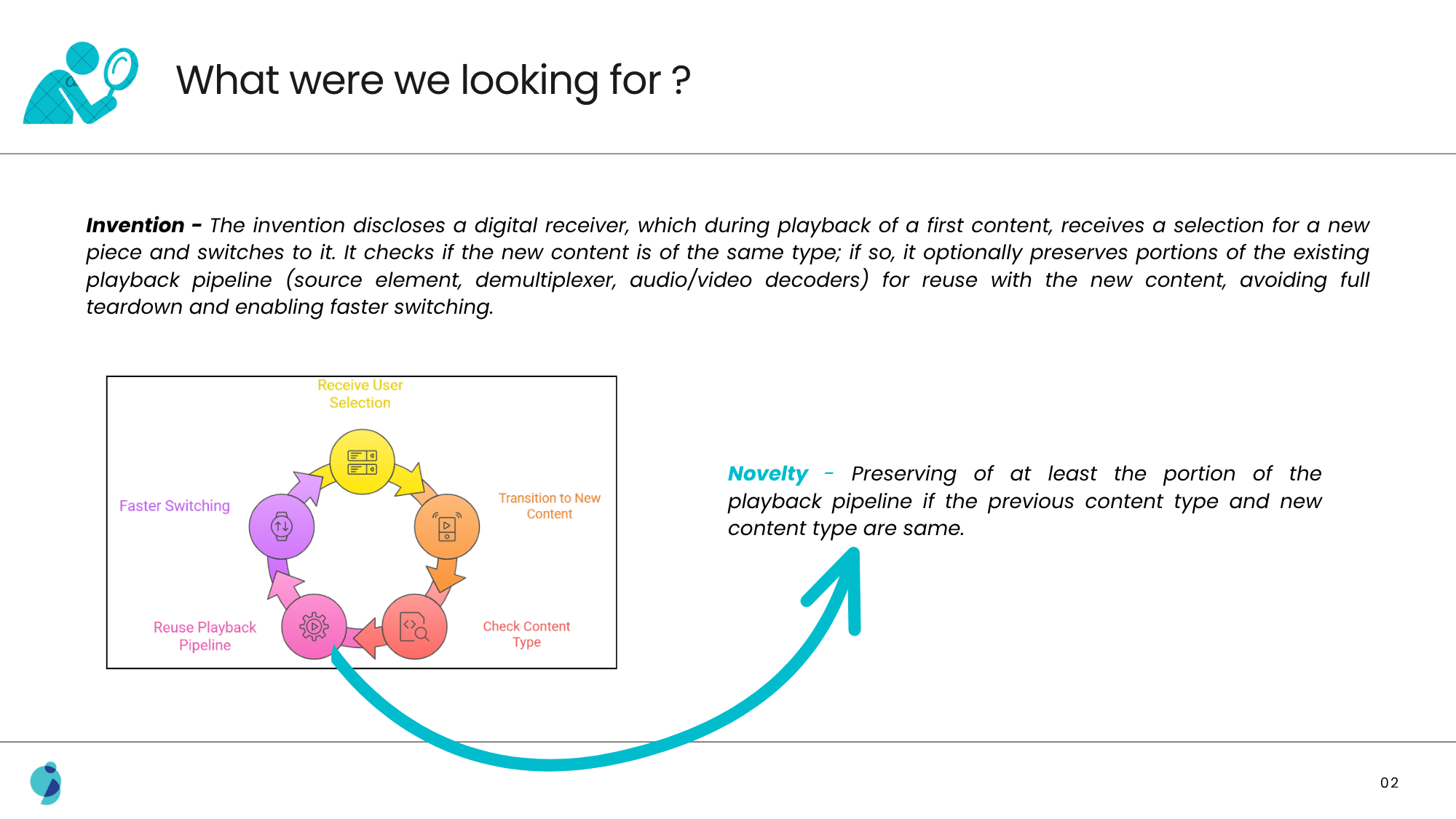
The patent concerned a digital receiver that, while playing one media item, receives a request to play another item and determines whether both items are of the same content type. When the types match, portions of the existing playback pipeline such as the source element, demultiplexer and audio or video decoders are preserved and reused, enabling faster content switching.
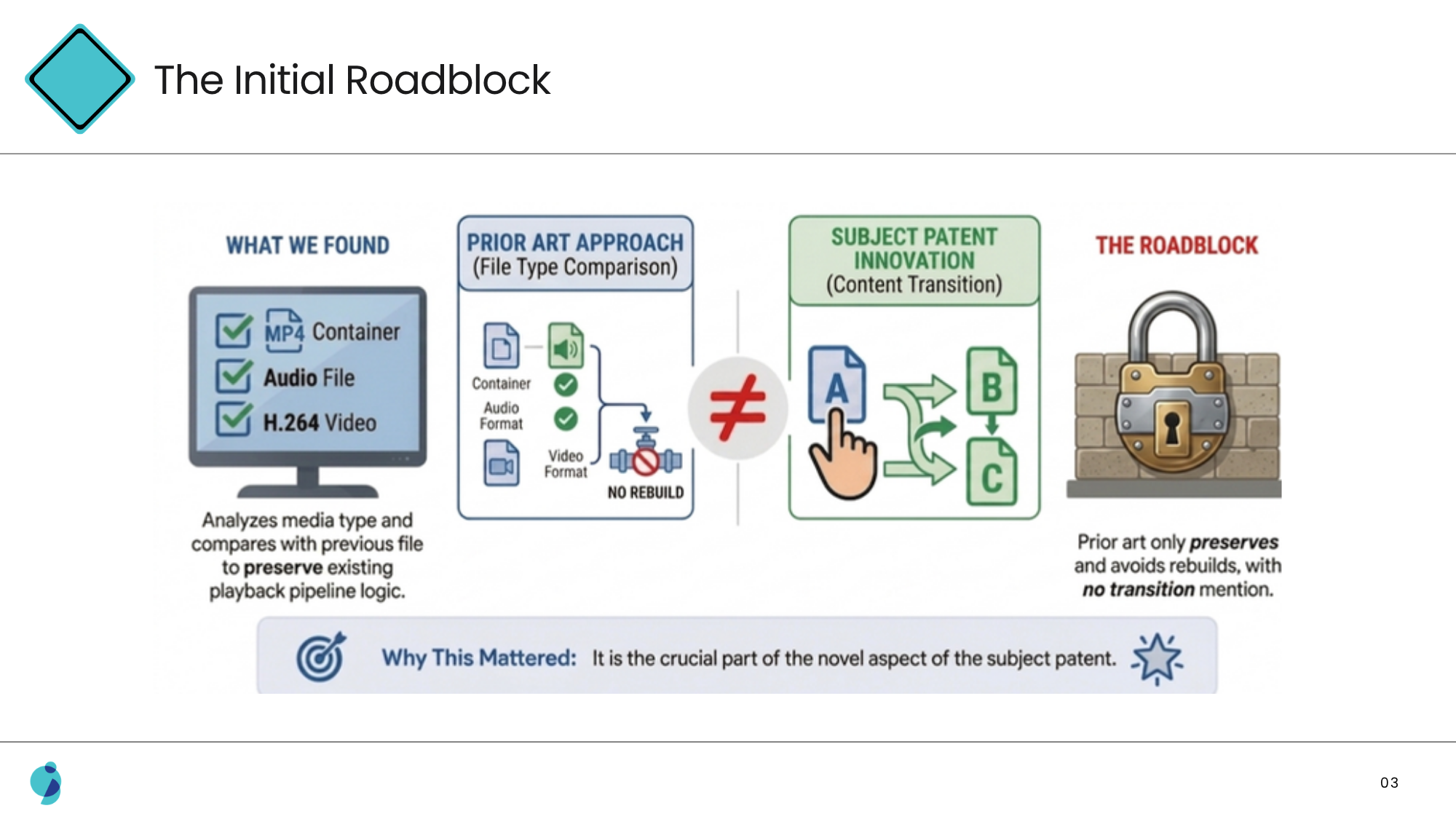
The initial search produced references that analysed media formats and avoided rebuilding portions of a playback pipeline. However, these references did not clearly disclose the critical context of transitioning from one content item to another while preserving the existing pipeline.
Narrow keyword searches around the patent language also failed to produce sufficiently strong prior art. The key challenge was that the relevant functionality was more likely to appear in developer documentation, software architectures and practical multimedia systems than in publications using terminology identical to the claim. The research therefore required identifying where the underlying technical problem had been solved in real-world systems rather than continuing with claim-language-based searching.

Solution Offered
The research team shifted from conventional keyword searching to a system-art analysis focused on multimedia frameworks where rapid content switching was actively implemented.
The investigation initially considered multimedia technologies such as GPAC, dash.js and GStreamer. GStreamer emerged as the strongest lead because its architecture used modular media-processing pipelines involving parsers, demultiplexers and decoders.
The team then analysed archived GStreamer conference materials and identified documentation relating to decodebin3 and the GStreamer 1.10 release. These materials helped establish how media-processing components could be retained, reused or reconfigured rather than completely reconstructed during content changes.
The investigation was further expanded into the related area of low-latency channel zapping in live television, IPTV and multi-channel streaming. These systems faced the same technical problem: noticeable delay caused by rebuilding the rendering pipeline whenever a user changed channels.
Following this technical lead, the team identified stronger prior art describing:
- Partial reuse of existing pipeline elements.
- Pre-built alternative playback paths.
- Intelligent buffering during content switching.
- Rapid pipeline reconfiguration.
- Near-seamless switching of real-time content.
These disclosures directly addressed the technical bottleneck underlying the patent, reducing switching latency by minimizing reconstruction of the playback pipeline, and provided the client with a more technically aligned and defensible invalidity position.
Get the full case study to discover System-Art Backtracking Uncovered Hidden Prior Art for Faster Digital Media Switching