




Sisvel’s Cellular IoT program brings dozens of LTE-M and NB-IoT patent portfolios into a single licensing framework. For an LTE-M device maker, that can remove substantial transaction complexity. One agreement can replace a long series of bilateral discussions with participating patent owners, and the program’s device-specific rate structure reflects the economics of IoT products more closely than a blanket smartphone-style LTE rate.
But a pool license answers only one part of the exposure question: which rights from participating licensors are covered.
It does not answer what remains outside that structure for the exact LTE-M device being sold.
GreyB’s analysis of the declared LTE landscape makes that distinction visible. Starting with approximately 29,400 declared LTE patent families, the webinar analysis mapped those families against LTE-M features and then compared the LTE-M-relevant set with the portfolios represented by Sisvel licensors.
In GreyB’s dataset, around 47% of the analyzed LTE-M-relevant patent families were associated with Sisvel licensors, while roughly 53% were associated with non-licensors.
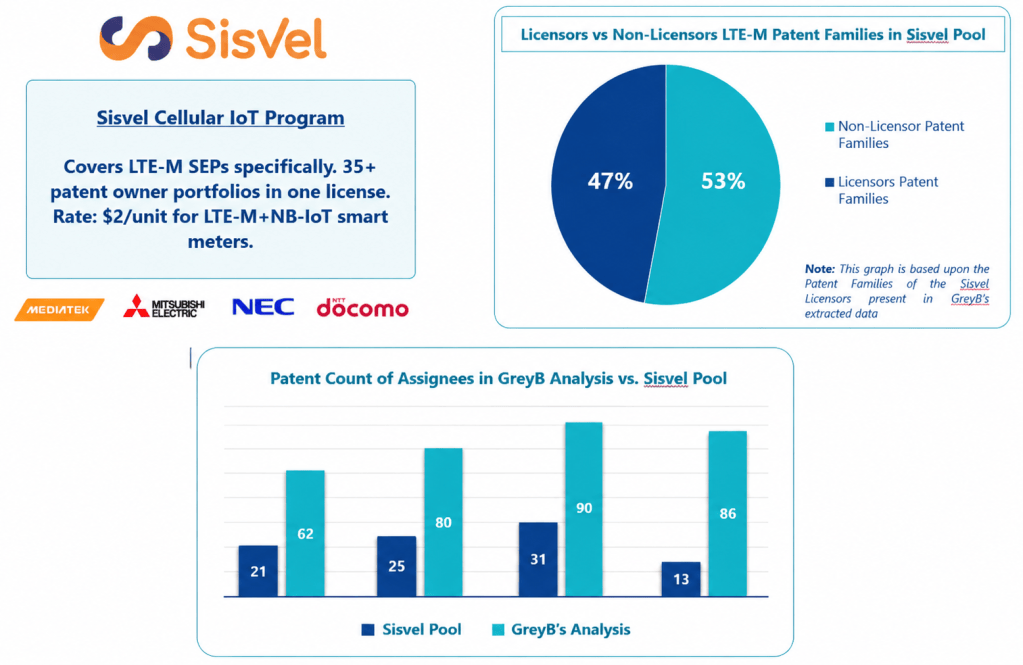
That 53% is not a second royalty stack waiting to be added to the pool rate. It is a residual portfolio universe that still has to be tested for actual device relevance.
This is where the broader Cellular IoT licensing picture becomes important. GreyB’s 2026 Cellular IoT Landscape Report shows why LTE-M, NB-IoT, RedCap, and V2X cannot be treated as one uniform licensing surface. Each technology has a different implementation profile, patent mix, pool structure, and stage of commercial adoption. The same fragmentation is also shaping the practical licensing models discussed in GreyB’s analysis of 2026 Cellular IoT licensing strategy.
For LTE-M, the immediate question is narrower: after the pool license is signed, which outside-pool patent families can still reach the product?
Access the complete webinar recording, Navigating LTE-M SEP Licensing with Device-Level Precision, for the full dataset, feature taxonomy, Sisvel comparison, and device-level analysis.
The 53% Outside the Pool Is Not a 53% Royalty Stack
Counting patent families outside a pool creates the same problem as counting LTE declarations in the first place. It assumes that every family has similar relevance to the product.
GreyB’s LTE-M analysis shows why that assumption breaks down.
Of approximately 29,400 declared LTE patent families analyzed, only around 56% appeared relevant to LTE-M implementations. Within the full declared set, about 32% mapped to foundational LTE-M features and another 24% to optional features. A large part of the remaining LTE portfolio mapped to capabilities outside the LTE-M implementation profile.
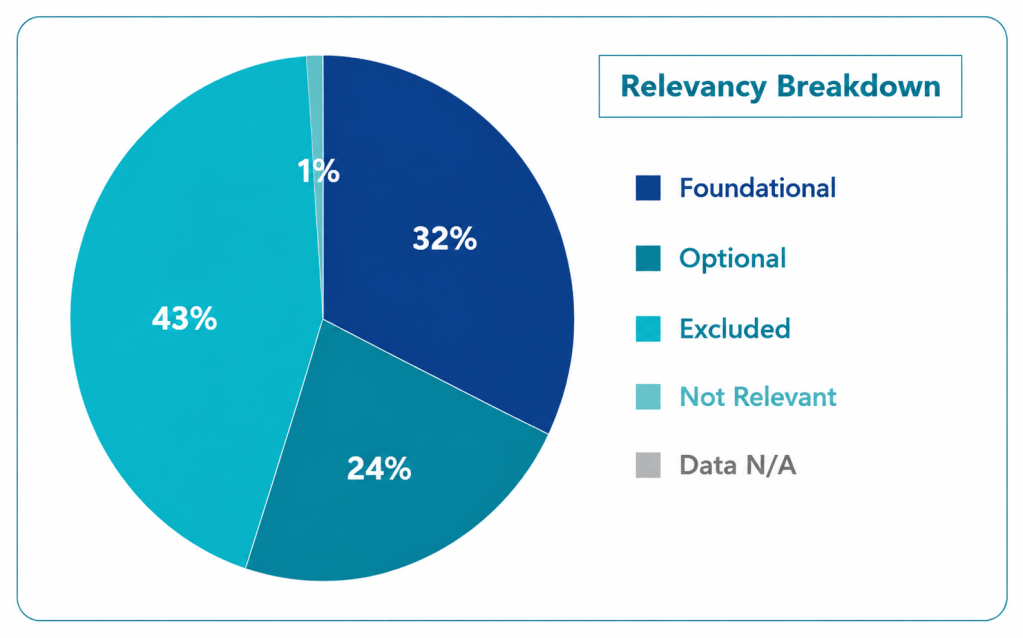
The distinction exists because an LTE declaration says little about what a specific LTE-M product actually implements. A patent declared against an LTE specification may cover RRC signaling required for LTE-M operation. Another patent in the same declared universe may cover carrier aggregation or high-throughput MIMO capabilities that an LTE-M device never uses. Both can appear in the ETSI declaration data without a device-category label separating them.
The webinar captured the problem in one line:
“Portfolio health and portfolio relevance are not the same thing.”
A live, granted family can be commercially enforceable and still have little relevance to the product sitting across the negotiating table.
The same principle applies to the outside-pool universe. Outside-pool status tells an implementer that a particular patent owner is not covered by that specific pool arrangement. It does not prove that every patent in that owner’s LTE portfolio applies to the device.
GreyB explored this declaration-versus-relevance problem in more detail in its LTE-M portfolio analysis, which explains why a smaller set of device-relevant patents can carry more negotiating weight than a much larger declared LTE portfolio. That earlier analysis is the right starting point for understanding the 56% figure. The pool question begins after that filter has already been applied.
A Smart Meter Changes Which LTE Patents Matter
Residual exposure becomes useful only when it is mapped to what the product actually does.
LTE-M was designed around a constrained implementation profile. Smart meters, asset trackers, industrial sensors, and similar devices prioritize low power consumption, narrower bandwidth, lower hardware complexity, reliable connectivity, and long operating life. They do not need the full throughput and antenna capabilities that drive many smartphone-oriented LTE features.
That changes the technical areas that matter most.
GreyB’s analysis found the strongest concentration of foundational LTE-M features in Core Network & EPC, Physical Channels & Reference Signals, and RRC/Radio Resource Management. These domains cover baseline functions such as network discovery, attachment, authentication, paging, signaling, and data transfer. Advanced MIMO and carrier aggregation were largely outside the LTE-M capability envelope.
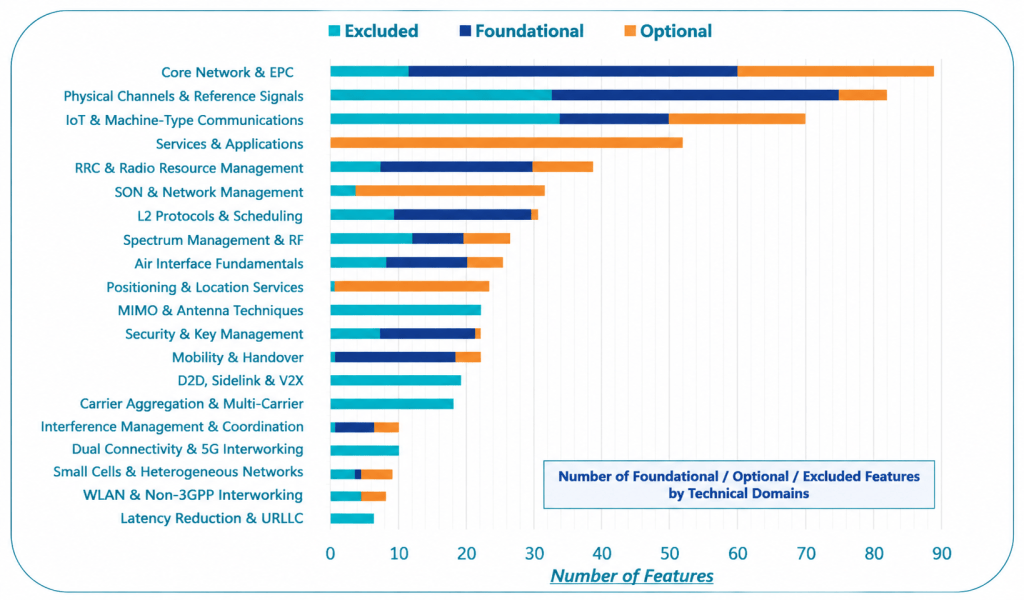
Even “IoT” is too broad a label for an exposure analysis. LTE-M and NB-IoT may sit in the same cellular IoT market and may be licensed together, but they do not implement identical feature sets. A patent relevant to NB-IoT cannot be assumed to apply to LTE-M simply because both technologies are used in low-power IoT devices.
The device adds another layer. GreyB’s methodology reviews commercial implementation information and chipset documentation, including LTE-M products built around devices such as Nordic Semiconductor’s nRF9160 and Quectel’s BG95. That makes it possible to move from “this family appears relevant to LTE-M” to the more useful question: “does this family cover a function implemented by this chipset and product configuration?”
This distinction is not unique to LTE-M. In a separate VVC essentiality case study, GreyB showed how a patent associated with a standard could still fail the final essentiality test because the claimed technical concept was excluded from the final specification. For an implementer, that is the practical reason to validate asserted patents rather than treating declaration or portfolio membership as proof of product exposure.
For Implementers, the Pool Reduces Complexity but Does Not Map Residual Exposure
A pool can meaningfully support risk management by consolidating rights from participating owners under one agreement. It cannot, however, evaluate every independently held LTE patent that may later be asserted against a particular product.
Suppose an LTE-M smart meter manufacturer has already taken the relevant pool license and later receives an assertion from a non-participating patent owner. The fact that the patent owner sits outside the pool does not establish the value of the demand. The asserted portfolio still has to survive several technical filters.
- First, do the asserted families actually map to LTE-M rather than full LTE functionality?
- Second, are they tied to foundational features or only optional capabilities?
- Third, does the target chipset implement those optional capabilities?
- Fourth, do the asserted claims map to the device’s technical mechanism?
Only after answering those questions does the residual portfolio begin to describe practical licensing exposure.
This is also why the commercial structure of Cellular IoT licensing matters. GreyB’s broader review of Cellular IoT licensing models explains how module-level licensing, end-device licensing, multiple pools, bilateral licensing, and technology-specific programs can coexist around the same connected product. A pool license may remove one group of rights from the negotiation, while other portfolios still require a separate technical assessment.
GreyB’s VVC work offers a useful parallel. When a client needed to determine whether declared patents were worth licensing, the analysis did not stop at declaration status. It checked claims against the final standard and traced the underlying technical proposal through standard-development documents. That review showed that a concept had been considered but ultimately excluded from the final specification, giving the client evidence to avoid paying for a patent that was not essential. The standard changed, but the licensing principle remains the same: technical applicability must be proved.
For Licensors, Foundational Coverage Determines How Strong an Independent Position Really Is
The same analysis works in the opposite direction for patent owners.
A licensor deciding how to approach LTE-M cannot rely only on the size of its LTE portfolio. The stronger question is how much of that portfolio survives the LTE-M filter and, within that smaller group, how deeply the portfolio covers functions that every target device must implement.
GreyB divides the LTE-M landscape into three layers. Foundational features are required for compliant operation. Optional features depend on device, chipset, network configuration, or deployment profile. Excluded features sit outside the LTE-M capability envelope.
That classification changes the licensing story.
A portfolio concentrated around attachment, RRC procedures, physical channels, paging, coverage enhancement, and power-saving mechanisms can support a stronger LTE-M position than a similarly sized portfolio weighted toward features that the target device does not implement.
This is where pool participation versus bilateral licensing becomes a portfolio-specific decision rather than a generic commercial preference. A pool provides licensing infrastructure and lower transaction costs. An independent route preserves control over bilateral negotiations, but the licensor then needs a technically defensible reason for why its portfolio carries value beyond a broad LTE declaration count.
GreyB’s SEP Readiness Report applies similar logic across standardized portfolios by separating mandatory, optional, and non-essential coverage and linking that technical position to pool strategy, litigation readiness, geographic coverage, and remaining patent life. For an LTE-M licensor, the useful question is not simply whether the portfolio is large enough to monetize. It is whether the portfolio is ready to defend its LTE-M value when the implementer asks for feature-level proof.
A separate GreyB patent-pool case study shows why that proof can change a licensor’s position. In that engagement, a patent initially appeared not to map cleanly to the 5G NR specification, but deeper technical analysis identified mathematical conditions in the standard that matched the claim. Confirming that relevance allowed the client to retain the asset and strengthen its position in patent-pool and licensing discussions. The value came from proving where the claim actually sat in the standard, not from the declaration label alone.
The same logic applies to LTE-M. A licensor with strong foundational coverage has a better basis for deciding whether to enter a pool, stay outside it, or use the pool as one part of a wider licensing program.
Evidence for the Licensor Has to Survive the Same Device Filter
This creates an important symmetry between the two sides. The implementer wants to know how much of an asserted portfolio survives the device filter. The licensor wants to know how much of its own portfolio survives that same filter before the implementer asks.
The technical analysis is the same. The negotiation use is different.
GreyB’s oneM2M licensing case study shows what this looks like when a licensor needs more than a broad standards narrative. The engagement combined claim-to-standard mapping with evidence that an inventor’s contribution had been incorporated into the relevant standard. That additional technical backing helped the client address likely licensee pushback before negotiations and strengthened the patent’s licensing position.
For LTE-M licensors, the equivalent proof package may include the specific 3GPP feature, whether that feature is foundational or optional for LTE-M, the relevant specification sections, the chipset implementation, and the claim elements that read on the mechanism.
That is much stronger than presenting a total LTE family count and expecting the implementer to infer device relevance.
From 29,400 LTE Families to a Device-Level LTE-M Scorecard
The difficulty is scale.
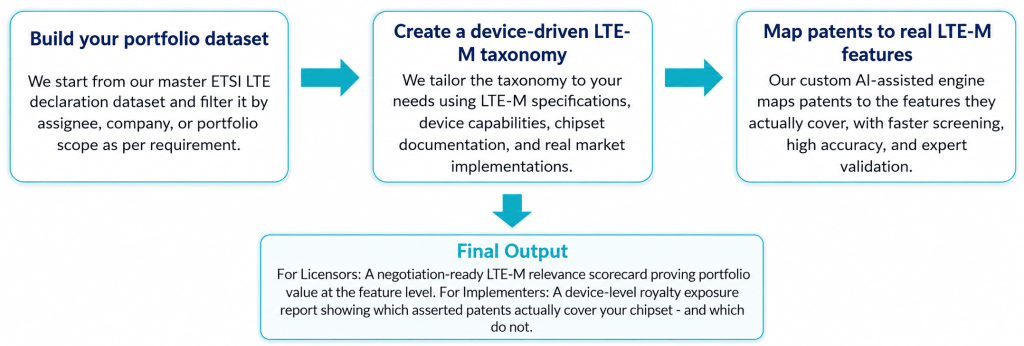
GreyB began with approximately 29,400 LTE patent families identified from ETSI declaration data. The records were collapsed into INPADOC families and checked for legal status before analyzing representative family members for LTE-M relevance.
The next step was not a keyword search for “LTE-M.”
GreyB built a four-level LTE feature taxonomy from 3GPP specifications. The hierarchy moves from broad technical domains to features, sub-concepts, and specific technical mechanisms that align more closely with patent disclosures and claims.
Those taxonomy nodes were then classified as foundational, optional, or excluded using LTE-M requirements, relevant 3GPP specifications, commercial implementation information, and chipset documentation.
Patent priority data, abstracts, and independent claims were then processed through a customized LTE categorization engine to map families to the relevant technical nodes. AI accelerates that screening process, but the webinar makes an important qualification:
“AI accelerates the screening and categorization, but expert validation is critical.”
That validation matters because the output is intended to support licensing, assertion analysis, claim charting, and negotiations rather than a high-level landscape alone.
The final output can be used in two directions.
For a licensor, it becomes a negotiation-ready LTE-M relevance scorecard showing which families should lead the discussion, which provide supporting coverage, and which should not be relied on for that product category.
For an implementer, the same process can produce a device-level royalty exposure report showing which asserted families remain relevant after the LTE-M feature and chipset filters are applied.
GreyB has used the same principle of narrowing large declared portfolios before committing expert resources in other standards. In its 5G SEP identification case study, filtering out non-SEPs reduced unnecessary analysis and allowed the client to focus expert effort on the patents with stronger standard relevance. LTE-M needs the same discipline because a broad LTE declaration universe is too large and too technically mixed to treat every family as equally important.
GreyB’s SEP Analysis work brings these layers together when a portfolio needs to move from declaration data to an evidence-backed licensing position.
The LTE-M Exposure Review That Should Happen After the Pool License
A pool license answers an important question: which rights from the participating patent owners are now covered?
For an LTE-M implementer, it does not answer which independently held patent families can still reach the product.
For a licensor, being outside the pool does not automatically create a stronger bilateral position either. The portfolio still needs enough foundational, device-relevant coverage to justify the value being asserted.
That is why GreyB’s 53% outside-pool finding should be treated as a starting universe rather than a royalty conclusion.
- The first filter asks which LTE families are relevant to LTE-M.
- The second asks which of those families are foundational or optional.
- The third asks which features the specific device and chipset implement.
Only then does the outside-pool portfolio become a useful measure of residual exposure or licensing opportunity.
The full webinar walks through that process from the 29,400-family LTE universe to the LTE-M taxonomy, the Sisvel portfolio comparison, the device-level filtering approach, and the final negotiation-ready scorecard.
Access the complete recording of Navigating LTE-M SEP Licensing with Device-Level Precision to see the methodology and dataset in sequence.