
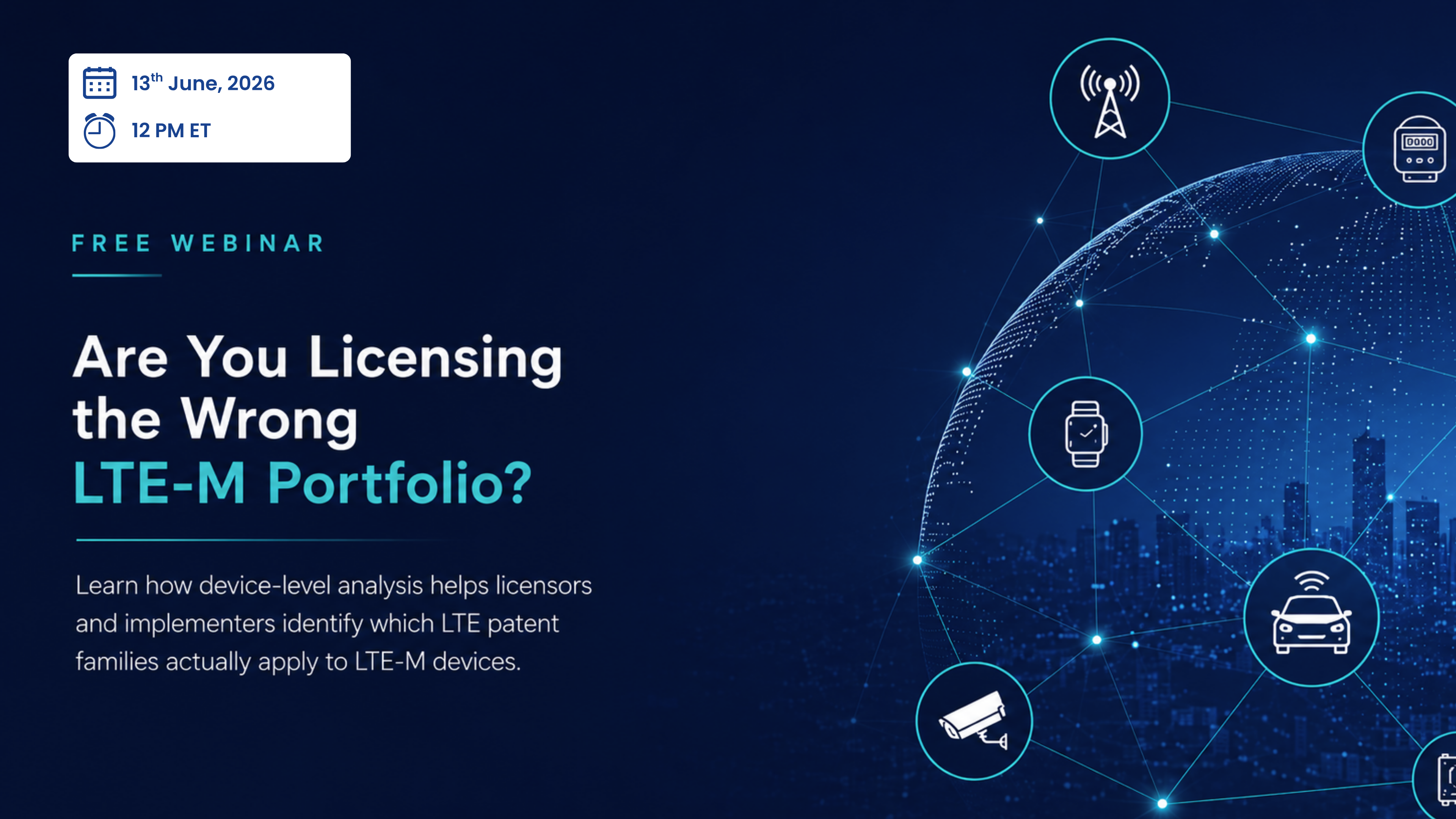
LTE-M is changing how cellular IoT patents are licensed. A broad LTE patent portfolio may look strong, but that does not always mean it is strong for LTE-M devices.
Smart meters, asset trackers, and industrial sensors do not use every LTE feature. They are built for low power, low cost, and long battery life. This makes patent licensing harder. Licensors need to prove which patent families matter. Device makers need to check which asserted patents actually apply to their products.
In this webinar, GreyB explains how LTE-M patent relevance can be tested at the device and feature level, so both sides can move beyond broad declaration counts.
258
operators have deployed LTE-M and NB-IoT globally
29,400
declared LTE patent families formed the analysis base
56%
of declared LTE families, appear relevant to LTE-M
You’ll get answers to
- Why is the total LTE declaration count not enough for LTE-M licensing?
- Which LTE patent families are actually relevant to LTE-M devices?
- How to separate foundational LTE-M patents from optional ones.
- Why features like carrier aggregation and advanced MIMO often do not fit LTE-M devices.
- How licensors can build a stronger proof package before negotiations.
- How implementers can test whether asserted patents map to their actual device.
- Why a Sisvel cellular IoT license may not cover the full LTE-M patent risk.
- How GreyB builds an LTE-M scorecard using ETSI data, 3GPP features, chipset inputs, and expert review.
Join the webinar to see how LTE-M licensing can be tested with clearer evidence. We’ll show how patent families can be filtered by device type, chipset, and actual LTE-M features, so licensing discussions are based on what the device really uses.