
A leading global consumer goods company wanted to move beyond conventional packaging formats that had become commoditized across its category. Existing solutions were well understood by consumers, but also by every competitor.
The innovation team wanted formats that could deliver a meaningfully different consumer experience while remaining compatible with the company’s formulation requirements.
The company partnered with GreyB to examine the entire packaging landscape. This included solutions within its category and formats from unrelated industries that could be adapted to its application. The team also needed clear guidance on what was commercially ready, worth monitoring, or too nascent for immediate action.
Within-Domain and Cross-Industry Searches Ran in Parallel
A conventional packaging scouting study would have searched the client’s category and returned solutions the innovation team had likely already encountered.
Instead, the engagement followed two parallel pathways:
Pathway 1: Within-Domain Innovation
This pathway focused on under-the-radar innovation within the client’s category. The search went beyond standard trade databases and covered:
- Research papers
- Inventor-level patent filings
- Niche supplier networks
- Geographies where the client had limited visibility
Pathway 2: Cross-Industry Solutions
The second pathway examined packaging formats from pharmaceuticals, laundry, cosmetics, and agriculture.
Each industry had developed different approaches to packaging and problems such as precise delivery, sustainability, consumer experience, and format differentiation. These challenges overlapped significantly with the client’s requirements.
Running both pathways simultaneously ensured that neither direction was diluted by the other. This technology scouting approach provided coverage of familiar and unconventional innovation sources.

Three Evaluation Verticals Turned a Long List Into Priorities
Identifying solutions was only half the challenge. A long list of packaging innovations without clear prioritization would leave the client to complete the evaluative work independently.
The team built a structured framework across three verticals:
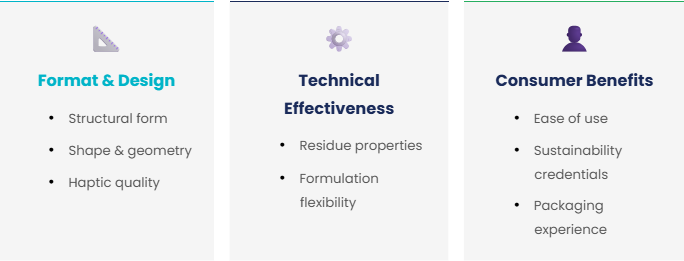
For solutions where information was not publicly available, the team contacted suppliers and innovators directly. This helped fill critical data gaps instead of leaving them as unknowns.
Three-Tier Evaluation to Separate Short-term And Long-term Opportunities
Each solution was assigned to one of three tiers based on the evaluation.
The tiers were shared with the client at intermediate checkpoints. This ensured that the final prioritization reflected the client’s feedback rather than relying only on the research team’s judgment.

Cross-Industry Mapping Revealed a Structural Innovation Gap
One of the clearest findings was a structural gap between innovation in the client’s category and innovation in other industries.
Certain formats were well established and actively evolving in pharmaceuticals and food and beverage. However, they had received limited attention within the client’s domain, despite addressing directly relevant problems:
- Rapid dissolution
- Zero packaging residue
- Consumer convenience
- Sustainability
The cross-industry assessment showed the following levels of activity:
| Format Type | Pharma | Laundry | Cosmetics | Client Category |
| Format A | High | Medium | Low | Low |
| Format B | High | High | Medium | Low |
| Format C | Low | Medium | High | Low |
| Format D | High | High | High | High |
| Format E | Low | Low | Medium | Low |
| ■ High innovation ■ Medium ■ Low — gap opportunity for client | ||||
The low activity around Formats A, B, and C in the client’s category represented potential gap opportunities.
This made cross-industry innovation a targeted whitespace strategy rather than a speculative search exercise. It helped the client focus on formats that other industries had already advanced, but competitors within its category had not yet occupied.
Supplier Outreach Added What Public Sources Could Not
Several promising solutions were at an early or pre-commercial stage. Public information was insufficient to evaluate their feasibility or compatibility properly.
The team conducted structured outreach to suppliers, startups, and technology developers. The discussions addressed:
- Performance
- Cost structures
- Formulation compatibility
- Commercial readiness
This improved the quality of the final evaluation. It eliminated solutions that appeared compelling in public descriptions but could not meet the client’s technical requirements.
The outreach also confirmed that several cross-industry formats had greater compatibility with the client’s application than their public profiles suggested. As a result, the tiered recommendations were based on validated information rather than surface-level claims.
Expert Interviews Pressure-Tested Cross-Industry Adaptation
Moving a packaging format from one industry to another is rarely a simple substitution.
The regulatory environment may differ. Manufacturing infrastructure may need to change. Consumer expectations around handling, storage, and disposal may also be different.
A format that performs well in its original industry is not automatically ready for another category at a commercial scale.
The team interviewed packaging specialists with experience across the client’s domain and the source industries. These discussions examined what would need to change in the material, geometry, or manufacturing process for each format to work in the target application.
The interviews produced insights that could not have been gathered through secondary research alone.
A Phased Roadmap Turned the Landscape Into an Investment Pipeline
The client received a tiered shortlist containing within-domain and cross-industry packaging candidates.
Each shortlisted solution included detailed analysis of:
- Key differentiators
- Material composition
- Performance characteristics
- Drawbacks
- Current commercial readiness
The final roadmap organized the strongest opportunities across three implementation horizons.
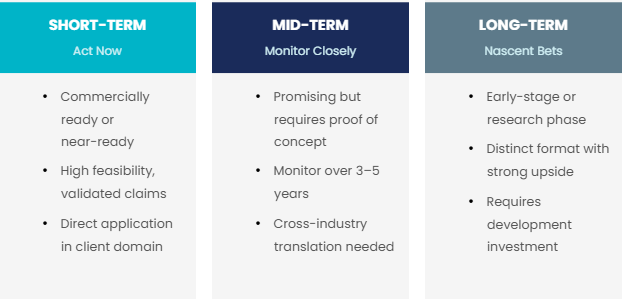
This structure gave the innovation team a concrete basis for prioritizing investments and shaping its development pipeline without repeating the evaluative work from scratch.
How Can Consumer Goods Companies Build a Commercially Relevant Packaging Pipeline?
Companies need more than a list of interesting formats. Each solution must be assessed for differentiation, formulation compatibility, technical effectiveness, consumer experience, sustainability, manufacturing requirements, and commercial readiness.
Through packaging innovation consulting, GreyB helps clients move from broad research, inventor-level patent filings, supplier claims, and early-stage concepts to validated and prioritized packaging opportunities. The result is a phased pipeline showing which formats are ready for action, which require proof of concept, and which should remain longer-term development bets.
Fill out the form below and connect with our expert today.