
Value Delivered
The client received a strong prior-art candidate for challenging a patent directed to an iron-carbohydrate complex used to treat patients with anemia or iron deficiency.
The identified reference brought the principal claim features together in one disclosure:
- An iron complex intended for treating iron deficiency;
- A preparation method relevant to the claimed iron-carbohydrate composition; and
- Analytical results showing a low concentration of lead and no detectable arsenic.
The findings enabled the client to:
- Strengthen the opposition or invalidity position: Rely on a reference that addressed both the therapeutic iron complex and the specific heavy-metal impurity requirements.
- Reduce dependence on inference: Move beyond references that broadly discussed heavy metals without identifying lead and arsenic individually.
- Overcome the closest-reference gap: Identify prior art with lead levels below the relevant threshold rather than relying on a composition containing excessive lead.
- Connect process and product characteristics: Evaluate whether a substantially similar preparation method would be expected to produce a composition with corresponding impurity levels.
- Support a focused technical argument: Provide analytical data from the reference’s experimental samples instead of relying only on general regulatory limits or assumptions.
Problem Solved
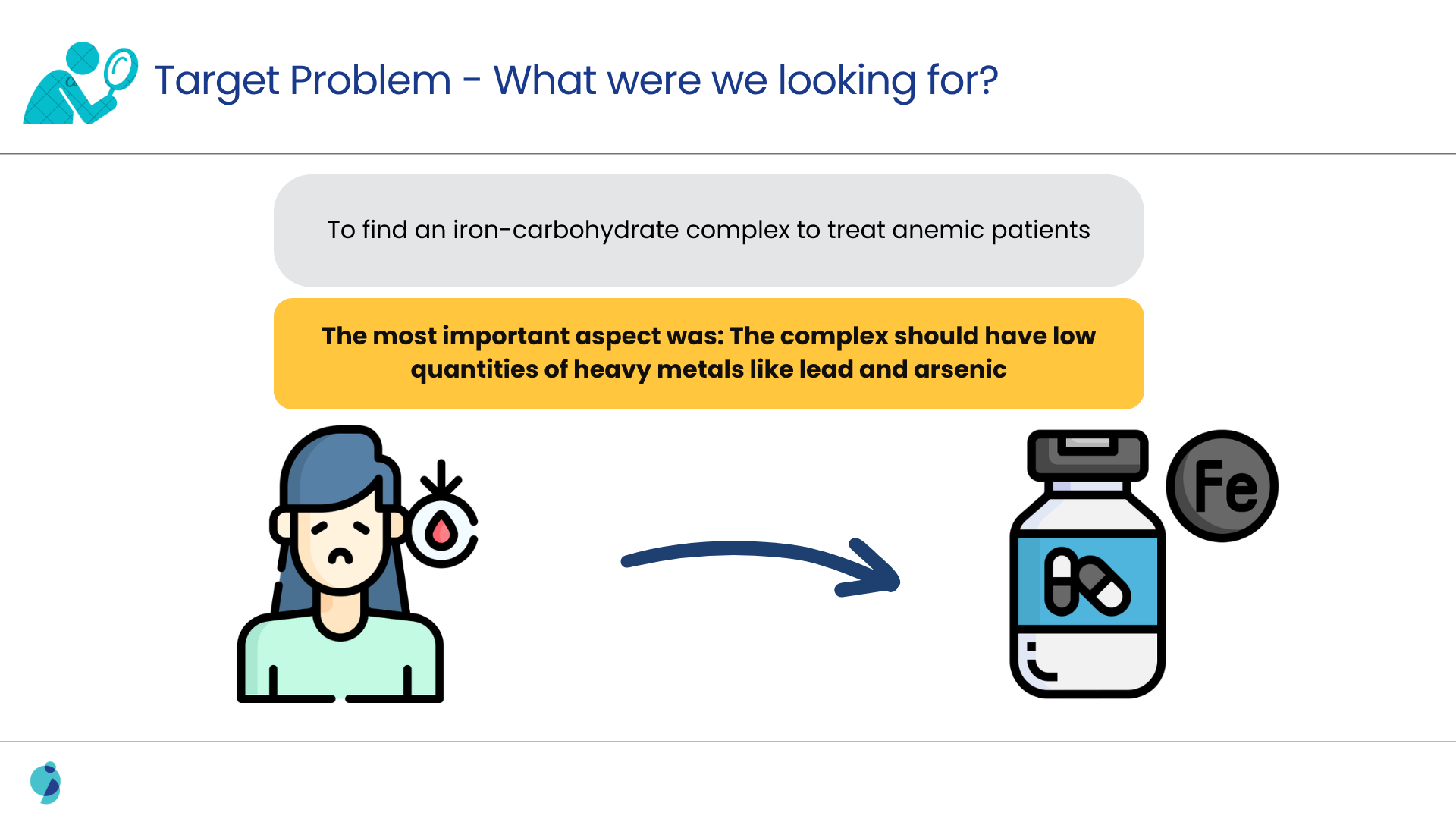
The target patent concerned an iron-carbohydrate complex for treating patients with anemia. A critical aspect of the claim was that the complex contained low quantities of heavy-metal impurities, particularly lead and arsenic.
The initial patent literature presented several challenges. Many references disclosed iron compositions and specified limits for total heavy-metal content. However, those general limits did not necessarily establish the individual concentrations of lead and arsenic.
Other technical and regulatory sources disclosed acceptable limits for lead and arsenic in dietary or pharmaceutical contexts. However, they did not describe those impurity levels in the claimed iron-carbohydrate complex. These references therefore addressed the numerical ranges but lacked the required product.
The closest composition reference disclosed an iron complex containing both lead and arsenic. Nevertheless, its reported lead concentration exceeded the amount required by the target claim. It therefore did not provide a complete disclosure.
The search consequently faced three recurring gaps:
- References describing the iron complex but not separately reporting lead and arsenic;
- References reporting suitable lead and arsenic limits but not applying them to an iron complex; and
- References disclosing the relevant impurities in an iron complex but at concentrations outside the required range.


Solution Offered
The research expanded beyond a conventional composition search to examine preparation processes, related patent families, foreign-language records, citations, and historical proceedings involving technically similar iron complexes.
The review of an earlier patent proceeding revealed an important technical argument: where substantially the same preparation process is used, the resulting composition may be expected to contain similar impurity levels. The proceeding also identified a reference describing a preparation route comparable to that of the target patent.
This shifted the assessment toward references disclosing not only the final iron composition but also the process used to prepare it. A similar production method could provide relevant support for the resulting impurity profile, even where the impurities were not emphasized in the abstract or principal claims.
Further review of related family records and citations led to a foreign-language patent describing a method for preparing an iron complex intended to treat iron deficiency. The reference included experimental samples and analytical data showing:
- Lead below the relevant threshold; and
- No detectable arsenic.
This reference directly connected the therapeutic iron complex with the required low-impurity characteristics, addressing the central gap left by the earlier search results.
The client ultimately received:
- A prior-art reference covering an iron complex for treating iron deficiency;
- Experimental evidence of lead below the required limit;
- Analytical evidence showing no detectable arsenic;
- A preparation-process disclosure relevant to the claimed composition;
- Supporting context from related patent proceedings and family citations; and
- A consolidated basis for challenging the claimed low-impurity iron-carbohydrate complex.
The result demonstrated that composition prior art may be hidden in experimental tables, preparation examples, family citations, or historical patent proceedings rather than in the title, abstract, or claims of the closest reference.
Get the full case study to discover how an overlooked foreign-language patent supplied the missing impurity disclosure for an iron-carbohydrate complex