


AOMedia finalized the AV2 1.0.0 specification on May 29, 2026. A patent acquisition covering AV2 closed ten days before that finalization date. Sauvegarder Investment Management, an IP monetization firm, bought 126 video codec patent assets from Alibaba on May 19, 2026, covering AV1, AV2, and VCM technologies, and framed the deal around what it called generational leaps in the video coding space. An aggregator does not commit capital to a standard’s patent value before that standard is even final unless it already has a strong read on where the licensing money is going.
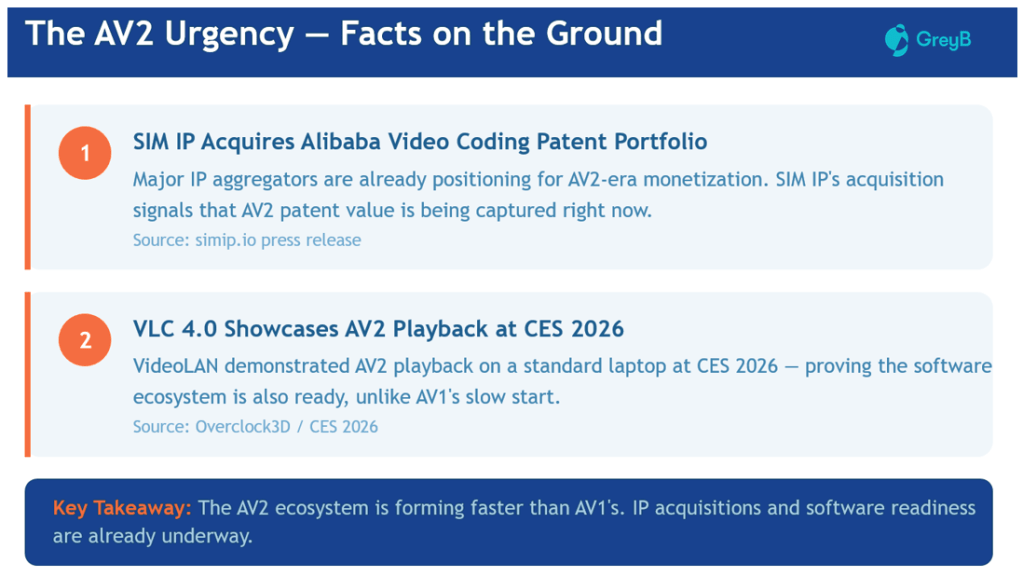
The pool side of the market moved just as early. Sisvel, which built the AV1 patent pool around 21 innovators and reached roughly half of the AV1 finished-product market, has stated it is preparing a follow-on AV2 pool using the same due-diligence process that shaped its AV1 program. On the adoption side, an AOMedia member survey found that 53 percent of respondents plan to adopt AV2 within 12 months of finalization and 88 percent within two years, and VideoLAN had a working AV2 decoder demonstrated at CES 2026 months before the spec was finalized. None of this happened for AV1 on the same timeline. The infrastructure, encoder libraries, decoder pipelines, and hardware acceleration built for AV1 already exist, and AV2 is landing directly on top of it.
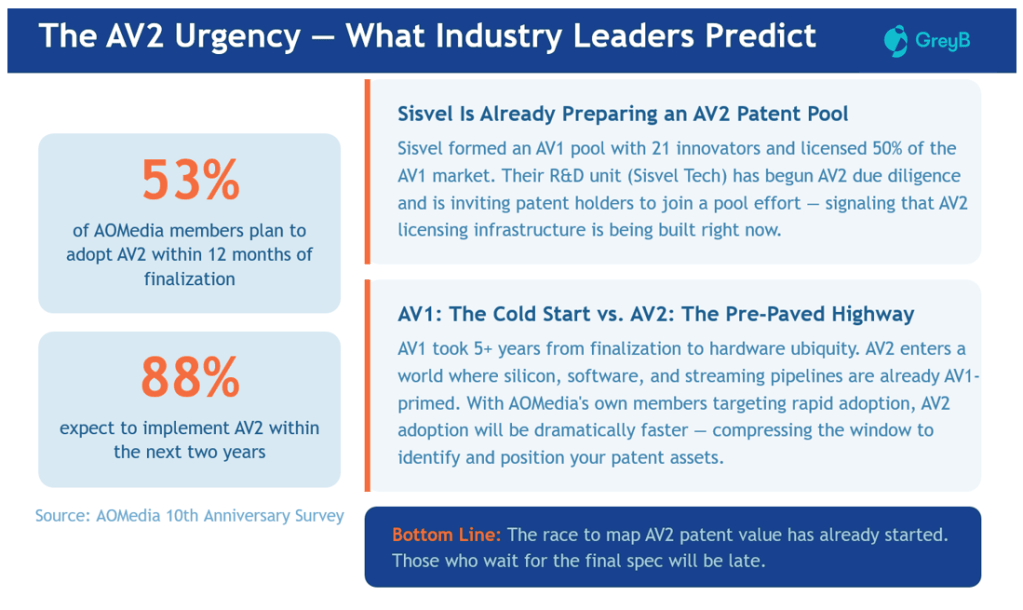
That compressed timeline changes who needs to move first. A video codec patent holder that waits for licensing disputes to clarify AV2’s essential patent landscape will be reacting to a market that has already been pricing this standard for months.
Register to get the webinar recording on: Mapping AV2: Finding Standard Essential Patents Before the Market Prices Them First
216 Families, 157 Also Reading on VVC: What a Portfolio Overlap Check Found
AV2 is not a codec built from a blank page. It carries forward substantial technical ground from HEVC and VVC, implemented through different syntax and different parameter names but built on the same underlying algorithms, and patent claims are written around those algorithms rather than around standard-specific terminology.
A portfolio overlap check applied that logic to a real video codec portfolio, working across all patent families alive and granted under CPC class H04N19. Out of that portfolio, 216 patent families showed meaningful potential overlap with AV2. Of those 216 families, 157 also overlapped with VVC, putting 73 percent of the AV2-relevant set inside an existing VVC position. Fifty-eight families overlapped with HEVC and 39 with AV1. Only 40 families overlapped with AV2 alone, with no VVC, HEVC, or AV1 connection at all, the highest-purity AV2-only assets in the set.
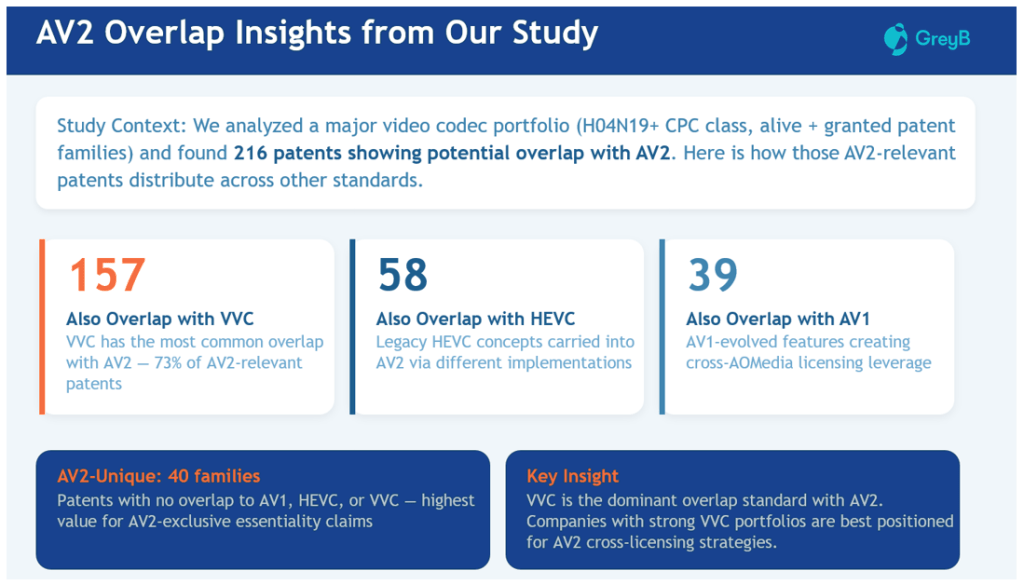
The concentration held a clear pattern by technical area. Prediction-related claims, covering inter prediction, intra prediction, and chroma-from-luma prediction, accounted for 107 of the 216 families, roughly half the set, consistent with prediction being where most of AV2’s compression efficiency gains originate. High-level syntax followed at 43 families. Partitioning carried the smallest family count but the highest concentration of high-confidence essentiality flags, at 42 percent.

A strong VVC or HEVC portfolio, on this evidence, is a strong candidate for undeclared AV2 exposure before a single new patent gets filed. The exercise is not about generating new IP, but about locating AV2 value that a VVC or HEVC-labeled portfolio is already holding.
AI Screening Plus Claim-Level Mapping Separates Real SEPs From Overlap Candidates
Two hundred and sixteen overlap candidates is a useful starting list, but overlap is not the same as essentiality, and a portfolio review that stops at overlap risks overstating its own position.
An AI-based screening pass runs first, evaluating each candidate patent’s claims against the AV2 specification and returning a high, medium, or low essentiality likelihood score. That step produces a prioritized shortlist without requiring an expert to work through hundreds of patents from a cold start. Every candidate that clears the AI threshold then goes to a codec expert for claim-by-claim mapping against the specification text, and that manual step is not optional. AV2 renames concepts relative to prior standards, so a patent describing a downsampling filter selection process has to be recognized against AV2’s own label for the same mechanism, something a keyword search will not catch. Keyword-only approaches are estimated to miss 30 to 40 percent of relevant patents that a trained analyst would identify through direct technical understanding of the specification.
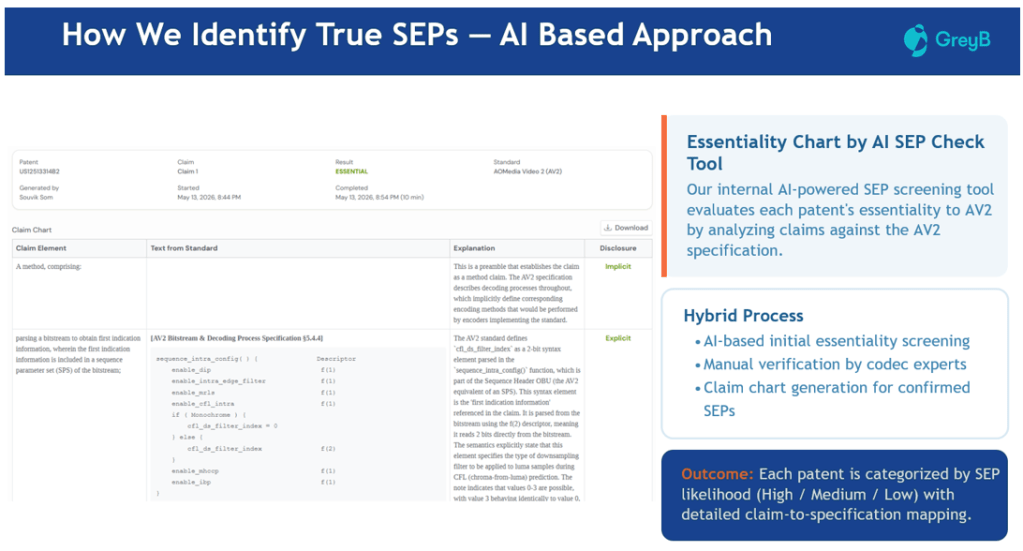
One claim mapping example makes the gap concrete. A patent titled “chroma block prediction method and device” describes a configuration value carried early in the bitstream that directs a decoder to one of several predetermined filters, each tied to a different chroma sample position. AV2 implements the identical underlying process under different terminology. Walked element by element, from the initial bitstream signal through filter selection logic, chroma sample positioning, and prediction output, every claim element maps to a defined section of the AV2 specification. That output is a documented, element-by-element claim chart tied to specification language, not a similarity score or a keyword match, and that documentation is what makes an essentiality finding usable in a licensing conversation rather than a research note.

Portfolio Strength Changes the Pool-Versus-Bilateral Decision, Not the Other Way Around
Whether to join a prospective AV2 pool or hold out for bilateral licensing is a portfolio-specific decision shaped by risk appetite and commercial goals, not a standard playbook answer. What does not change by portfolio is the prerequisite: knowing SEP quality and count before the decision gets made.
Entering a pool negotiation with two strong SEPs is a different proposition than entering with 20, and knowing a bilateral position rests on 10 high-confidence SEPs rather than an undifferentiated declared count changes how that negotiation gets approached from the first conversation. The broader 2026 video codec landscape work shows the same pattern playing out across VVC, where portfolio depth and claim quality, not raw patent counts, are what separate companies positioned to shape licensing terms from companies reacting to them.
Three groups carry the most exposure to this gap right now. Holders of large HEVC or VVC portfolios have the clearest overlap path into AV2, given that VVC showed the highest overlap concentration in the sample above. Existing HEVC or VVC licensors are positioned to extend that licensing relationship into AV2 rather than negotiate a separate one from scratch. IP aggregators and NPEs, having already watched the early AV1 period play out, are moving early because first-mover identification of high-value SEPs sets the terms for everyone who comes after.
The Portfolio Review That Should Happen Before the First AV2 Licensing Dispute
An AV2 essentiality position built after litigation starts is a defensive one. An AV2 essentiality position built now, while the standard has just been finalized and the pool landscape is still forming, is a position that shapes the terms other parties have to negotiate around. GreyB’s SEP Analysis work applies this same claim-level mapping process to video codecs and other standards for portfolios that need that position established before the next licensing conversation, not during it.
The same overlap logic that surfaced 216 AV2-relevant families in the sample portfolio above, along with the AI-screening and claim-mapping process that separated genuine SEPs from overlap candidates, is covered in the webinar recording, Mapping AV2: Finding Standard Essential Patents Before the Market Prices Them First.
For a closer look at where that overlap concentrates across the wider video codec landscape, including the VVC and HEVC families most likely to carry AV2 value, the AV2 Landscape Report breaks down the family-level data behind this analysis.