




A licensor walks into a Cat-M1 negotiation citing 2,000 declared LTE families. The implementer across the table does not dispute the number. Instead, they ask a different question: how many of those families cover features does a smart meter actually use?
That question is the new negotiation. And most licensors are not ready to answer it.
The Declared LTE Pool Is Three Times Larger Than the LTE-M Implementation Envelope
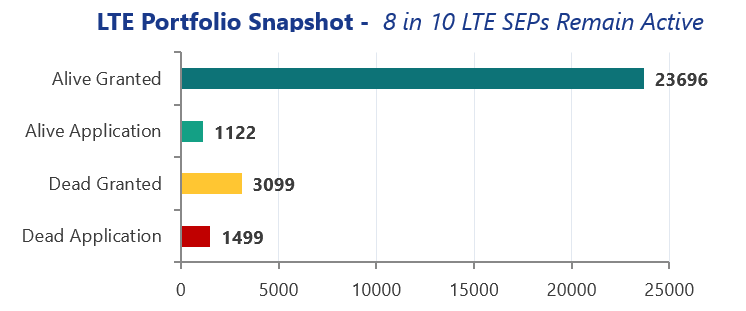
The ETSI IPR database records 29,416 declared LTE patent families as of March 2026. Approximately 80 percent, 23,696 families, carry at least one alive-granted member across at least one jurisdiction. The pool has commercial weight. It is enforceable. And for IoT licensing, it is largely the wrong unit of analysis.
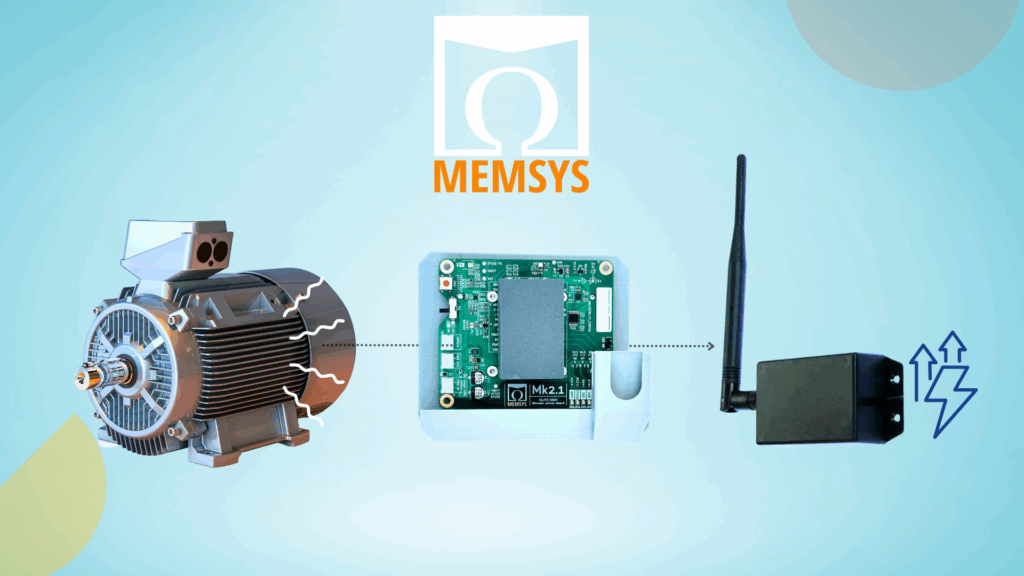
LTE-M devices, smart meters, asset trackers, industrial sensors, and connected health wearables do not implement the full LTE feature set. They operate within a constrained technical envelope: maximum 1 Mbps downlink, a single receive antenna, 1.4 MHz narrowband operation, half-duplex FDD, and low-power procedures including PSM and eDRX. The gap between what LTE declares and what LTE-M devices deploy is not minor. Feature-level analysis of the 29,416-family pool shows that only 56 percent of declared LTE families appear relevant to LTE-M implementations at all. The remaining 44 percent maps to features outside the Cat-M1 capability envelope entirely.
Within that 56 percent, the separation matters further. Foundational families, those covering features mandatory for LTE-M compliant operation, account for 32 percent of the total declared pool. Optional families, relevant to some deployments but not universally implemented, account for 24 percent.
A licensor holding 2,000 declared LTE families, therefore, enters a Cat-M1 negotiation with roughly 640 foundational assets before any quality or jurisdictional filtering begins. The implementer’s question is not unfair. It is arithmetically correct.

ETSI Declarations Were Never Designed to Sort by Device Category
The structural problem is not a bad-faith declaration. It is that ETSI’s IPR database was built to record essentiality claims against standards, not against device categories. A patent declared against TS 36.331 may cover RRC signaling that every LTE-M device must implement. Another patent declared against the same specification may cover carrier aggregation procedures that Cat-M1 devices never execute. Both entries appear identically in the database. Neither carries a flag distinguishing foundational LTE-M relevance from full-LTE-only applicability.
This creates the asymmetry that implementers are now exploiting. When a licensee asks whether a portfolio is relevant to their specific device, the declaration database cannot answer. The licensor who relies on that database and leads with total family count has already ceded the evidentiary high ground. As one practitioner observation captured in recent licensing commentary notes, when licensors cannot demonstrate transparency in mapping declared assets to implemented features, implementers have standing to contest FRAND validity on proportionality grounds.
The three questions that implementers are now posing in Cat-M1 discussions encode this shift directly: why should full LTE rates apply to a device implementing only a subset of LTE; which licensors actually contribute to LTE-M functionality rather than LTE generally; and are all portfolios equally relevant once the device lens is applied? The third question is the most consequential. Portfolios that look comparable at the declaration level diverge sharply once carrier aggregation, MIMO, 256-QAM, and URLLC features are removed from scope.
“Portfolio size gets attention and may open the conversation, but when an implementer asks for proof, relevance closes it. A licensor with 500 foundational LTE-M families carries more defensible leverage than one with 2,000 broadly declared assets that don’t survive device-level scrutiny.” — Aman Kumar, IP Consulting, GreyB.
Foundational Coverage Is Concentrated in Release 8, Not Release 13
The counterintuitive finding in the data concerns release attribution. Release 13 is where eMTC was standardized, and it contributes 788 foundational families to the LTE-M relevant pool. That is a commercially meaningful number. It is also dwarfed by what Release 8 contributes: 6,965 foundational families.
The reason is architectural. LTE-M does not replace the LTE baseline. It operates on top of it. The procedures an LTE-M device relies on for network discovery, attachment, authentication, paging, and basic data transfer were defined in the earliest LTE release. Release 13 commercialized eMTC and introduced Cat-M1-specific enhancements. Release 8 built the foundation that those enhancements depend on.
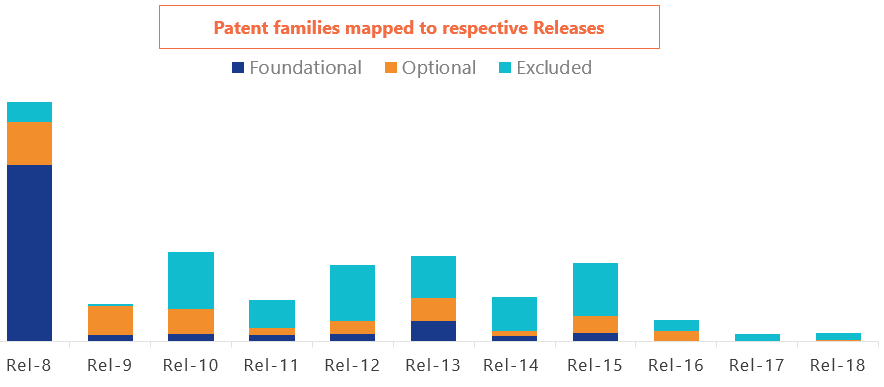
The licensing implication is two-directional. Licensors who focus exclusively on Release 13 assets as their LTE-M story are leaving the majority of their foundational coverage undefended. Their early LTE families may carry stronger Cat-M1 relevance than their later IoT-specific assets, simply because the core network and physical layer functions defined in Release 8 appear in every LTE-M device implementation.
Conversely, licensors who assume that all LTE Release 8 families are automatically relevant to LTE-M are overstating. A Release 8 patent covering carrier aggregation preparation procedures is still outside the Cat-M1 envelope regardless of its age.
The analytical unit is not the release date. It is the feature. The release date is a starting point for prioritization, not a substitute for mapping.
“The strongest foundational relevance in LTE-M sits in the basic LTE functions that allow devices to discover the network, attach, conserve power, and transfer data. A smart meter does not need the same throughput profile as a smartphone, but it absolutely needs reliable attachment, coverage, paging, and signaling. Those procedures trace back to Release 8, and they are where claim-level mapping produces the most defensible licensing position.” — Nripdeep Singh, Senior IP Analyst, GreyB
Ownership Concentration Narrows the Benchmark Set, but Relevance Still Decides Leverage
The foundational and optional LTE-M relevant pool is not evenly distributed across the industry. The top 10 assignees collectively hold approximately 62 percent of those families. Traditional telecom incumbents dominate, and Chinese entities hold a substantial share within the leading group. For licensing negotiations, this concentration defines the competitive context: licensors will be benchmarked against a small number of players, not against a diffuse field.
Jurisdictional spread does not alter this dynamic. Patent families in the relevant pool carry coverage across all three major enforcement jurisdictions. The US holds 23,209 families with foundational representation; EP covers 19,056; CN covers 21,581. The geographic profile is broad and roughly balanced. A strong foundational family is likely to carry actionable coverage in each major market.
But the jurisdictional data underscores rather than resolves the core challenge. A granted family in the United States, Europe, and China is a strong asset only if it maps to a feature the licensed device implements. Jurisdictional breadth is a multiplier applied to relevance. Applied to an excluded feature, it multiplies nothing.
The competitive question for any licensor entering a Cat-M1 negotiation is therefore not whether their portfolio is globally filed. It is what percentage of their foundational and optional families covers the features that the top-10 assignees are also asserting, and where their coverage is differentiated rather than overlapping.
The Methodology That Converts Portfolio Size into a Negotiation Position
Filtering 29,416 declared families to a defensible LTE-M subset requires a structured process, not a keyword search.
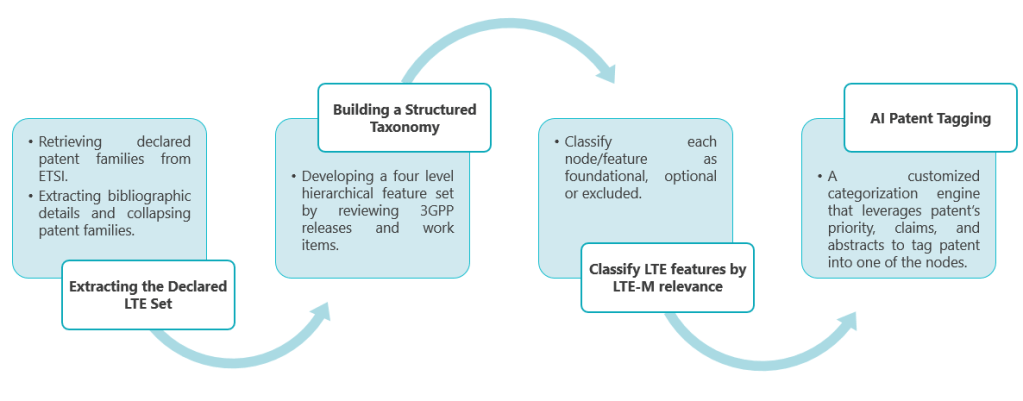
The taxonomy that underlies this analysis is built from 3GPP specifications, TS 36.331, 36.213, 36.211, 36.300, 36.212, and related documents, structured into a four-level hierarchy: domain, feature, sub-concept, and technical mechanism. Each node in that hierarchy is classified against Cat-M1 capability constraints: foundational if mandatory for compliant operation, optional if supported by a subset of deployments, excluded if outside the Cat-M1 envelope entirely.
The excluded category captures not only obvious exclusions like MIMO and carrier aggregation but also the important distinction between NB-IoT features and LTE-M features. Broad MTC references do not automatically imply LTE-M relevance. The taxonomy enforces specificity.
Patent tagging applies an AI-assisted engine that maps abstracts, independent claims, and priority context against taxonomy nodes, processing families in batches with SME validation at each iteration. The output is not a keyword-matched approximation. It is a relevance scorecard that separates foundational families from optional and excluded families at the claim level, benchmarks that scorecard against the declared pool, and produces the evidence package a licensing discussion requires.
For licensors, the output defines the subset of families that can survive implementer scrutiny and the feature coverage narrative that justifies the rate. For implementers, it provides the basis to test whether an asserted portfolio actually maps to their device’s implementation profile. For counsel, it directs essentiality review, claim charting, and validity analysis toward the assets that will carry the most weight in negotiations or disputes.
Five Questions That Determine Your Position Before the Next Meeting
Before entering any Cat-M1 licensing discussion, as licensor, implementer, or counsel, the following questions should have specific, data-backed answers:
- Of your declared LTE families, what percentage maps to LTE-M foundational features as classified against Cat-M1 capability constraints?
- Which technical domains carry your highest foundational density, core network and EPC, physical channels and reference signals, or RRC and radio resource management, and what does that profile imply for the device categories you are targeting?
- How does your foundational share compare to the top-10 assignees that collectively hold 62 percent of the relevant pool?
- Of your Release 8 families, how many map to LTE-M baseline procedures versus features that fall outside the Cat-M1 envelope?
- When a counterparty asks which families cover PSM, eDRX, MPDCCH, or narrowband reference signals, can you produce claim-level mapping in the meeting rather than promising to follow up?
If any of these questions does not have a ready answer, the negotiation begins with an information asymmetry that the implementer will use.
An LTE-M relevance scorecard, by patent family, identifies which assets in your declared LTE portfolio are foundational to Cat-M1 devices, optional, or outside the implementation envelope. This provides you with a defensible rate narrative and gives implementers a basis to evaluate asserted portfolios against their actual product.
Fill the form to receive your portfolio-level LTE-M relevance scorecard