
Sustainability-driven product claims are increasingly shaping competitive positioning in the packaging industry. As brands race to demonstrate circular credentials, “world-first” claims carry both immense marketing value and significant legal and reputational risk. A leading packaging board manufacturer had developed what it believed to be a genuinely novel product: a 100% recycled board coated with 100% chemically recycled polyethylene under a mass balance approach, backed by ISCC PLUS certification.
Before going to market with this claim, the client needed an independent, rigorous answer to a critical question: does this combination, in its entirety, already exist anywhere in the world? And if not, how safely and confidently can the “world-first” claim be made?
Existing market intelligence was fragmented, biased towards individual components, and lacked the structured threat mapping needed to make a defensible launch decision.
A standard competitive scan was insufficient
The conventional approach for projects like this focuses on identifying existing competitor products. However, since the client’s product was still in its pre-launch stage, competing innovations were unlikely to be openly marketed or publicly showcased.
Entities working on similar combinations tend to keep their developments low profile, and inter-company collaborations are rarely disclosed through websites or secondary sources. A standard competitive scan would therefore have been insufficient and potentially misleading.
Tracing the Value Chain Across Two Parallel Pillars
The “world-first” claim rests on two distinct but equally critical pillars: chemically recycled polyethylene and recycled paperboard, both combined in a single food-safe solution. A critical early insight shaped the entire methodology: no single entity in the market currently offers both together. This product sits at the intersection of two traditionally separate industries, the petrochemical and the paper industry, making it a unique bridge between the two.
Rather than waiting for a finished competing product to surface, GreyB traced each pillar independently across the value chain and identified where they could potentially converge. It is precisely at this convergence point, where a chemically recycled PE supplier meets a recycled paperboard manufacturer through a collaboration or partnership, that the real threat to the client’s claim lies.
GreyB mapped the value chain across two parallel tracks:
Track 1: The Chemically Recycled PE Pillar GreyB identified upcyclers and polyolefin manufacturers such as SABIC, INEOS, Borealis, and Braskem, focusing not just on who produces chemically recycled PE, but on which suppliers are actively exploring use cases involving food contact applications and paperboard coating. Direct outreach to these entities was also conducted to identify emerging use cases not previously captured in secondary sources.
Track 2: The Recycled Paperboard Pillar In parallel, GreyB identified recycled fiberboard and linerboard producers and assessed whether any are actively pursuing food-contact compliant applications in combination with recycled PE coatings.
Where the Two Tracks Meet The real differentiator was identifying where these two tracks intersect, meaning packaging converters, extrusion coating specialists, and brand owners who are sourcing from both sides of the value chain simultaneously. Companies like Tetra Pak and SIG, for instance, already work with chemically recycled PE but still rely on virgin board, placing them one step away from posing a full threat. Mapping these connecting points allowed GreyB to ensure that every player currently posing a threat, or with the potential to do so in the future, was captured, and that emerging competitive threats were identified well before they become publicly visible.
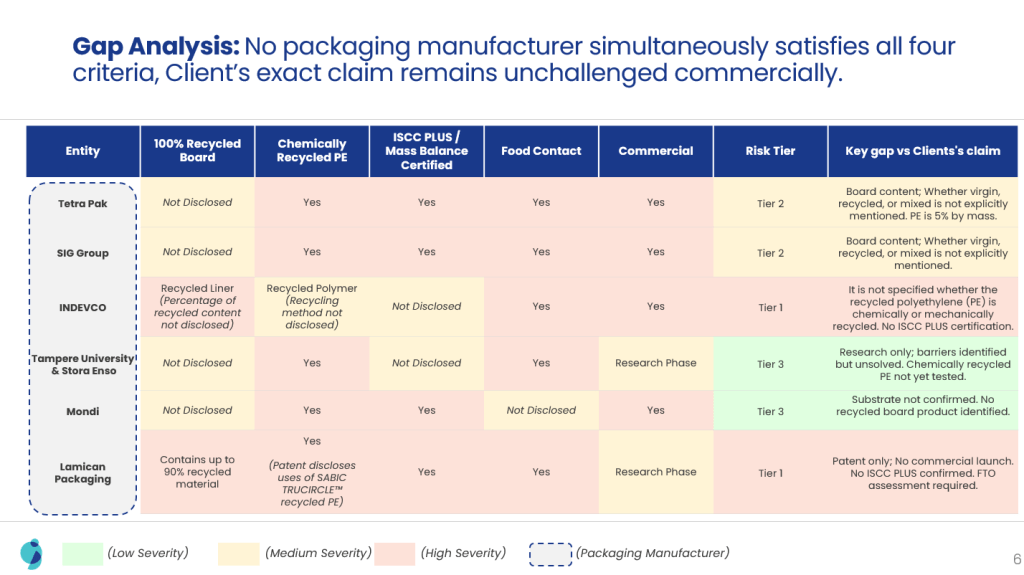
Each identified entity was assessed against the client’s four-component claim and assigned a risk tier:
Tier 1 (Highest Threat): Entities combining recycled board with recycled PE coating in any form. Two players were identified, one commercial and one at patent stage. The patent-stage player explicitly disclosed chemically recycled PE, naming SABIC TRUCIRCLE and INEOS as preferred suppliers, on a recycled fibre paper core for liquid food applications. This was the closest structural match found in the entire search.
Tier 2 (Moderate Threat): Entities using chemically recycled PE with ISCC PLUS certification on virgin or undisclosed board substrates, including global carton leaders who have proven the commercial feasibility of the PE coating component but fall short on the board substrate.
Tier 3 (Lower Threat): Entities with R&D-stage activity, PE-only roles, or missing certification, including academic research confirming that mechanically recycled PE faces unresolved extrusion coating challenges on paperboard. This indirectly validated the technical difficulty of replicating the client’s solution.
For each identified threat, GreyB assessed the severity level and provided recommended actions, including primary reach-outs required to confirm board composition for four key players before launch, and an IP Freedom to Operate assessment given the existence of the Tier 1 patent filing.
The “world-first” claim is safe but time-limited
No exact match exists commercially. Across all 10 entities screened, no single commercial product was found that simultaneously combines 100% recycled fibre board, chemically recycled PE coating, and ISCC PLUS mass balance certification for food-contact packaging.
The “world-first” claim is safe but time-limited. While the claim is currently defensible, the competitive landscape is active. PE suppliers with ISCC PLUS-certified circular PE are expanding capacity significantly, and at least one R&D project focused on chemically recycled PE on paperboard is concluding imminently. The window of uniqueness is real but not indefinite.
Partial overlaps are well-mapped and manageable. The two Tier 1 threats, one North American commercial player using mechanically recycled PCR PE on recycled linerboard without ISCC PLUS certification, and one Chinese patent application, both fall short of the full four-component claim. The gaps are specific, documented, and defensible.
An IP assessment is a prerequisite. The patent identified at Tier 1 explicitly names chemically recycled PE on recycled fibre board for liquid food applications. While no commercial launch has occurred, the patent’s existence means the client must complete a formal Freedom to Operate assessment prior to launch.
Primary reach-outs are needed to close residual uncertainty. For four players where board substrate composition remains undisclosed, GreyB identified targeted outreach as a necessary next step to fully close the validation loop before launch.
Validating the “World-First” Claim Through Global Product Gap Analysis
The study provided the client with the independent, structured evidence they needed to proceed with confidence. Instead of relying on fragmented industry knowledge or potentially biased supplier claims, the client now had a clear, tiered view of the global competitive landscape, with each threat assessed, gaps documented, and the path to a defensible “world-first” claim fully laid out.
The gap analysis confirmed that the client’s combined claim is not currently matched by any single commercial product globally. GreyB’s recommendation was to proceed with a qualified “world-first” claim, with an IP assessment running in parallel and targeted primary reach-outs completed before the official launch.
Beyond the immediate findings, the client recognized that polyolefin recyclers and upcyclers were just as relevant as any direct product competitor, and even identified an opportunity to pursue exclusive rights with one of these recyclers, further strengthening their first-mover position in Europe.
This methodology goes beyond conventional competitor mapping by recognizing that in a pre-launch innovation space, real threats are often invisible at the product level but traceable at the supply chain level. The framework developed here serves as a repeatable model for future claim validation engagements, particularly where the client’s product is novel, pre-launch, or operating in an emerging technology space.
Need to confirm market uniqueness before a high-stakes product launch? Connect with our experts today.