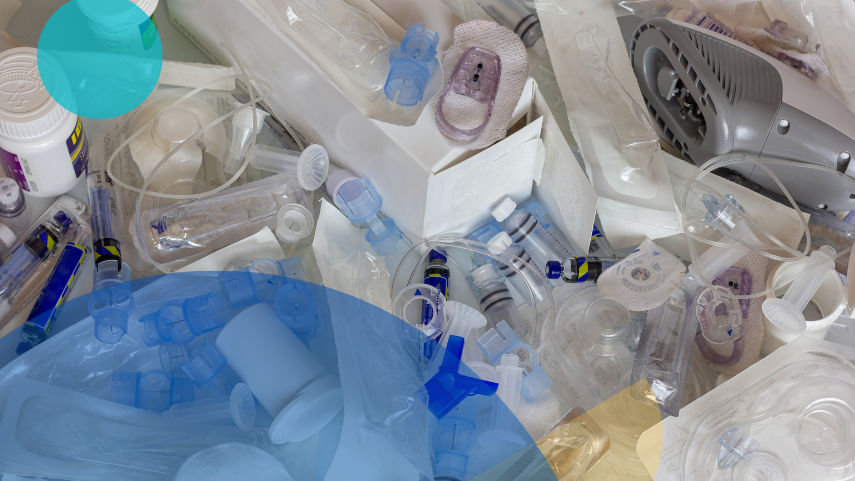
An industrial manufacturer generated large volumes of residual packaging during routine PET and PTA operations. This waste included plastic bags, such as liners with raffia sacks and bulk bags, along with metal and plastic drums and wooden pallets.
Much of this packaging was contaminated with hazardous chemical residues, including metal acetates, powder residues, glycols, and heat-transfer oils.
To meet compliance requirements, the company sent this packaging to certified disposal partners. This was a safe and legally sound approach, but it kept adding costs. The packaging had no clear route for reuse, recycling, or value recovery.
The client wanted to find a practical and repeatable solution. The goal was to reduce disposal costs, break even, or create value from the used packaging.
Framing the Problem around Economic Viability
The team looked at the challenge through a simple business lens. The goal wasn’t just to dispose of the contaminated packaging safely, but to see if the packaging could recover its own cost or create value.
GreyB tested two practical options:
- Sell the contaminated packaging directly to buyers who are certified to handle hazardous residues.
- Clean the packaging first and then sell it to buyers who would not accept contaminated material.
Both options were tested using one simple rule:
Resale value − total cost ≥ 0
Here, the total cost included cleaning, transportation, handling, and compliance-related expenses.
If the resale value was lower than the total cost, the option was not viable. This helped team focus on finding a value-creating route, instead of only improving disposal efficiency
Direct sale of residual packaging was not a viable option
First, the team tested the feasibility of the simpler pathway, the direct sale of contaminated packaging.
The team mapped potential buyers and checked whether they could handle such packaging. This showed that the problem was not a lack of demand. The real barriers were technical and regulatory.
- Hazardous contamination transfers liability, not just material. Buyers were unwilling to assume ownership without explicit authorization for specific contaminant classes.
- Contaminant specificity was rarely disclosed. While many entities claim to handle “chemical contamination,” few are prepared to accept powder-based residues or metal salts due to downstream processing and certification risk.
- Downstream acceptance criteria remain strict. Even where recyclers exist, contaminated packaging can compromise quality, certifications, or end-customer commitments.
So while resale value was almost zero, costs still remained. Therefore, the direct sale was not economically viable.
Focusing on formats where resale value was higher than the total cost
Once direct sales were ruled out, GreyB tested the second option: cleaning the packaging first, then selling it.
This option was only useful if cleaning could do two things:
- Remove the hazardous classification
- Increase the resale value enough to cover cleaning and other costs
The team assessed this pathway by packaging format rather than treating all materials uniformly:
- Metal and plastic drums
Established reconditioning ecosystems existed. Cleaning could remove residual oils and liquid contaminants, making the drums suitable for resale. This also opened access to buyers willing to pay for clean containers. - Plastic bags / bulk liners and wooden pallets
Commercial cleaning options were limited, especially when the packaging contained powder-based residues. Even when cleaning was technically possible, the resale value was often too low to cover the total cost.
This evaluation helped the client focus on packaging formats in which resale value could cover the total cost, rather than pursuing technically feasible but commercially impractical solutions.
Comparing vendors on operational, regulatory, and handling criteria
GreyB’s contribution was not limited to identifying vendors. The client was guided from uncertainty to resolution by:
- Validating buyer and service-provider claims through direct engagement
- Challenging contaminant-handling assumptions rather than accepting generic statements
- Comparing options side-by-side using a consistent economic condition
- Eliminating routes that could not meet break-even requirements early
The shortlisted options were compared side by side against operational, regulatory, and handling criteria.
The focus shifted from asking, “Who can take this packaging waste?” to “How can it create value for the business?”
This gave the client a more practical, evidence-based way forward, rather than continuing with a model that only added disposal costs.
Cleaning unlocked resale potential for selective packaging formats
The analysis gave the client a clear and practical way forward.
- Direct sale of contaminated packaging was not commercially viable
- Cleaning followed by resale was a workable pathway for selective packaging formats
The client also gained a repeatable decision framework to assess future packaging streams using the same economic logic.
Instead of forcing a single solution across all packaging formats, GreyB helped the client identify where value recovery was feasible. The final pathway aligned with regulatory requirements, operational limits, and commercial realities.
If you are evaluating viable pathways to create value from contaminated industrial packaging residual, connect with our experts today.
Schedule a Consultation With Our Experts Today
Get in touch by filling out the form below