




5G’s role in medicine is usually described through what it enables: continuous monitoring, faster image transfer, ambulances that reach a hospital already known to the care team. Less visible is the patent layer underneath those applications, and how far each part of that layer has already moved through licensing and litigation.
GreyB analyzed 29,336 5G and NR patents across six clusters that support medical 5G. The NR Sidelink and V2X technology, which enables connected ambulances, is the largest cluster by a significant margin, with 2,893 patents, 904 of which have already been implemented. Avanci’s 5G Vehicle program also includes this technology, licensed at $32 per vehicle, and it is part of a FRAND dispute revived by the UK Supreme Court in July 2026.
In contrast, RedCap, the technology supporting wearables and hospital-at-home monitoring, has the smallest patent base among the three device-facing clusters. However, as of 2026, industry reports indicate it is transitioning from pilot programs to commercial deployment, similar to the signals observed before V2X moved into pool licensing.
Key Takeaways
- Connected-ambulance connectivity has the deepest patent base of any cluster analyzed (2,893 patents, 904 implemented) and the most active 2026 licensing and litigation history in the dataset.
- Wearable and hospital-at-home connectivity (RedCap) holds the smallest patent base of the three device-facing clusters, but its 2026 maturity signals mirror V2X’s position roughly two years before pool licensing began.
- The gap between patent depth and licensing maturity across these six clusters is where a portfolio or FTO strategy should be built now, not after the next pool forms.
The Patent Base Behind Medical 5G Is Concentrated, Not Evenly Spread
The mapping of 5G and New Radio patents spans air-interface fundamentals, sidelink (V2X), positioning, ultra-reliable low-latency communication (URLLC), reduced-capability IoT devices, non-terrestrial networks, and edge computing. The distribution across these six clusters is far from even.
Figure 1. Patent volume by cluster. V2X/Sidelink holds nearly 3.5 times the volume of the smallest cluster, URLLC.
| Technology Area | Patents | Medical Relevance |
| NR Sidelink & V2X | 2,893 | Connected ambulances, emergency corridors |
| NR Positioning | 826 | Ambulance location, indoor asset tracking |
| NR IoT & Reduced Capability (RedCap) | 752 | Wearables, continuous patient monitoring |
| Edge Computing & Services | 562 | On-site AI, private hospital networks |
| Non-Terrestrial Networks (NTN) | 452 | Rural clinics, disaster and maritime care |
| URLLC & Time-Sensitive Communication | 417 | Remote robotic surgery, deterministic control |
| Total analyzed patents | 29,336 | — |
That concentration extends further once automotive relevance is factored in. Of the full dataset, 18,160 patents (61.9%) show strong automotive relevance, the domain that overlaps most directly with emergency medical transport.
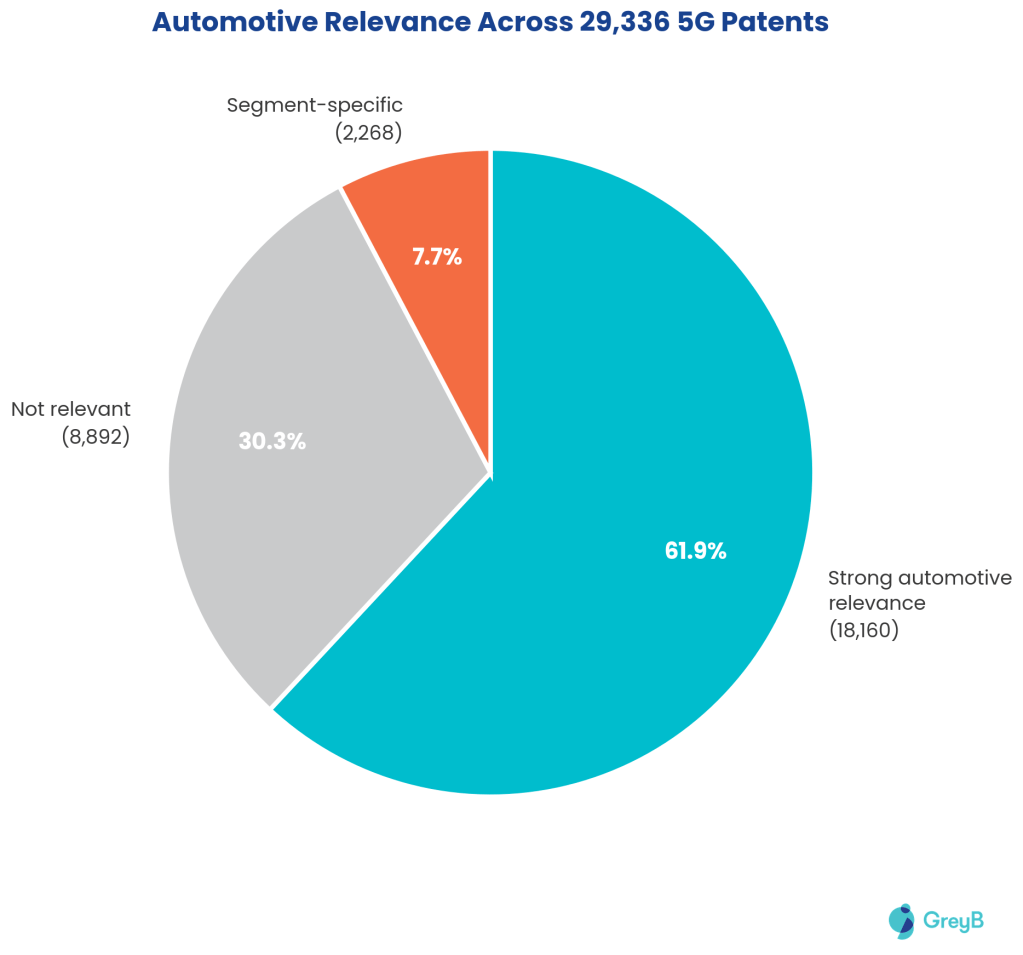
Figure 2. Automotive relevance across the full set of 29,336 analyzed 5G patents.
This healthcare-adjacent set maps onto what GreyB’s broader ownership research already treats as Pillar 2 of the 5G-Advanced patent landscape: sidelink/V2X, advanced positioning, and RedCap, the technologies built to make 5G-Advanced the connectivity backbone for automotive, industrial, and public-safety verticals. Healthcare is not a separate track. It rides on the same IP.
Access the 5G Advanced Patent landscape report below.
Connected Ambulances Are Where V2X Patents Meet the Road
The largest cluster of healthcare-related patents in the dataset pertains to the technology that transforms emergency vehicles into cooperative participants in both healthcare and road systems. This cluster includes 2,893 patents in NR Sidelink and V2X, almost all of which are classified as core automotive technology.
Of these, 904 patents have already been implemented in commercial systems.
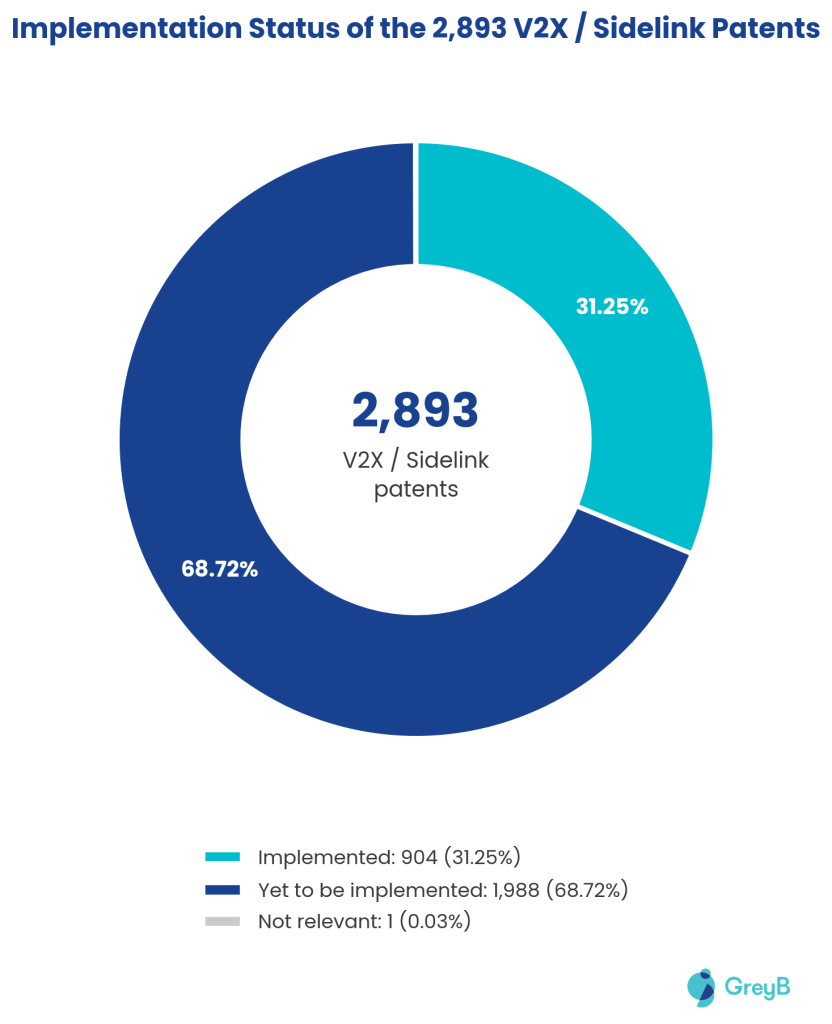
Figure 3. Roughly a third of the V2X/Sidelink cluster is already commercial. Most of the rest is still in early testing.
That evidence lines up with what is already operating in the field. Bharti Airtel built India’s first 5G-connected ambulance with Apollo Hospitals and Cisco, demonstrated in Bengaluru, and has since been referenced by GSMA as a connected-healthcare case study. The vehicle streams a patient’s full telemetry, including vitals, to the hospital’s command center in real time, and geolocation data lets the nearest ambulance be dispatched to preserve the golden hour. Apollo Hospitals has described connected ambulances as core to reducing mortality in emergency transport.
GSMA’s Connected Healthcare program has since folded that use case into its 2026 scaling agenda, listing connected ambulances alongside intelligent hospitals and hospital-at-home as applications healthcare systems are actively trying to take from pilot to scale rather than future possibilities.
Four specific capabilities explain why the V2X patent base runs deeper than basic telemetry streaming:
- Priority corridors and green-wave signaling. The ambulance broadcasts path and urgency over sidelink; traffic signals and nearby vehicles clear a lane using resource-allocation and sensing features covered by hundreds of the V2X patents.
- Relative positioning and collision avoidance. Continuous exchange of location, speed, and heading with roadside units, drawing on both V2X and the 826 positioning patents, supports higher safe speeds in dense traffic.
- Multi-vehicle coordination. A second ambulance, police escort, or organ-transport vehicle can form a coordinated group using inter-UE coordination and sidelink DRX patents.
- Coverage fallback. Sidelink keeps nearby-vehicle communication alive when the ambulance leaves cellular coverage, a safety net for rural or underground routes.
2,893 V2X patents. 904 already implemented. Connected ambulances are now named as a live use case in 2026 healthcare-scaling programs. Together, emergency transport is the clearest pathway through which automotive 5G IP is crossing into healthcare infrastructure, and it has the deepest patent base of the six clusters analyzed.
Also Read:

Ambulances show what happens when a mature, heavily implemented cluster meets an obvious use case. RedCap tells a different story: a smaller cluster, still early in its standards life, whose relevance is arriving ahead of its patent count.
RedCap’s Patent Count Understates Its Healthcare Relevance
RedCap has the third-largest cluster in the dataset, with 752 patents, ranking behind V2X and 5G. In 2024, 3GPP finalized the Release 18 specification, marking the first 5G-Advanced release. RedCap, which was introduced in Release 17, received enhancements in Release 18 as eRedCap. These improvements focus on simplifying devices and extending battery life, specifically to meet healthcare needs for wearables and distributed monitoring. eRedCap offers lower complexity, lower costs, and longer battery life than full 5G NR. Release 19 continues this evolution as a bridge to 6G, advancing RedCap and related IoT features based on commercial deployment needs.
The filing activity supports this upward trend. GreyB’s research on 5G-Advanced technologies, which will shape licensing in 2026, shows that RedCap filings increased from 274 in 2020 to 307 in 2021, as companies like Qualcomm, Ericsson, and Xiaomi secured foundational radio design and signaling IP following the standardization of Release 17. This momentum has continued to build through Release 18 and into Release 19.
Simultaneously, demand for these technologies is rising. At MWC Barcelona 2026, Singapore’s National University Health System showcased 5G-enabled hospital-at-home applications. This demonstration was part of a strategic partnership with GSMA Foundry, Ericsson, and Singtel to transition remote surgical assistance, XR training, robotics, and hospital-at-home models from pilot phases to live deployment. The hospital-at-home concept and continuous low-power monitoring are precisely the use cases that eRedCap was designed to support.
RedCap’s 752 patents are the smallest of the three device-facing clusters after V2X and positioning, but the technology addresses the cost, complexity, and power constraints that have limited full 5G adoption in wearables. As care shifts from hospital wards to homes, low-complexity 5G devices could become a more commercially significant healthcare IP layer than their patent volume alone suggests.
Wearables and hospital-at-home monitoring only work if the hospital behind them can process what those devices send. That is where edge computing and private 5G take over.
Private 5G Is Becoming the Infrastructure Layer for Hospital AI
Treating hospital connectivity and hospital AI as separate topics no longer matches how the market is building. The 562 edge-computing patents in the dataset sit underneath that convergence.
The clearest evidence comes from a ZTE and China Telecom deployment named “Relieving the Pressure on Physicians,” which combines a medical large language model with secure 5G-enabled infrastructure to automatically generate checkup reports. Early results at Shanghai Tenth People’s Hospital show a tenfold increase in daily report output and a 70% reduction in manual workload. The solution won both the Cross-Cutting Excellence Award and the GSMA Foundry Innovation GLOMO Award at the 2026 GSMA Foundry ceremony and is scheduled to scale across Chinese hospitals through the rest of the year.
Singapore’s NUHS offers a second, differently shaped example. Its private 5G deployment uses a network slice to guarantee bandwidth to clinicians, backed by 19 5G radio units across 10 operating theatres and three in-patient wards, with 40 staff trained on mixed-reality and holographic 3D imaging. The GSMA-NUHS partnership frames private 5G explicitly as infrastructure for digital twins, XR, IoT devices and ambient AI, not connectivity as an end in itself.
Private 5G’s commercial story in healthcare has moved past faster hospital Wi-Fi. It is now the network layer that makes on-premises AI, robotics, and XR viable inside a hospital, and the 562 edge-computing patents in the dataset represent the IP base underneath that shift.
Note: edge processing enables local data handling. It does not, on its own, guarantee that patient data never leaves the hospital campus. Architecture, governance, and configuration determine that outcome, and the published version should say so rather than asserting it as automatic.
Also Read:

Edge infrastructure and RedCap devices solve the data problem. What they don’t solve is the dataset’s highest-stakes use case: keeping a surgical robot’s control loop reliable enough to operate on a patient from another city.
Remote Surgery Is the Highest-Stakes Use Case and the Least Mature
URLLC and time-sensitive communication account for 417 patents, the smallest of the six clusters, and the healthcare use case with the highest regulatory and clinical bar to clear.
Ultra-reliable low-latency links can keep a robotic surgery control loop tight enough for precise instrument movement and force feedback. On their own, they cannot establish clinical readiness. Distance-independent surgery remains constrained by clinical regulation, redundancy requirements, equipment certification, local surgical support, and jurisdiction, not solely by network performance. The published version should frame 5G’s role as providing the connectivity characteristics remote surgery requires when paired with the right device, edge, and clinical architecture, rather than claiming that distance no longer limits who can operate.
The same caution applies to diagnostic video consultation: network quality supports the exam. It does not, by itself, establish diagnostic confidence.
Six clusters, six different maturity levels. The question that actually matters for an IP or licensing team is what to do with that spread.
Where the Next Filing and Licensing Signals Will Show Up
- Assignee concentration within each cluster, and whether V2X and RedCap ownership is concentrated among a small number of filers.
- Release 18 versus Release 19 filing activity, to see whether RedCap and edge-computing IP is accelerating or plateauing.
- Portfolios that cross V2X, RedCap, and healthcare-tagged patents, since those crossover holders are best positioned as connected-ambulance and hospital-at-home deployments scale.
- Declared SEP overlap within the V2X and RedCap clusters, and whether implementation concentration among a small number of owners signals emerging licensing leverage.
- Filing momentum around 5G-Advanced healthcare-enabling features (eRedCap, positioning enhancements, edge-AI integration) heading into Release 19 commercialization.
5G SEP Dashboard: Run this exact concentration question against 20,000+ manually reviewed 5G SEP families, flagged for litigation exposure, licensing-program participation, and recent ownership changes.
Conclusion
As digital health moves from individual deployments toward connected ecosystems, companies will need visibility into how patent ownership is distributed across critical 5G-Advanced technologies, where licensing leverage may emerge, and which organizations are shaping the standards that will support future healthcare infrastructure.
GreyB’s 5G-Advanced Ownership Report maps the patent ownership landscape across emerging 5G-Advanced technologies, including V2X, positioning, RedCap, and other technologies expected to influence the next generation of connected systems.
Explore the 5G-Advanced Ownership Report to understand which organizations are building the IP foundation behind the technologies shaping future digital health and connected industries.