




With over 100,000 patent families declared essential to 5G standards and 21 companies holding portfolios exceeding 1,000 SEPs each, the instinct heading into licensing negotiations is to lead with scale. Declared family count. ETSI share. Portfolio rank by volume.
The assumption is that the number carries the leverage. But, in a growing share of 5G licensing negotiations in automotive and IoT, implementation-adjusted portfolio strength, not declared count, is determining which licensor controls the framing of the discussion.
A company with 963 declared families and 22.1% foundational patent share is currently outperforming a holder with 4,709 declared families and 18.1% foundational patent share across all measured verticals: network infrastructure, automotive, satellite, and smartphone. The declared count is four times larger. The negotiating position is not.
The reason is structural. Implementers in automotive and IoT now routinely arrive at licensing discussions having already mapped which features in the asserted portfolio are present in their products and which are not. When that analysis has been done on one side of the table but not the other, the licensor’s declared count becomes the opening number the implementer reduces, rather than the rate the licensor defends. The licensor enters with 4,000 families. The discussion begins at 50.
Watch the complete webinar discussion on this analysis here:
This article draws on that analysis to set out what implementation-adjusted portfolio assessment looks like in practice, why the underlying data has not existed until now, and what a licensing position built on deployment reality rather than declaration volume enables in automotive and IoT negotiations where royalty norms are still being set.
What 100,000 Declared Families Actually Means
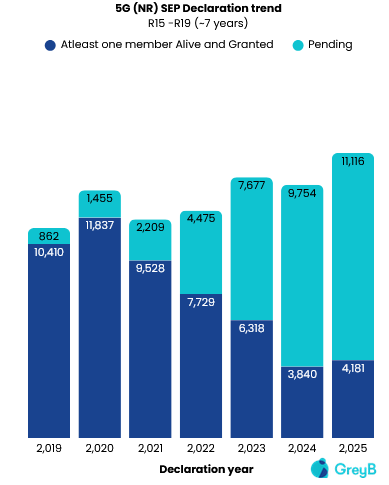
Since around 2019, declarations to ETSI have grown from roughly 20,000 to 25,000 to over 100,000 patent families. For any 5G implementer, whether an automotive OEM, an IoT device manufacturer, or a smartphone maker, this creates a royalty stacking problem that is real and growing. Multiple licensing demands arrive from multiple holders, all asserting against the same product.
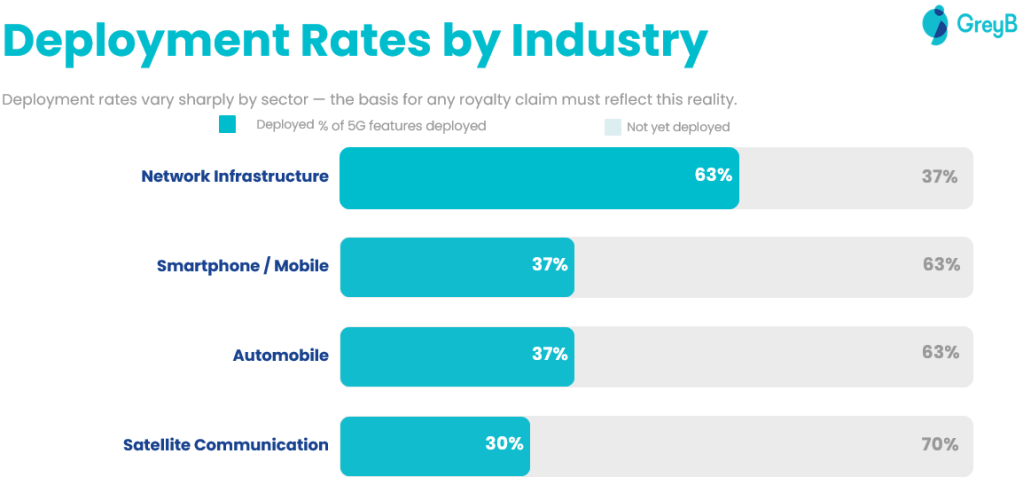
But the declared count does not reflect deployment reality. A declaration to a standard body is a legal commitment to license on FRAND terms. It is not proof that the feature the patent covers is present in any commercial product. ETSI keeps track of these declarations but does not monitor actual deployments. This gap between declarations and deployments is where many licensors are currently facing challenges; they may not even realize they are losing ground. Among the 300-plus features defined in 3GPP Releases 15 through 18, the deployment in commercial products reveals significant discrepancies.
A licensing demand structured around declared count treats all 100,000 families as equally relevant to a connected vehicle or an IoT module.
Also Read:

“The declaration is a legal commitment, not a deployment confirmation. When a licensor walks into a negotiation anchored to their ETSI share, the first thing a prepared licensee does is challenge essentiality. The second is challenge implementation. If you cannot answer both, your effective portfolio shrinks in the room, and it shrinks on someone else’s terms.” — Subham Roy, GreyB
Why This Data Has Not Existed Until Now
The absence of implementation mapping in licensing negotiations is not due to a lack of interest. It is structural, and the barriers are specific.

That last point is the most consequential. Without a taxonomy, there is no framework. Without a framework, implementation mapping is qualitative at best. A qualitative argument against a quantitative demand loses in the room, even when the underlying technical reality supports it.
GreyB’s 5G feature taxonomy now covers over 300 features across Releases 15 through 18, built from 3GPP technical reports, RAN meeting work items, and successive release-level analysis. It is the infrastructure that makes implementation-adjusted licensing arguments possible to construct and defensible to present.
The Feature That Makes a Portfolio Strong Is Not the One You Expect
Out of the 300-plus features in the 5G standard, ~16% are foundational. Not the most sophisticated. Not the most recently standardized. The most universal.
A foundational feature is one that every 5G device must implement to achieve basic connectivity, regardless of vertical, use case, chipset generation, or regional configuration. Waveform technologies, channel coding schemes including LDPC and polar codes, and numerology-related functions are the substrate on which every other 5G capability is built. A vehicle implementing V2X uses them. An IoT sensor uses them. A satellite terminal uses them. A smartphone uses them.
Also Read:

The licensing implication is direct. A patent covering a foundational feature is not a smartphone patent or an automotive patent. It is a 5G patent. Its royalty reach extends across every vertical simultaneously, without requiring the licensor to run separate campaigns against separate implementer categories. One family. Multiple revenue streams. Across every sector where 5G is deployed.
This is where the counterintuitive result in the data becomes visible.
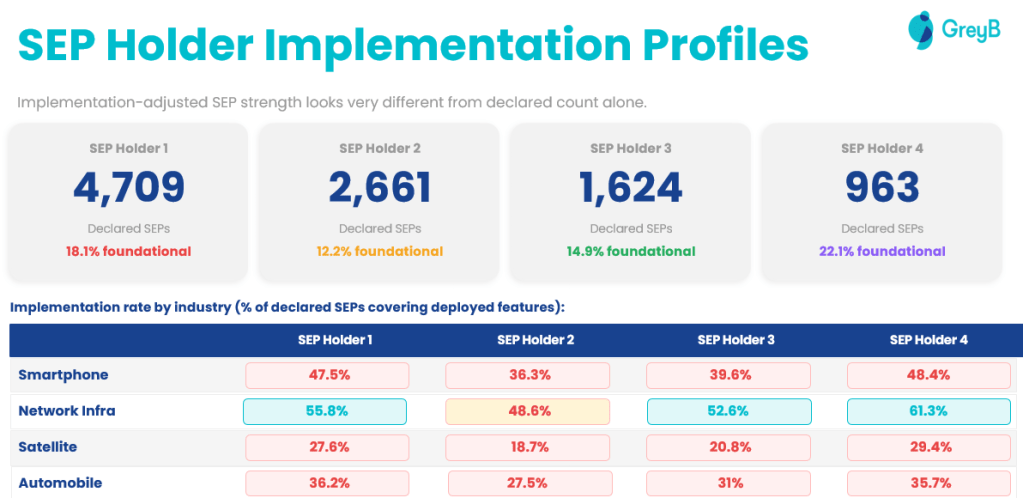
Smaller declared count. Higher foundational share. Better implementation rates across every vertical are measured.
“Building a larger portfolio should not be the goal. Building a portfolio that is actually implemented across verticals, one that holds patents in foundational technologies, is where the real licensing revenue compounds. A single foundational family licensed universally across automotive, IoT, and network infrastructure outperforms five low-implementation families in every commercial scenario we have modeled.” — Subham Roy, GreyB
Vertical Segmentation Is Not Optional
The automotive and IoT licensing markets are not extensions of the smartphone market. They are structurally different, with different deployment profiles, different chipset configurations, and different regulatory constraints. Treating them as equivalent produces the same outcome as leading with a declared count: it gives the implementer the argument.
A V2X-related patent family should not appear in a demand directed at a smartphone manufacturer. A Release 16 industrial automation feature has no claim against a basic IoT sensor. When an implementer can identify irrelevant families in an asserted portfolio, and in 2025, they reliably can, those families do not disappear quietly. They become evidence of an undisciplined assertion and lower the credibility of every other patent in the deck.
The segmentation that implementation data enables is precise. Network infrastructure implementers deploy 63% of 5G features and represent the highest-value licensing targets across most major portfolios. Automotive sits at 37% but is expanding, with royalty norms still in formation. The commercial logic of establishing early licensing positions is strongest in automotive and IoT precisely because the structures are not yet mature, unlike in smartphone markets, where norms are settled, and rates are harder to move. IoT and satellite represent emerging verticals where deployment currently sits at 30%, but where the trajectory of Release 18 features is accelerating faster than Releases 16 and 17 did at equivalent stages.
A licensor who knows which of their families map to which verticals can construct a demand that is difficult to challenge on scope. One who does not is presenting an undifferentiated stack that the implementer will systematically narrow on their behalf.
Release 18 Is Moving Faster Than Expected
Releases 16 and 17 showed patchy, uneven adoption. The features they introduced, covering industrial automation extensions, power efficiency enhancements, and intermediate V2X capabilities, optimized existing functionality rather than opening genuinely new market categories. Implementers absorbed them selectively, and licensing norms around them remain contested.
Release 18 is different in kind. Extended reality, non-terrestrial networks, ambient IoT, and integrated sensing and communication are not refinements of what Release 15 established. They address market categories that did not exist within the 5G framework before. The data clearly reflect this: Release 18 features are gaining commercial traction faster than their predecessors did at equivalent stages of the standardization cycle.
For licensors, this creates a specific, time-bound window. Licensing norms for Release 18 technologies have not yet been established. The precedents that will govern royalty rates, portfolio scope, and FRAND proportionality arguments in satellite and ambient IoT licensing are being set now, in bilateral negotiations that most implementers are not yet treating as seriously as they will need to. These technologies also bridge directly into what will become the 6G foundation. A licensor with early, defensible coverage in Release 18 is not just positioning for current licensing revenue. They are positioning for the next standardization cycle.
“The window to establish a Release 18 position before licensing norms calcify is present right now. These are the technologies that bridge 5G and 6G. A licensor with early coverage in ambient IoT or NTN today is building the portfolio that matters in the next decade of licensing, not just the current one.” Aman Kumar, GreyB
What a Defensible Opening Position Looks Like

A licensing demand anchored to declared count invites a specific response from a sophisticated implementer: challenge essentiality, challenge implementation, and drive the effective portfolio number down in the room. Every negotiation where a licensor opens with a raw declaration share follows the same sequence. The licensor enters with 4,000 families and leaves discussing 50.
The alternative is to perform that reduction yourself, in advance, and arrive with a position that has already absorbed the challenge.
That means leading with the foundational patent share rather than the declared count. It means presenting implementation coverage by vertical rather than an aggregate rate that averages across sectors where the portfolio is strong and sectors where it is not. It means identifying cross-vertical families, channel-coding patents, and waveform families that apply simultaneously to automotive, IoT, and network infrastructure, and pricing them to reflect that reach. And it means having a claim-level mapping that shows, for each family in the demand, exactly which feature in which product it covers.
This is not a defensive posture. It is an offensive one. An implementer cannot drive down a portfolio that the licensor has already scoped to its genuinely implemented core. The challenge that derails an undifferentiated declaration-based demand has no purchase against a position that has already done the work.
The Questions That Separate a Defensible Position from One That Is Not
Before any 5G licensing demand is presented in automotive, IoT, or any other vertical, a licensor should be able to answer five questions.
- What percentage of declared families cover the 51 foundational features that every 5G implementer must deploy?
- Which families map to features actually present in this implementer’s product category, by release and by vertical?
- What is the implementation-adjusted portfolio size after eliminating features not deployed in the target sector?
- How does foundational share compare to the other holders this implementer is negotiating with simultaneously?
- And what cross-vertical applicability does the portfolio carry beyond the primary target vertical?
These questions are the exact sequence a prepared implementer will work through from the other side of the table.
Most 5G portfolios have never been mapped against deployment reality. The foundational share number, which percentage of declared families covers, features every implementer in every vertical must use, is the single most actionable starting point for a licensing campaign that holds up under scrutiny.
Find out where yours stands with GreyB’s Patent Licensing Team