

A specialty chemicals manufacturer wanted to move a compound used in industrial B2B applications into consumer-facing B2C categories.
The company planned to use the compound with specific catalysts to produce an intermediate. This intermediate had properties that could support applications across several consumer markets. Before investing in commercialization, the client needed answers to two questions:
- Was the intermediate compound already being used in relevant applications?
- Which application areas could the company explore further?
The client needed more than a patent count or broad technical map. It wanted an IP landscape showing which application areas were genuinely open, which were crowded, and where it could build a defensible IP position.
On the surface, this appeared to be a standard patent landscape project. It was not.
Standard Patent Searches Missed Filings Where the Compound Was Never Named
Keyword searches did not behave as they usually do in landscape studies.
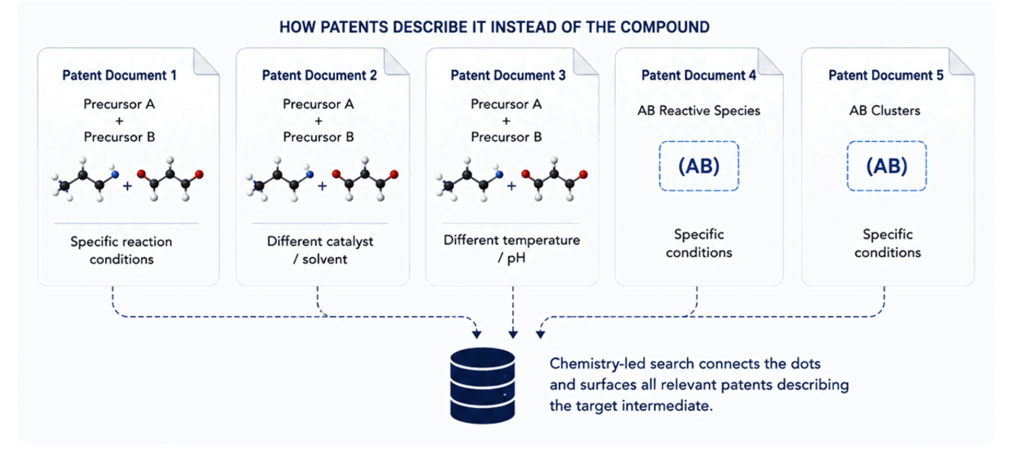
The target was an intermediate compound formed during reactions. Very few patent filings referred to it by its direct chemical name.
Some patents used terms such as “AB reactive species” or “AB clusters” in their descriptions. These terms only indicated the possible presence of the intermediate. They were broad enough to describe several other materials and introduced substantial noise into the results.
A literal chemical-name search returned a thin result set that clearly understated activity in the space. Descriptor-based searches produced too many irrelevant results.
Neither approach provided a defensible basis for:
- Ranking application areas
- Comparing patent claims
- Identifying commercially relevant filings
- Recommending where the client should invest
This was not a query problem that synonyms, patent classes, or tighter Boolean logic could solve. The compound was simply under-named in the literature.
A conventional keyword approach could have produced a polished-looking landscape while missing the patents that mattered most. These were filings in which the intermediate performed the relevant function without being explicitly named.
Precursor Combinations Revealed Patents That Keyword Searches Could Not Find
The team stopped searching for the compound and started searching for the conditions that produced it.
The intermediate consistently formed from a fixed set of precursor materials under defined reaction conditions. Patents describing the compound could therefore be identified through its chemistry, even when the document never named it.
The team created a candidate list covering:
- Precursor combinations
- Reaction routes
- Catalysts
- Reaction conditions likely to produce the intermediate
This approach worked from the underlying chemistry rather than text matching.

Before extending the analysis, the team presented the search hypothesis to the client’s technical group. The client supported the approach and directed its internal research team along a similar path.
This agreement confirmed the precursor logic and provided a tested foundation for the remaining analysis.
The validation step was as important as the search hypothesis. A precursor-based search is only as reliable as the precursor list supporting it. Testing the approach early allowed the client’s internal technical knowledge to serve as a checkpoint.
Had the precursor list been incorrect, the team would have discovered the problem before building the entire landscape around it.
The method also applies beyond this project. When a target cannot be found by name, it may be identified through what produces it. This is particularly relevant for:
- Intermediates
- Transient species
- New formulations
- Compounds protected through processes rather than composition
- Targets described inconsistently across patent documents
Once the precursor-based search returned a reliable set of filings, the broader landscape analysis became possible.
Six Patent-Strength Parameters Separated Defensible Claims From Filing Noise
A clean patent set shows what exists. It does not show what is worth pursuing.
A technology space may appear crowded but contain only narrow or weak patents. Another area may appear quiet while containing one broad, enforceable patent that blocks an entire application.
Instead of counting filings, the team graded every relevant patent using six parameters:
- Independent claims: More independent claims usually indicate broader protection across multiple aspects of an invention.
- Patent families: Filings across several jurisdictions support global enforcement and can indicate higher commercial value.
- Claim wording: Fewer words in an independent claim generally indicate broader scope. Longer claims tend to provide narrower and more specific protection.
- Backward citations: Heavy reliance on earlier prior art may weaken claims when novelty is challenged. Fewer backward citations can suggest more original subject matter.
- Forward citations: A patent cited by many later filings may be foundational and have greater technical impact.
- Legal status: Only active, granted patents present an enforcement threat. Expired and abandoned filings were therefore removed from the relevant risk picture.
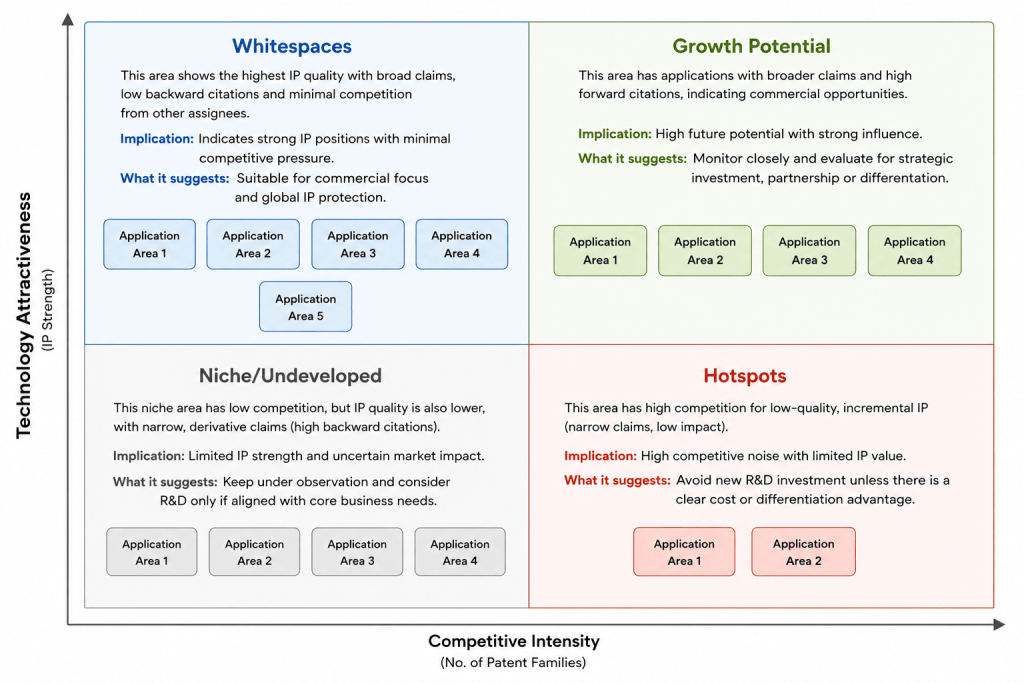
These scores formed the IP-strength axis of a whitespace map.
The second axis represented competitive intensity, measured by the number of distinct assignees actively filing in each application area.
True Whitespace Emerged Where Strong IP Met Low Competition
The resulting map separated genuine whitespace from areas that only appeared open.
True whitespace combined:
- High-quality IP
- Broad and potentially enforceable claims
- Low competitive intensity
- Limited activity from other assignees
Some application areas under consideration by the client fell within this genuine whitespace quadrant. These areas offered stronger opportunities to file patents and build a defensible position.
Other areas appeared attractive when judged only by patent volume. However, the deeper analysis showed that they were crowded with low-quality IP.
The distinction allowed the recommendations to rest on patent strength and competitive intensity rather than filing counts or assumptions.
Adjacent Filings Revealed Both Commercialization Risks and Licensing Opportunities
Looking beyond the client’s portfolio uncovered two additional groups of filings.
The first group included earlier-priority patents owned by other entities. These patents could constrain the client’s intended applications and informed:
- Freedom-to-operate analysis
- Patent prosecution monitoring
- Potential opposition actions
The second group included filings from individual inventors and small entities working in adjacent areas. Their patents aligned closely with the client’s compound chemistry.
These findings indicated opportunities to expand through licensing or acquisition rather than developing every capability through internal R&D. A search focused only on established assignees could have missed these opportunities entirely.
The final assessment classified application areas into four groups:
- Open areas: Strong IP opportunities with low competition, where the client could file patents and establish a defensible position.
- Crowded areas: High filing activity but low IP quality, where additional filings would offer limited protection and designing around existing patents could be more practical.
- Low-value areas: Applications where the compound’s role was unlikely to support strong claims and could be deprioritized.
- Adjacent areas: Spaces where smaller entities held aligned IP and licensing or acquisition could offer a faster route than internal R&D.
The strategic recommendations showed the client:
- Where to file
- Which areas to avoid
- What patent activity to monitor
- Where licensing or acquisition should be considered
The visible output was the application-level strategy. Its reliability came from two less visible decisions.
First, the search was built around the chemistry that produced the intermediate rather than the language used to describe it. Second, relevant filings were graded by patent strength rather than counted.
How Can Chemical Companies Identify Defensible Patent Whitespace?
Patent landscapes in chemical fields often contain intermediates, compounds, and process steps described inconsistently. Raw filing volume can further obscure whether an application area contains valuable IP or only a large number of narrow patents.
A reliable analysis must move beyond keywords. It should model the target through its precursor chemistry, validate that model with technical experts, and assess the resulting patents by claim strength, legal status, citation activity, family coverage, and competitive intensity.
Through its patent landscape analysis services, GreyB helps R&D, IP, and strategy teams move from broad patent noise to validated application opportunities, commercialization risks, and defensible filing positions.
Fill out the form below and connect with our expert today.