

Value Delivered
The client received a Tier-1 prior-art result by identifying a missing disclosure hidden within the priority document of an already identified close reference.
The research established that the same patent family contained the complete implementation detail required for the invention. While the later publication described the compact and extended Power Headroom Report (PHR) formats and linked the format change to a secondary-cell index, the priority document clarified that only secondary cells with configured uplink resources should drive the format selection.
This finding helped the client strengthen their prior-art position by showing that the missing claim condition was not absent from the patent family, but was preserved only in the earlier priority filing.
Problem Solved
The challenge was identifying prior art that disclosed the complete rule for switching between compact and expanded PHR formats.
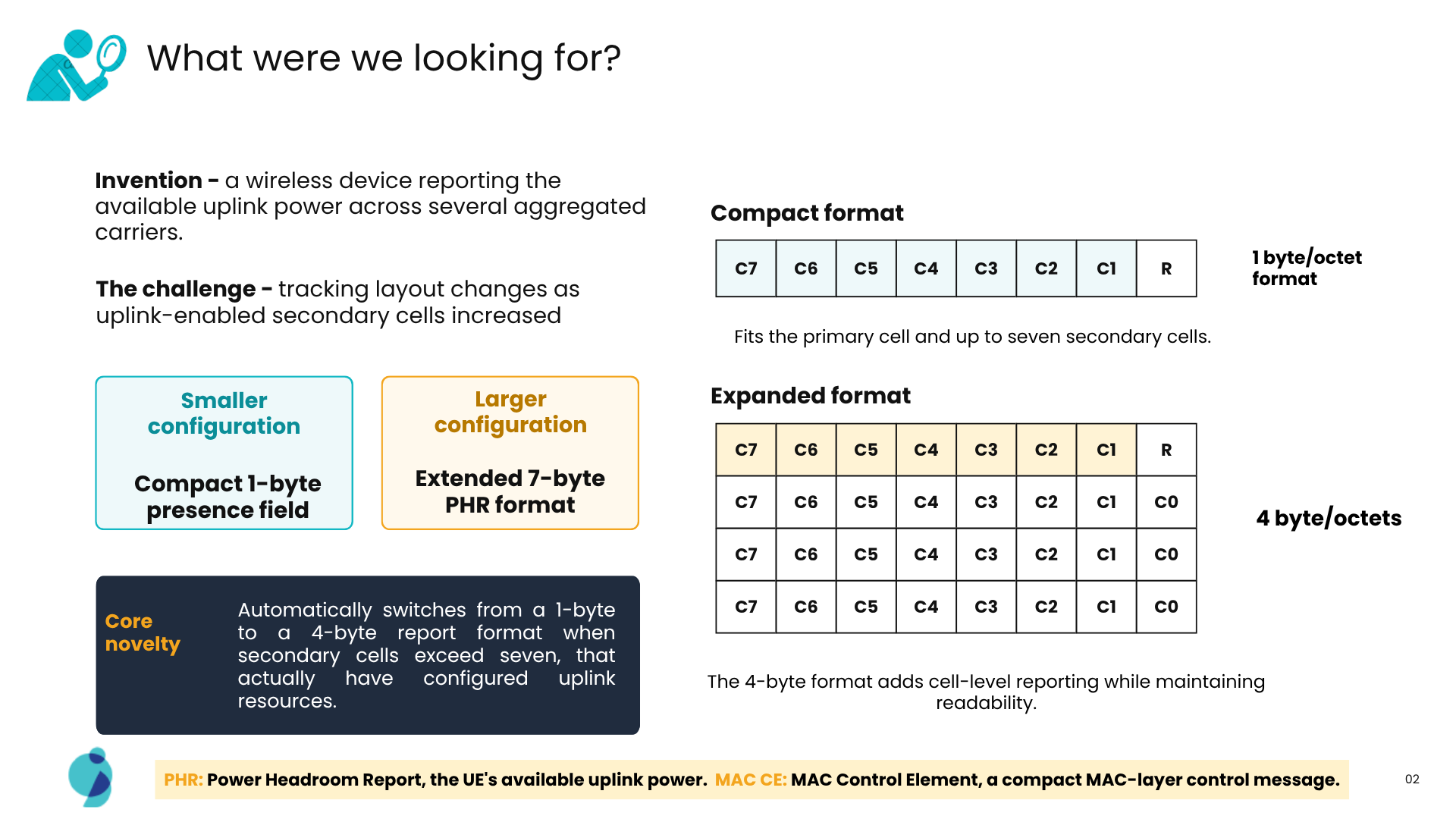
The invention focused on a wireless device reporting available uplink power across aggregated carriers, where the report format changes based on the number of secondary cells having configured uplink resources:
- A compact 1-byte presence field for smaller configurations.
- An expanded 4-byte report format for larger configurations.
- A format switch triggered when the number of relevant secondary cells exceeds seven.
Initial searches found many related disclosures, but no single reference contained the complete limitation. 3GPP discussions and email archives covered compact and extended PHR layouts and different PHR MAC Control Element versions, but the exact combined condition was missing. Patent and non-patent literature searches identified SCell-index-based format switching, but the specific trigger of “SCell with configured uplink” remained unclear.
The challenge was not finding related technology. The challenge was finding the exact condition that controlled the format selection.


Solution Offered
The research team used a deeper family analysis approach instead of stopping at the published version of the closest reference.
The team:
- Screened more than 1,500 patents and narrowed them to three relevant families and one standout candidate.
- Identified a visual match through an extended PHR layout containing multiple cell-level fields.
- Reviewed the same patent family at an earlier priority-document level to locate the missing implementation detail.
The priority document provided the missing disclosure by confirming that the format decision was based on secondary cells with configured uplink resources. This transformed a close reference into a complete Tier-1 prior-art result.
The key takeaway was that priority documents can preserve technical details that later publications simplify or omit. A near-match reference can become a complete prior-art solution when reviewed at the correct filing level.
Get the full case study to discover how a hidden trigger in the priority document uncovered a winning prior-art strategy