

Value Delivered
The client received pre-priority-date product literature that disclosed the required elements for challenging the validity of a software-simulation patent. The identified white paper and product data sheet described the capabilities of the earlier Firefly simulation tool and provided the technical disclosures required for the invalidation analysis.
The findings enabled the client to:
- Build an invalidity position using contemporaneous product documentation rather than relying only on patent references.
- Demonstrate that the claimed simulation-management functionality existed before the relevant priority date.
- Support the publication timeline through archived website records.
- Use the retrieved white paper and data sheet for detailed claim mapping and technical arguments.
Most importantly, the research converted an incomplete product reference in a patent into a verifiable prior-art trail supported by archived, dated documentation.
Problem Solved
The subject patent related to a system that automatically creates and manages software simulations replicating an application’s interface and behavior. Its identified novelty was that, when the underlying application changed, the system dynamically updated the existing simulation file rather than requiring the simulation to be recreated manually.
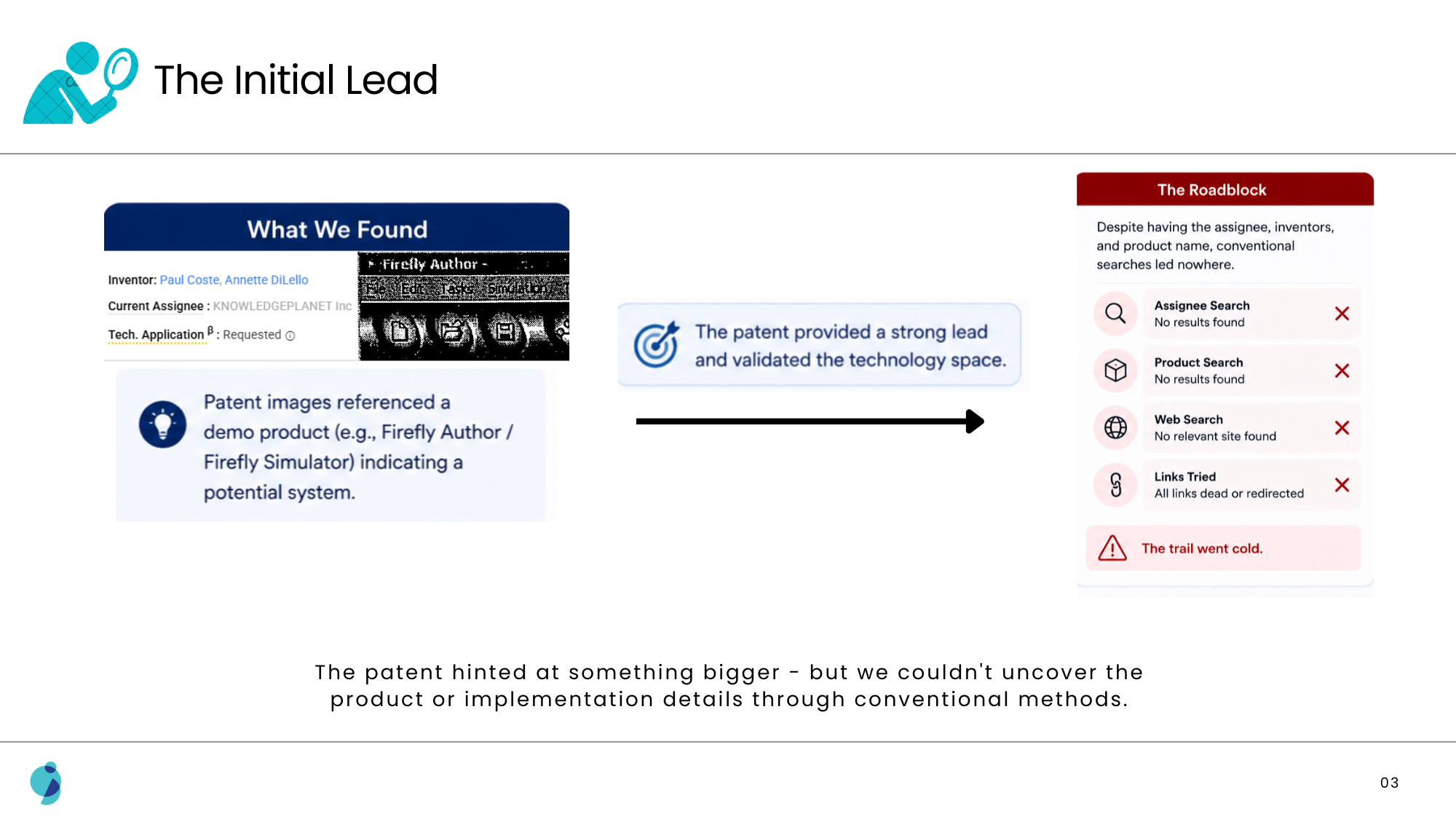
The patent images referred to a potential product called Firefly Author or Firefly Simulator, providing an initial lead. However, conventional searches based on the assignee, inventors and product name produced no usable results. Relevant websites were unavailable, and the accessible links were either dead or redirected.
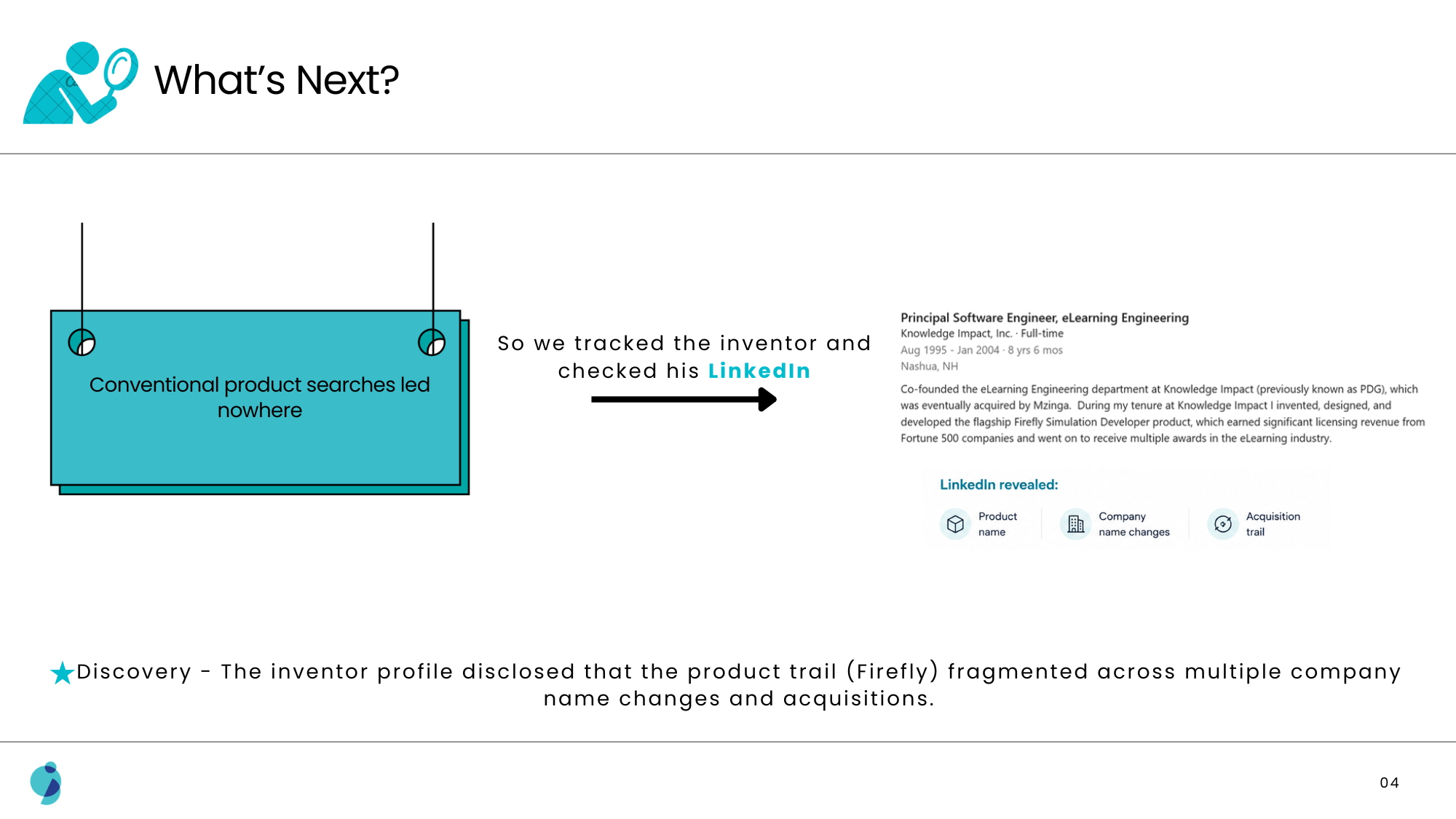
The principal research challenge was that the product had passed through multiple company-name changes and acquisitions. As a result, its technical documentation was fragmented across discontinued websites and could not be located through a straightforward product or company search.

Solution Offered
The research team moved beyond conventional patent and product searching and reconstructed the product’s historical trail.
First, the inventor’s professional history was examined to identify the organizations associated with the development of Firefly. This revealed a succession of entities, including PDG, Knowledge Impact, Mzinga and KnowledgePlanet, which provided additional company names for targeted searching.
A German document discovered during this process referenced another historical website. That website address became the next lead and was examined using the Wayback Machine. The archived pages led to Firefly-related product materials, while the archive records also confirmed that the content was publicly available before the 2006 cut-off date.
The archived website ultimately provided a Firefly white paper and data sheet containing the required technical disclosures. These documents were then assessed against the claim elements and used as the principal prior-art evidence for the invalidation analysis.
The solution combined:
- Inventor and employment-history research.
- Tracking of company acquisitions and name changes.
- Targeted searching across historical company identities.
- Retrieval of discontinued websites through web archives.
- Verification that the evidence existed before the critical date.
- Technical mapping of archived product literature to the claimed functionality.
By following the historical trail rather than repeatedly searching only for the product name, the team uncovered prior art that conventional patent and product searches had missed.
Get the full case study to discover How an Archived E-Learning Website Uncovered Claim-Killing Prior Art.