
Value Delivered
The client received additional non-patent evidence supporting its defense in litigation involving a sports-shoe patent.
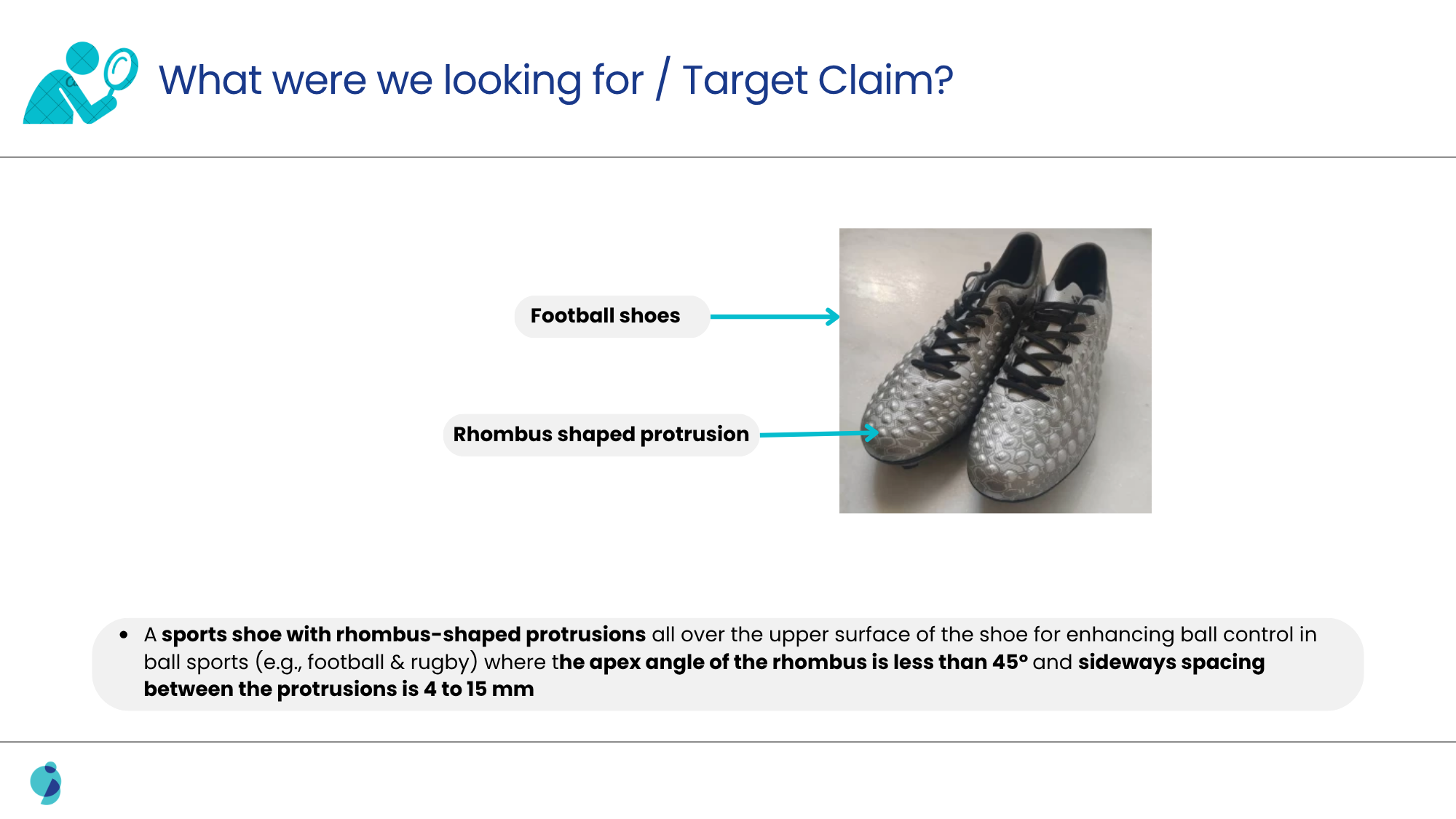
The target claim required a sports shoe having rhombus-shaped protrusions distributed over its upper surface to improve ball control. It also required two specific dimensional characteristics:
- An apex angle below a defined limit; and
- Sideways spacing between the protrusions within a specified range.
Existing patents and product materials disclosed the rhombus-shaped surface pattern but did not expressly provide the required numerical dimensions. By analyzing suitable product images, the team established that the visible protrusions satisfied both dimensional requirements.
The findings enabled the client to:
- Address the missing claim limitations: Obtain quantitative support for the required apex angle and spacing.
- Strengthen the litigation defense: Use commercially available product evidence to supplement the disclosures found in patent literature.
- Move beyond written specifications: Extract relevant technical information from images where product descriptions did not report the dimensions.
- Distinguish express and derived disclosure: Clearly explain that the protrusion structure was visible in the images, while the numerical values were established through graphical analysis.
- Preserve relevant product prior art: Avoid rejecting commercially available products merely because their technical dimensions were not stated in accompanying text.
Problem Solved
The target patent concerned a sports shoe designed for football, rugby, or similar ball sports. The shoe included rhombus-shaped protrusions across the upper surface to enhance contact with and control of the ball.
The patent literature disclosed footwear having similar rhombus-shaped protrusions and described their use for improving ball control. However, the references generally did not disclose the apex angle of the rhombus or the sideways spacing between adjacent protrusions.
Commercial products from established footwear manufacturers also displayed comparable surface patterns. High-quality product photographs clearly showed the rhombus-shaped protrusions across the shoe upper, but the product descriptions did not provide dimensional specifications for those structures.
This created an evidentiary gap. The relevant products appeared visually similar to the claimed footwear, but the critical numerical limitations could not be established from the written materials alone.
The analysis therefore needed to determine:
- Whether the apex angle of the visible rhombus-shaped protrusions was below the claimed limit; and
- Whether the sideways spacing between adjacent protrusions fell within the claimed range.
Any conclusion also needed to account for image scale and magnification so that measurements taken from a photograph were not mistakenly treated as the product’s actual dimensions.


Solution Offered
The research expanded from written patent and product disclosures to a quantitative analysis of professional product images available through commercial sources.
The selected images showed the relevant footwear and provided sufficiently clear views of the rhombus-shaped protrusions. The graphical analysis evaluated two separate claim requirements.
First, the orientation of the sides forming the rhombus was examined to derive its apex angle. The resulting value was below the maximum angle specified in the claim.
Second, the distance between adjacent protrusions was evaluated using a known product dimension as a scale reference. This allowed the relative spacing visible in the image to be converted into an estimated physical distance. The resulting spacing fell within the range required by the claim.
The analysis therefore connected the visible product structure with the claim’s numerical limitations:
- The images showed rhombus-shaped protrusions across the shoe upper;
- The derived apex angle was below the claimed threshold; and
- The derived sideways spacing was within the claimed interval.
The client ultimately received:
- Product-based non-patent evidence showing the relevant protrusion arrangement;
- A graphical assessment of the rhombus apex angle;
- A scale-adjusted assessment of the spacing between protrusions;
- A clear explanation of which features were visually disclosed and which values were analytically derived; and
- Additional technical support for the client’s litigation defense.
The result demonstrated that potentially relevant prior art may disclose a claimed structure visually even when no accompanying text provides its dimensions. A controlled graphical analysis can help determine whether those visually disclosed features fall within the claimed numerical ranges.
Get the full case study to discover how quantitative analysis of product images supplied missing dimensional evidence for a footwear litigation defense.