
Value Delivered
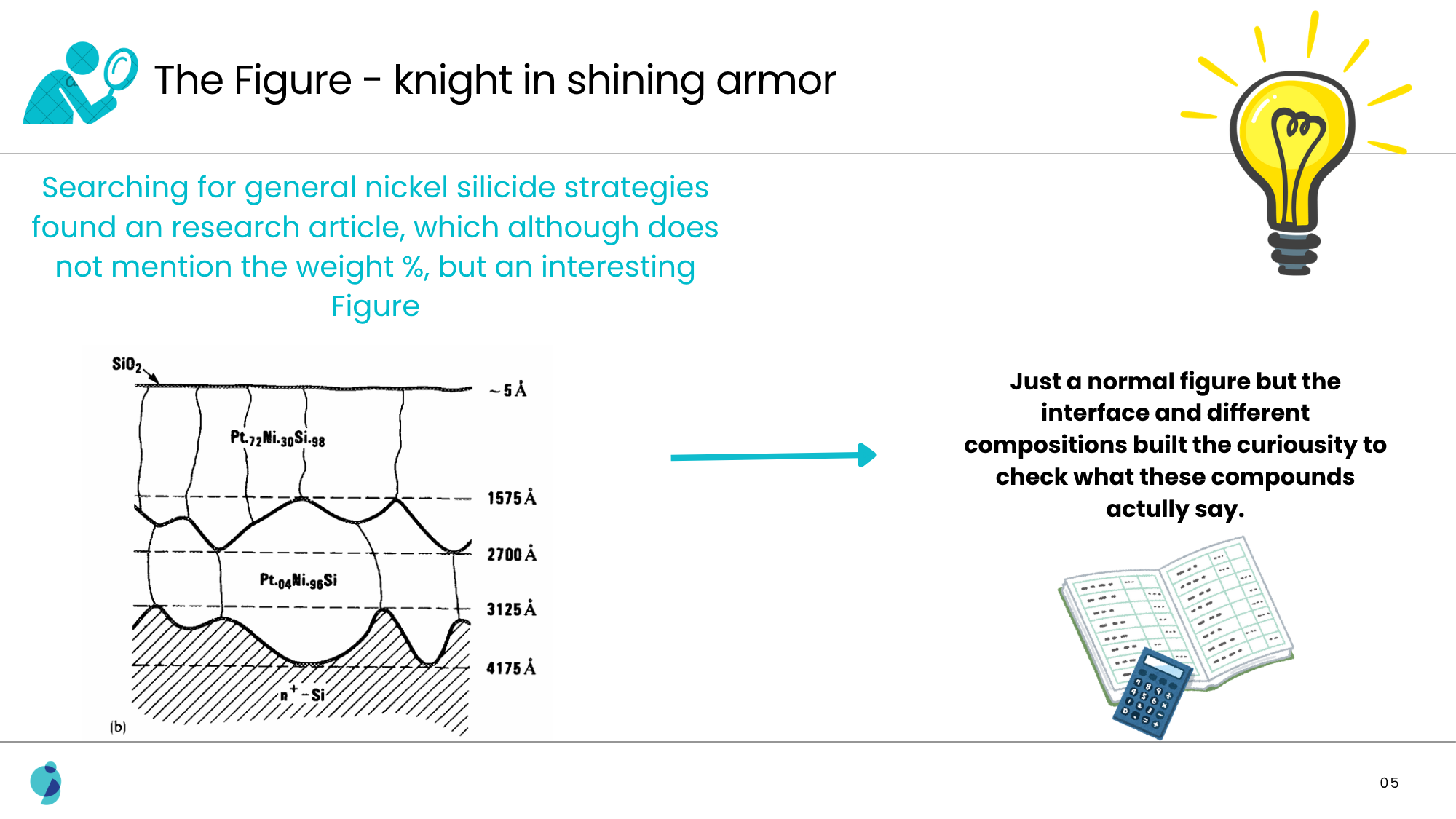
The client received a strong technical basis for challenging the novelty of a semiconductor claim that required a platinum concentration of 8–12 wt.% at the silicon interface. Although the prior-art reference did not expressly disclose the concentration in weight percentage, its figure identified the relevant material composition as Pt₀.₀₄Ni₀.₉₆Si near the interface. By converting this chemical composition into weight percentage, the research team established that the disclosed platinum concentration was 8.46 wt.%, falling directly within the claimed range.
The client could use this finding to:
- Strengthen a novelty or invalidity argument with a numerical disclosure derived directly from the prior-art reference.
- Demonstrate that a claim limitation may be disclosed even when the reference uses a different scientific representation.
- Support the analysis with a transparent and reproducible calculation rather than relying on an unsupported inference.
- Expand the prior-art record beyond references that expressly use the claim’s terminology.
The case ultimately demonstrated how a seemingly ordinary technical figure, combined with a fundamental chemistry calculation, could provide the evidence needed to challenge the claim.
Problem Solved
The invention concerned a semiconductor device containing a platinum-gradient nickel silicide, or NiSi, layer. The platinum concentration was kept relatively low near the silicon interface to maintain low resistivity and increased toward the upper surface. The identified novelty resided in the specific concentration of 8–12 wt.% platinum at the silicon interface.
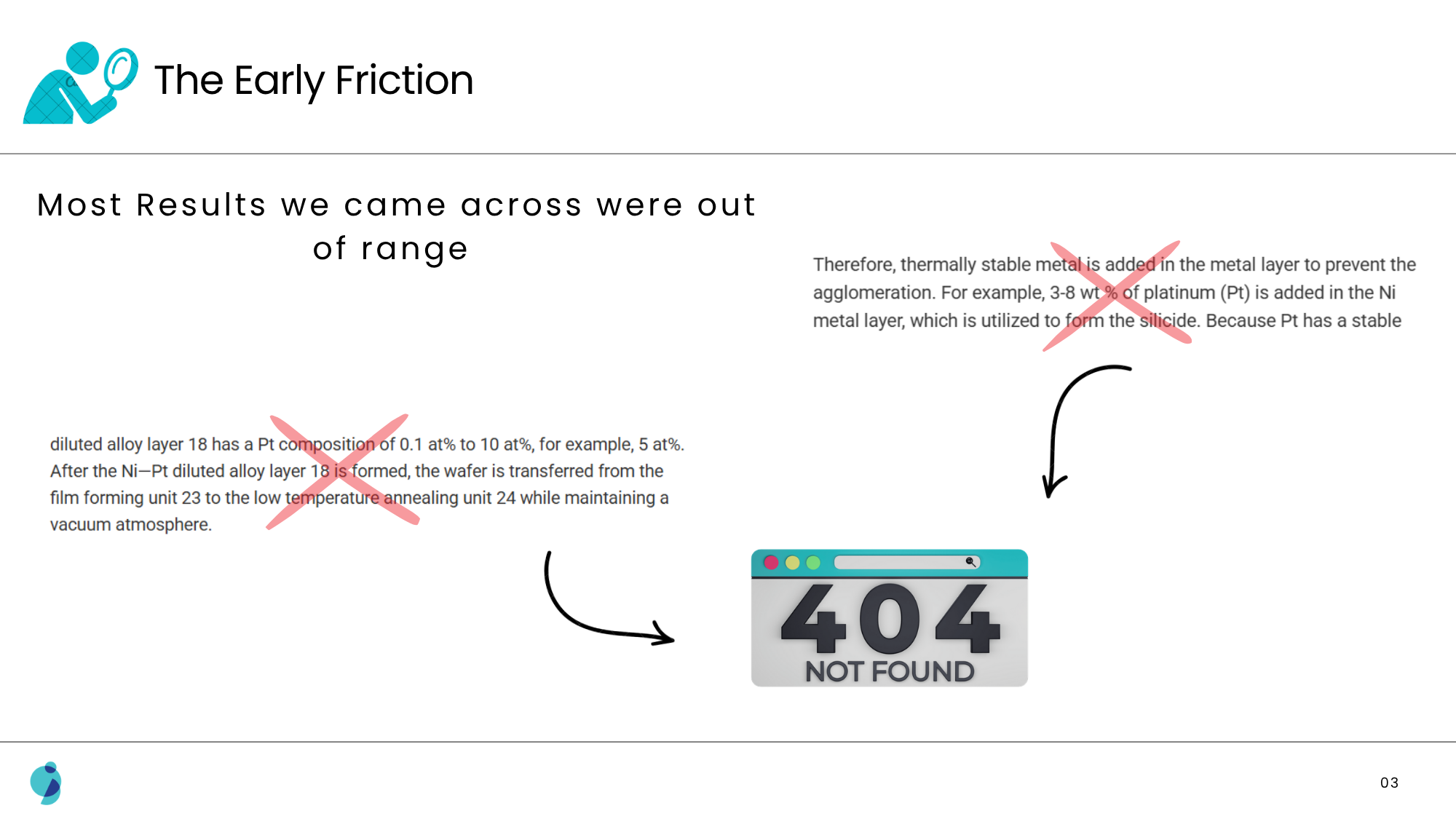
The principal search challenge was that most references disclosed platinum concentrations outside the claimed range. Consequently, conventional keyword and numerical searches did not produce a direct result.
A further difficulty was the difference in how the claimed concentration and the prior-art composition were expressed. The claim used weight percentage, while a potentially relevant research article represented the material through a chemical formula in a figure. The article did not expressly state the corresponding platinum weight percentage. Therefore, the reference could easily have been overlooked as non-responsive.
The researcher’s challenge was to determine whether the chemical composition shown in the figure implicitly disclosed a platinum concentration within the claimed range.

Solution Offered
Instead of limiting the search to references expressly mentioning “8–12 wt.% platinum,” the research team broadened the strategy to general nickel-silicide structures and compositions. This led to a research article containing a figure that showed different material compositions across the silicide layer, including the composition present near the silicon interface. Although the article did not provide the concentration in weight percentage, the interface and the varying chemical compositions indicated that the figure warranted further analysis.
The team extracted the formula Pt₀.₀₄Ni₀.₉₆Si from the figure and converted the platinum content into weight percentage using the atomic weights of platinum, nickel and silicon:
Pt wt.%=(0.04×195.084)+(0.96×58.6934)+(1×28.085)0.04×195.084×100
The calculation produced 8.46 wt.% platinum, which lies squarely within the claimed 8–12 wt.% range.
Thus, the solution combined:
- A non-patent research article disclosing the relevant layer structure and chemical composition through a figure.
- A basic chemistry conversion establishing the corresponding platinum weight percentage.
- A clear technical mapping between the prior-art composition and the claimed concentration limitation.
This approach transformed an apparently incomplete graphical disclosure into meaningful prior-art evidence and supported the conclusion that the claimed concentration was not novel.
Get the full case study to discover How a Basic Chemistry Formula Uncovered Claim-Killing Prior Art