Value Delivered
GreyB helped the client build a stronger invalidity position by moving beyond keyword-led searching. The findings equipped the client with a multi-layered attack: one reference supported the polymer structure and synthesis route, while additional references supported its use as a battery electrode binder and its hydrogen-bonding behavior.
Problem Solved
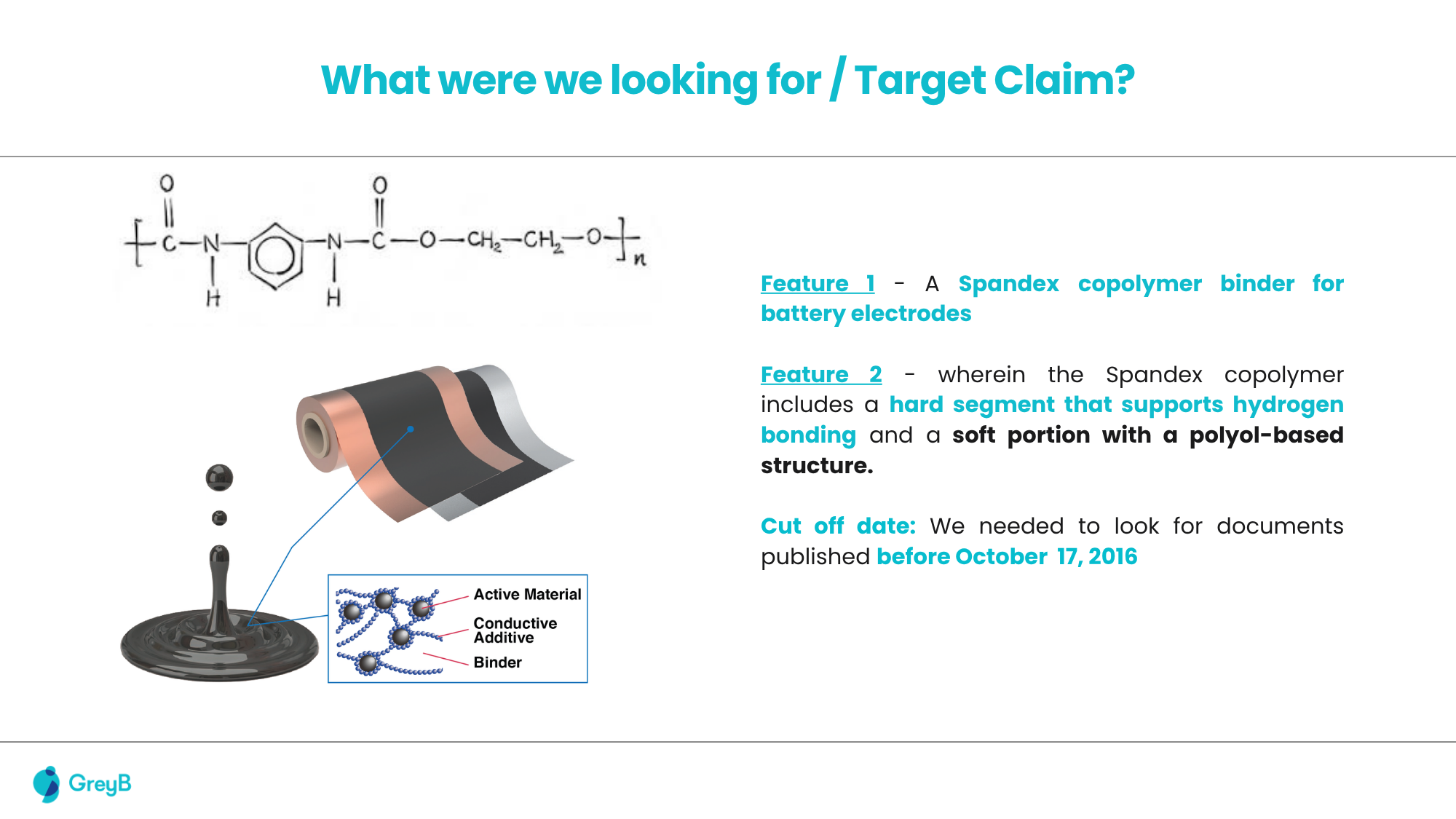
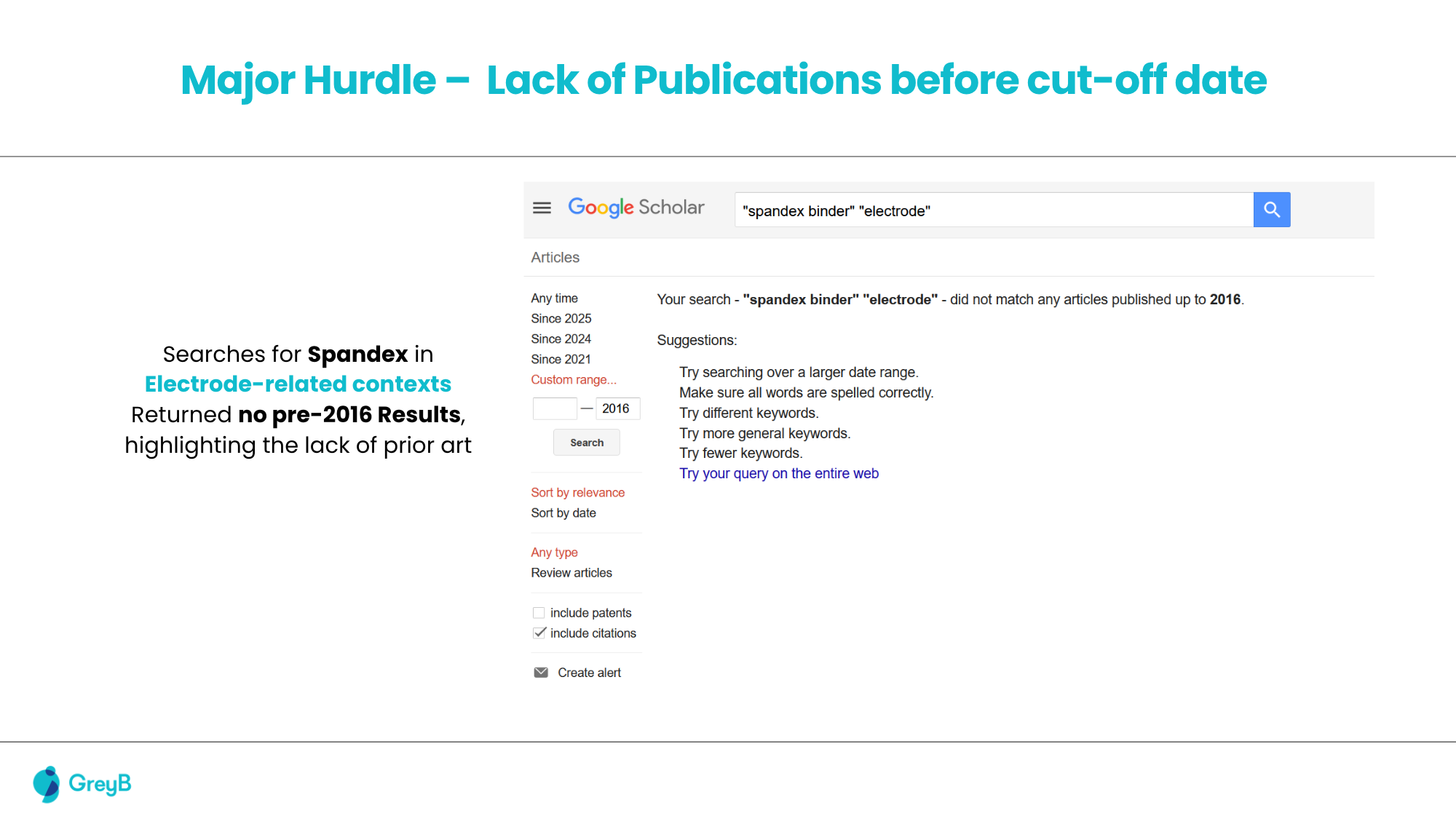
The target claim required a Spandex copolymer binder for battery electrodes, where the copolymer had a hard segment supporting hydrogen bonding and a soft polyol-based portion. Initial searches using direct terms such as “Spandex,” “binder,” and “electrode” did not return useful results.
The key challenge was that relevant prior art did not explicitly describe the polymer as “Spandex” in a battery binder context. Some references disclosed similar polymer structures, but they were silent on battery electrode use. This created a gap between the polymer chemistry and the claimed application.

Solutions Offered
GreyB reframed the search from a product-name approach to a synthesis-based approach. Instead of searching only for “Spandex,” the team deconstructed the material into its core chemistry: isocyanates and polyols forming polyurethane/polyurea structures.
By identifying the core chemical precursors, the team mapped the material’s structural lineage rather than its stated use. This methodology allowed for a cross-domain correlation between “structure-only” art (found in polymer journals) and “application-specific” art (found in electrochemical patents).
Get the full case study to discover how GreyB read between the lines of the synthesis method and uncovered hidden prior art.