


The International Energy Agency (IEA) notes that heavy-duty EVs require charging strategies tailored to their intensive usage patterns, with depot charging often requiring close to a one-to-one ratio of chargers per electric heavy-duty vehicle.
Commercial fleets are adopting electric vehicles, but high battery costs remain a key challenge. BloombergNEF reported that lithium-ion battery pack prices averaged $115 per kWh in 2024. For commercial vehicles that need larger battery packs to cover longer distances, this adds significantly to the upfront cost of the vehicle, while long charging times keep vehicles off the road.
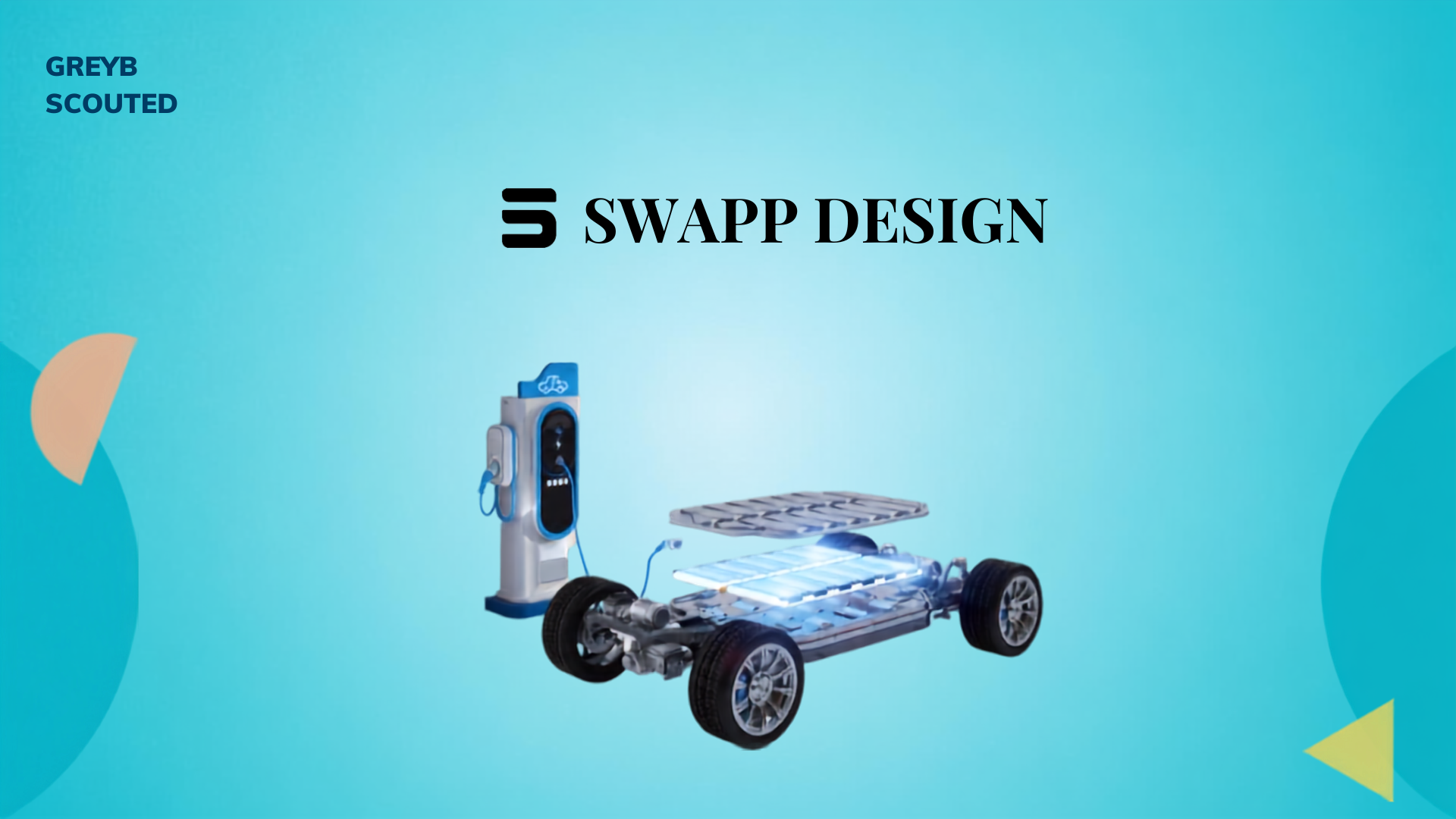
Swapp design tackles this problem with its automated battery-swapping platform, where modular batteries are replaced using SwappBots. By allowing batteries to charge separately from the vehicle, the system helps reduce downtime.
To better understand how they do it, we spoke with Buddhabrata Chakravorty, Co-Founder and CEO of Swapp Design. This article contains notable highlights from our entire conversation.
Related Read:

This interview is part of our exclusive Scouted By GreyB series. Here, we speak with the founders of innovative startups to understand how their solutions address critical industry challenges and help ensure compliance with industry and government regulations.
“The battery and the vehicle can be decoupled. We enable certain advantages which not only give you uninterrupted mobility, it also allows the grid to stay much more resilient.”
— Buddhabrata Chakravorty

Buddhabrata Chakravorty is the Co-Founder and CEO of Swapp Design, a Bengaluru-based startup founded in 2022. Originally from Guwahati, he studied General Science at Cotton College, Guwahati, before completing a Bachelor of Engineering in Instrumentation Technology at M.S. Ramaiah Institute of Technology, Bengaluru, and later pursued Automotive Electronics at BITS Pilani.
An engineer with expertise in instrumentation and automotive electronics, he spent several years in the automotive industry, including at Bosch, where he met his co-founder, before starting Swapp Design.
Swapp Design Uses a Portal System to Address Battery Interoperability Challenges
Swapp Design develops an automated battery-swapping system for commercial electric vehicles, including buses, trucks, and light commercial vehicles. The company focuses on reducing challenges associated with large battery requirements and vehicle downtime during charging.

Its system uses modular batteries, a vehicle-mounted portal, and an autonomous robot called SwapBot to remove and replace batteries. By separating battery charging from vehicle operation, the system allows batteries to be charged independently while vehicles return to service faster.
Why did Swapp Design decide to focus on battery swapping instead of improving charging speeds?
Buddha: Electric mobility has a fundamental challenge because batteries have physical and electrochemical limits. There is only so much power you can push into a battery before creating compromises for the grid, thermal management, and battery health.
Battery swapping allows us to separate when the vehicle needs energy from when the battery receives energy. A bus should spend its time moving passengers, not waiting beside a charger. By separating these two cycles, we can keep vehicles operating while charging batteries in a way that is better aligned with the grid.
This creates two advantages. Users get uninterrupted mobility because they can quickly replace a depleted battery, and the grid gets a more stable load because charging can happen when energy availability is better.
Battery swapping has always faced the challenge of different vehicles requiring different batteries. How does Swapp design solve interoperability?
Buddha: Interoperability is one of the biggest challenges in battery swapping. Different vehicle categories require different battery sizes and power requirements, so a single approach does not work everywhere.
Our solution is built around something we call a portal. The portal acts as an adapter between the vehicle chassis and the battery. The same battery platform can work across vehicles in a category, while the portal is customized depending on the vehicle structure.
The other important part is software intelligence. Different vehicles need different amounts of energy depending on their driving patterns. Our hardware and software work together so that the vehicle receives the power it needs without feeling like it is using a different battery system.
How does Swapp design achieve faster battery swaps, and is the one-minute swap possible?
Buddha: The key is modularity. We design batteries like Lego blocks. If one module can be swapped quickly, multiple modules can be handled together using multiple robots working simultaneously.
Our current demonstration has achieved a complete swap in around three minutes with one bot. However, the actual movement of one bot carrying and replacing a battery takes around 38 to 40 seconds. With multiple bots working together, achieving a one-minute swap becomes possible.
The goal is not just speed. The architecture is designed so that we can scale the system in the future. Today we may start with a simple battery and robot setup, but the foundation allows us to build much larger systems.
How does SwapBot work, and what role does robotics play in the system?
Buddha: SwapBot is essentially an autonomous robot designed specifically for battery swapping. It uses cameras and sensors to understand its surroundings and position itself under the vehicle.
Similar to how humans use their eyes to understand the environment, the bot uses computer vision and artificial intelligence to identify the vehicle, move into position, and communicate with the battery system.
The robot can carry the battery weight with additional safety margins. It communicates with the portal and the station through multiple safety checks before removing or installing the battery. From the user’s perspective, the process looks simple, but there is a lot of engineering happening behind the scenes.
What was the most difficult engineering challenge while building Swapp design’s technology?
Buddha: The biggest challenge was not solving one individual component, but making all the systems work together. There was no established blueprint for the type of battery swapping architecture we wanted to create.
Traditional battery swapping approaches often require expensive stations with high capital costs. For commercial mobility in India, we needed a solution where the station itself remained affordable.
So we moved complexity away from the station and into the robot, battery, and software systems. This allows us to build stations with much lower capital requirements while maintaining higher throughput. Ultimately, the success of the model depends on serving more customers with less infrastructure cost.
Is Swapp design a robotics company or an energy company?
Buddha: Robotics is an important part of what we do, but we see ourselves primarily as an energy company. The robot exists because it enables a better way of managing energy.
Our vision is that someday energy should flow as freely and easily as information. Battery swapping helps us move toward that because batteries inside swap stations can absorb energy when it is available and provide it when vehicles need it.
For example, solar energy often creates surplus during the daytime, while vehicles may need charging at night. By storing energy in swap stations, we can better use renewable energy and reduce pressure on the grid.
How does battery swapping help reduce the cost of electric buses and commercial vehicles?
Buddha: One of the biggest reasons electric buses are expensive is the large battery pack they carry. The battery is oversized because vehicles need enough range to operate all day without charging.
But if a bus can swap batteries in a minute, it does not need to carry such a large battery. It only needs enough energy for its immediate operation before returning for another swap.
This reduces the upfront cost of vehicles and also improves scalability because the same amount of battery resources can support more vehicles. The same principle can also help retrofit existing diesel buses by replacing fixed batteries with a swapping system.
What are Swapp design’s expansion plans and how do you see the technology scaling?
Buddha: We are focused on commercial mobility because that is where battery swapping can create the biggest impact. The same architecture can support different vehicle categories, including buses, trucks, and light commercial vehicles.
Our approach is also designed around better economics. The station cost is significantly lower because we avoid expensive infrastructure-heavy designs. We believe the station and battery costs can be recovered within a few years because vehicles spend less time idle and can operate more frequently.
As we expand, the goal is not only to deploy more swapping stations but to build a complete energy ecosystem around them.
Battery swapping has faced many challenges over the years. What keeps you motivated when facing uncertainty?
Buddha: Every technology has moments where you discover a weakness or a problem that needs to be solved. The approach is simple: identify the problem and work on solving it.
Having the right people around you is important. A co-founder, team members, and mentors can help you see problems from different perspectives when you become too focused on one small issue.
For us, the motivation comes from the size of the problem we are solving. Battery swapping is only the visible part. Underneath it are larger opportunities around grid stability, renewable energy usage, and energy storage. If we solve this correctly, the impact can be much larger than just faster charging.
Meet our Interviewer – Shabaz Khan, Marketing Manager at GreyB

Shabaz Khan, Marketing Manager
Want to find other scalable startups working on battery solutions? Please fill out the form below to contact our experts.