


Energy-related CO₂ emissions reached a record 37.8 gigatons in 2024, while global natural gas demand hit an all-time high and continues to soar with the recent events. This creates a difficult gap for industry: modern economies still need dense hydrocarbon fuels like natural gas and methanol, but producing them from fossil sources continues to increase atmospheric carbon. Direct air capture is gaining attention, but a key commercialization gap remains. Captured CO₂ is still treated as a carbon-management liability rather than as feedstock for valuable products.
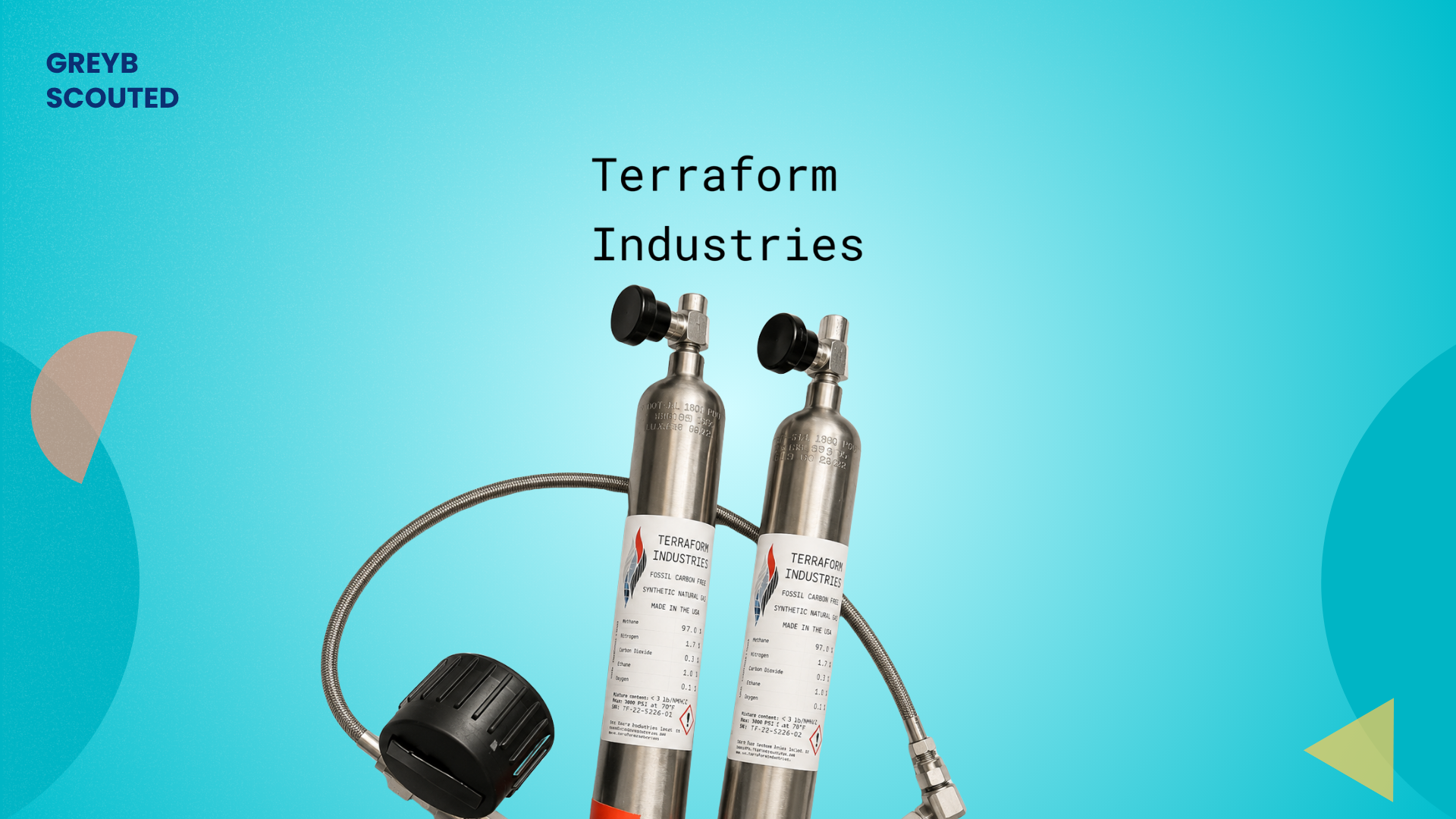
Terraform Industries is trying to close that gap by making synthetic natural gas and methanol from sunlight and air, or precisely captured CO₂.
To better understand how they are doing it, we spoke to Casey Handmer, CEO of Terraform Industries. This article contains notable highlights from our entire conversation.
Also Read:


This interview is part of our exclusive Scouted By GreyB series. Here, we speak with the founders of innovative startups to understand how their solutions address critical industry challenges and help ensure compliance with industry and government regulations. (Know more about startups scouted by GreyB!)
“If anyone can produce hydrogen for around a dollar a kilogram and CO2 for around 10 cents a kilogram or a hundred dollars a ton, then they’re in contention economically.”
– Casey Handmer

Dr. Casey Handmer is the founder and CEO of Terraform Industries. He is triple-majored in pure mathematics, applied mathematics, and physics at the University of Sydney and holds a Ph.D. in theoretical physics from Caltech. Handmer was part of NASA’s Jet Propulsion Laboratory, where he worked across GNSS science, Mars mapping, and advanced technology development.
He also worked with Hyperloop One. Handmer left NASA, started Terraform in his garage, and secured $5 million in seed funding to prove his central thesis: that cheap solar electricity had finally made it economical to synthesize hydrocarbons from air and water rather than extract them from the ground.
Having assembled a world-class engineering team and raised $26 million in funding to date, Handmer has positioned Terraform Industries as a potential reinvention of how civilization sources its energy.
Synthetic natural gas and methanol from sunlight and air
Instead of selling carbon credits, Terraform is using captured CO₂ as a feedstock to produce fuels and chemicals such as synthetic natural gas and methanol, targeting markets that already have large-scale demand. Methanol alone is a multi-billion-dollar global market, while natural gas remains one of the world’s largest energy markets.
Its strategy depends heavily on reducing capital costs across the system, especially in hydrogen production and CO₂ capture, so the economics can work without relying only on subsidies.
In March 2024, Terraform completed its end-to-end demonstration, successfully producing fossil carbon-free, pipeline-grade natural gas from sunlight and air. It also hit the landmark cost targets for green hydrogen and direct air capture CO2. (more in the interview)
How is Terraform Industries different from other carbon capture or fuel production startups?
Terraform is making cheap synthetic natural gas and methanol from sunlight and air. The main difference is that we approach direct air capture as a profit center rather than a cost center. For us, captured CO₂ is not just something to bury or offset. It is a precursor for making valuable hydrocarbon fuels.
A lot of companies focus on one part of the process. Some capture carbon and sell credits. Others turn CO₂ into niche materials or chemicals. We are focused on a much larger market: fuels that already power modern civilization. From day one, we understood that the key was keeping capital costs low enough to earn a return and fund expansion.
That is why we have been focused across our three major subsystems: hydrogen production, CO₂ capture, and fuel synthesis. If each part is too expensive, the whole system fails. But if we can engineer the cost down, we can make synthetic fuels that are economically interesting, not just technically impressive.
Why is making synthetic fuels from captured carbon so difficult?
The technology has existed in some form for more than a century. The hard part is not proving that you can make synthetic natural gas. The hard part is making it with positive economic value. There have been projects that achieved their technical goals but still produced gas at prices that would never support modern civilization.
The problem is net energy gain and cost. If the process consumes too much energy, uses too much equipment, or requires too much capital, the final product becomes too expensive. A synthetic gas project can work chemically and still fail economically.
That is why this space is so challenging. Some people underestimate the technical difficulty and have no real chance of success. Others understand the difficulty so well that they never try. We are somewhere in the middle: just bold enough to try, and just technical enough to make progress.
Why did you choose hydrocarbons instead of other CO₂-derived products?
The major challenge here is economic scale. Suppose you find a CO₂-derived product that sells for a high price per carbon atom, which helps unit economics. But if the market is too small, you can spend years building a brilliant process that only serves a tiny part of the economy.
I did not start Terraform to work around the margins. Hydrocarbon fuels are part of a massive global market. Natural gas and methanol are not niche products. They are central to energy, industry, and chemical supply chains.
There are many valid approaches to using captured carbon, and I do not wish ill on other entrepreneurs. But our goal is to solve the core problem at the scale where it matters most. That is why we chose fuels.
What is the biggest cost factor you are trying to solve?
The two key numbers we look at are hydrogen at around $1 per kilogram and CO₂ at around $100 per ton. If anyone can hit those figures, the economics become very interesting. Conventional wisdom says there is still roughly a factor-of-ten gap, so we have been pulling every trick we can think of to bring costs down.
Our intermediate goal was to reach around $2 per kilogram for hydrogen and $200 per ton for CO₂. We are now around that level internally. There is some spreadsheet work involved because we are still running test systems, but we are not pretending labor or real-world costs are zero.
The next step is another factor-of-two reduction. That is harder than the first one, but we are much smarter now. We know where the costs are, and we know which parts of the system need to improve.
What is different about your electrolyzer technology?
Conventional green hydrogen systems are expensive partly because electrolyzers can cost thousands of dollars per kilowatt. If your equipment is that expensive, even perfect uptime and perfect efficiency do not make the economics work.
Our system is under $100 per kilowatt right now. I sometimes compare it to the cost of a very cheap microwave. My goal is to bring it closer to electric kettle territory, around $20 to $30 per kilowatt.
We achieved this through repeated engineering iteration. For example, our previous prototype used a temporary construction method that simplified manufacturing but added cost. We later moved to a plastic welding process, which helped remove around half of the remaining electrolyzer cost. These are not flashy breakthroughs. They are hard engineering improvements that compound over time.
How low is your hydrogen cost today?
Our best internal estimate is around $2 per kilogram, probably slightly under that. This is based on our current test systems and our understanding of how the productized system will perform.
That number matters because conventional green hydrogen is often discussed at much higher prices. From what we see inside the industry, electrolysis-based green hydrogen is rarely anywhere close to where it needs to be for synthetic fuels.
We are already showing that the existing model is weaker than many people assume. Our internal cost basis is below $2 without depending on large subsidies. That gives us confidence that our approach can work.
How does Terraform’s cost strategy support expansion?
Expansion only works if the economics work. If your first plant is too expensive, you cannot use it to fund the next one. That is why we have focused on capital cost from the beginning.
Our view is that low CapEx gives us a higher return on investment, which then allows us to expand the technology. This is not just about building one impressive machine. It is about building a system that can reproduce itself economically.
That is also why we focus on large markets. If the product is valuable, the market is enormous, and the system can be built cheaply enough, then growth becomes much more practical. The whole company is designed around that idea.
Meet our Interviewer – Shabaz Khan, Marketing Manager at GreyB

Shabaz Khan, Marketing Manager
Want to find other scalable startups working on carbon capture and its utilization? Please fill out the form below to contact our experts.