



NVIDIA’s H100 AI accelerator generates over 700W of heat per chip. A single Blackwell Ultra rack draws up to 140kW, equivalent to ~100 household kettles running simultaneously. Air cooling, the industry standard for decades, maxes out at around 40kW per rack. Even with water cooling, heat sinks, and vapor chambers, heat is primarily dissipated rather than actively pumped away at the hotspot.
Traditional systems are also bulky, energy-intensive, and unable to target localized temperature spikes. That gap has consequences: lower chip performance, shortened device lifespan, and mounting reliability challenges for chips and batteries.
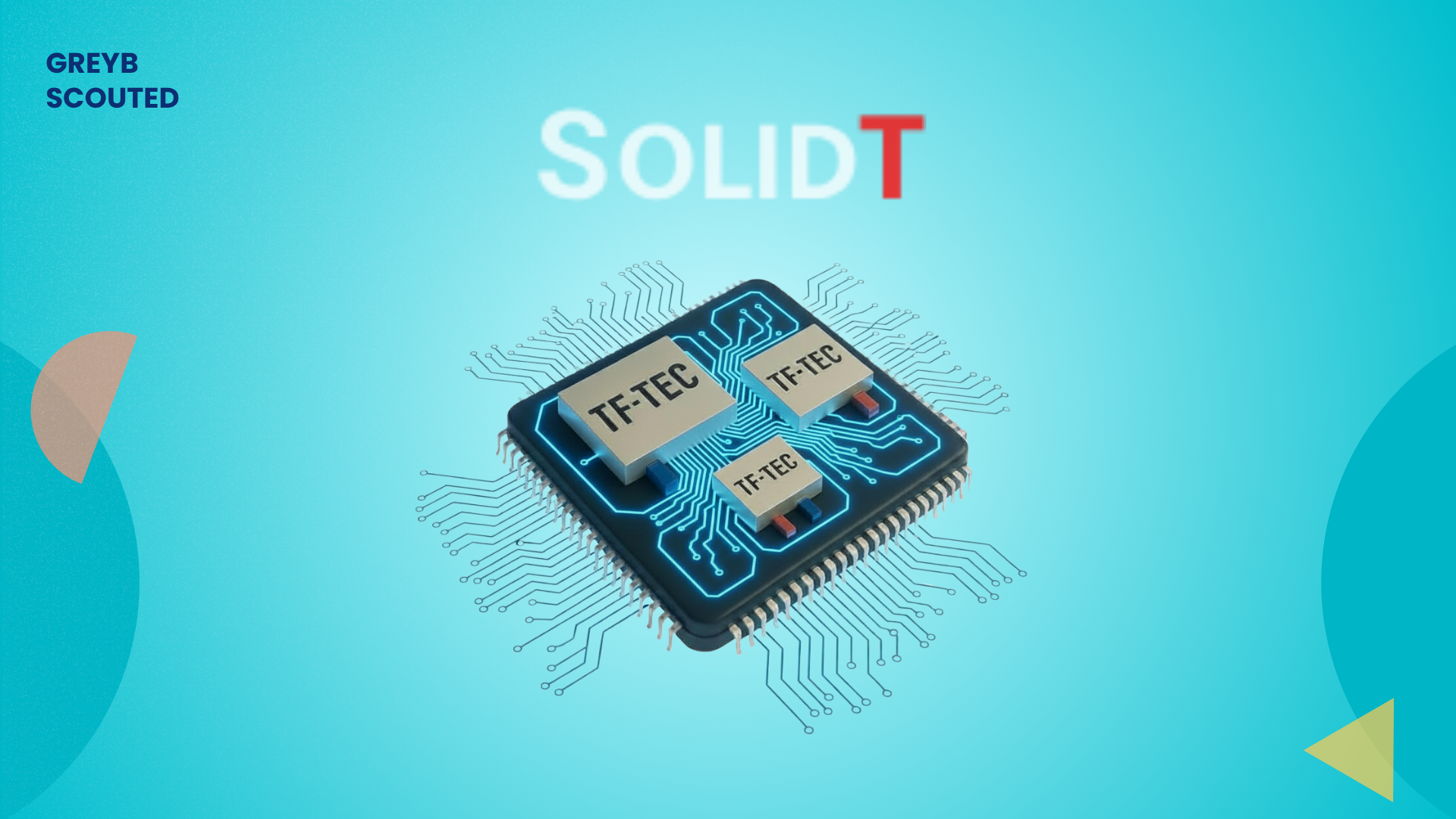
SolidT addresses this challenge with an ultra-thin thermoelectric heat pump that actively pumps heat away directly from the chip or hotspot.
To better understand how they are doing it, we spoke to Ariel Popper, co-founder and CEO of SolidT. This article contains notable highlights from our entire conversation.
This interview is part of our exclusive Scouted By GreyB series. Here, we speak with the founders of innovative startups to understand how their solutions address critical industry challenges and help ensure compliance with industry and government regulations.
(Know more about startups scouted by GreyB!)
“Reducing thermal constraints can significantly improve achievable system performance and unlock the full potential of advanced processors.”
– Ariel Popper

Ariel Popper is the Co-Founder and CEO of SolidT, with nearly 30 years of experience building and scaling businesses. In 1997, he founded Approach Ventures, one of the first firms focused on helping tech entrepreneurs grow their startups worldwide. He also co-founded DATA Detection Technologies and has served as CEO, owner, advisor, and board member across the industry.
He is a member of the International Trade Council’s Business Council for Innovation and Technology, and among his notable wins, he helped grow a four-person tech firm into a major market player.
At SolidT, Popper leads commercial strategy, securing a patented thin-film heat pump portfolio, grant-round investor backing, and a semi-finalist spot at the 2026 ACF AutoTech Grand Prix.
A thermoelectric cooling technology to solve the AI overheating crisis
Most thermal management solutions focus on dissipating heat after it is generated, while SolidT’s technology actively pumps heat away directly from the hotspot. Its next-generation thermoelectric heat pumps are capable of localized, chip-level cooling.
The company has re-engineered thermoelectric cooling materials and architectures to overcome the efficiency limitations. Its ultra-thin cooling modules can actively cool hotspots on CPUs, GPUs, batteries, and other electronics.
Its technology offers high cooling power density, fast response times, lower energy consumption, and compatibility with existing chip architectures. Beyond semiconductors, the platform has potential applications in EV batteries, aerospace systems, advanced electronics, and future thermal management solutions.
SolidT is already executing industrial validation projects with automotive giants like Hyundai and advancing industrial engagements across multiple sectors.
How does SolidT’s technology work, and how is it different from traditional cooling methods?
Ariel: Traditional thermal management systems generally fall into two categories: heat dissipation and active cooling. Heat dissipation technologies such as heat sinks, fans, heat pipes, vapor chambers, and liquid cooling systems help move heat away, but they cannot actively cool below ambient temperatures. Active cooling systems like air conditioners can pump heat away, but they are too large, complex, and mechanically intensive to be integrated directly into modern electronics.
At SolidT, we focus on thermoelectric heat pumps. The underlying physics already exists, but conventional thermoelectric systems have historically suffered from low efficiency and limited cooling performance. We redesigned the materials and architecture to eliminate many of those limitations. The result is an ultra-thin heat pump that can actively cool specific hotspots on a chip while consuming significantly less energy than previous thermoelectric approaches.
How does the technology function compared to conventional water-cooling systems?
Ariel: Water-cooling systems require a centralized chiller, pumps, pipes, and circulating coolant. The cooled liquid travels through the system, absorbs heat, and then returns to be cooled again. While effective, it is a large, complex infrastructure that cools the entire system rather than addressing specific thermal hotspots.
Our technology sits directly on or near the heat source itself. Instead of transporting cooling from a remote location, we actively pump heat away at the chip level. After extracting the heat, conventional methods like heat pipes, fans, or heat spreaders can remove it. In many applications, there is no need for complex liquid-cooling systems at all, making the overall solution simpler and more energy efficient.
What industry problem does SolidT solve that existing solutions cannot?
Ariel: Most thermal management companies focus on improving heat dissipation. They build better liquid cooling systems, advanced heat sinks, or immersion cooling technologies. These are valuable solutions, but they are still fundamentally managing heat after it is generated.
We address a different problem. We actively cool hotspots directly where they form. This becomes especially important for modern CPUs and GPUs, where temperature differences across the chip can create thermal stress and mechanical strain. Our cooling modules can be placed only on the hottest regions of the chip, reducing thermal stress and allowing manufacturers to build larger and more powerful processors without compromising reliability.
How can customers integrate the technology into existing products?
Ariel: We support two integration models. Large semiconductor manufacturers can incorporate our cooling layer directly into their chip production processes so that cooling becomes part of the chip itself.
For electronics manufacturers and system integrators, we provide standalone cooling modules that can be attached to existing devices using thermal interface materials. Because our solution is external to the chip architecture, customers do not need to redesign their electronics to benefit from the technology.
What are the primary benefits customers can expect?
Ariel: One of the most important benefits is improved performance. Lower temperatures allow processors to operate at higher performance levels. In many cases, the same chip can deliver dramatically higher output simply because thermal constraints are reduced.
We also extend device lifespan, reduce energy consumption associated with cooling infrastructure, and enable new system architectures. By managing thermal stress more effectively, manufacturers can build larger and more capable chips without encountering reliability issues caused by temperature gradients.
Can this technology be used outside of electronics?
Ariel: Absolutely. A heat pump is a versatile platform technology. It can be used in refrigeration, air conditioning, batteries, aerospace systems, and many other applications.
As a startup, however, we focus on electronics because the market has an urgent problem with very limited solutions. Entering a market where a critical need already exists allows us to create value more quickly before expanding into broader thermal management applications.
How could SolidT impact electric vehicle batteries?
Ariel: EV batteries require precise thermal management to maintain performance, safety, and driving range. Current systems cool entire battery packs using centralized cooling infrastructure, even when only specific areas require temperature adjustment.
Our approach allows cooling and heating at the module or even cell level. Each cooling unit can monitor local temperatures and respond autonomously. This decentralized architecture could improve battery efficiency, stabilize temperatures more accurately, and potentially enable entirely new battery pack designs. We have already discussed integration opportunities with major automotive manufacturers and battery developers.
What performance metrics have you achieved?
Ariel: Thermoelectric performance depends on operating conditions, so there is never a single performance number. Under typical measurement conditions, conventional thermoelectric systems achieve a coefficient of performance around 0.3 to 0.5, depending on operating conditions.
Our technology is designed to achieve COP values between 1 and 3, depending on operating conditions. More importantly, conventional thermoelectric cooling densities are typically around 5 watts per square centimeter. We are targeting cooling power densities above 300 watts per square centimeter and potentially approaching 1000 watts per square centimeter in future generations.
What is the response time and durability of the system?
Ariel: The response time is extremely fast. We verified this as part of an industrial validation program with Hyundai, which included an extensive test campaign across multiple operating and environmental conditions. The response time was one of the factors measured. It came in milliseconds.
Durability is another major advantage. Unlike mechanical cooling systems, we have no compressors, pumps, refrigerants, or moving parts. Once thermal stress challenges are addressed, the cooling modules can operate for decades without failure.
How scalable and compatible is the technology with current manufacturing processes?
Ariel: One of our core advantages is that we remain external to the electronics being cooled. We do not require changes to CPU or GPU architectures. Manufacturers can integrate the cooling layer while maintaining their existing designs.
Our modules are also flexible, which is unique in the thermoelectric industry. Traditional systems are rigid and struggle with curved or irregular surfaces. Our manufacturing process, which uses a proprietary layer-by-layer deposition approach, allows us to create thin, flexible cooling elements that conform directly to the surfaces they cool.
What are your future expansion plans?
Ariel: In the near term, our focus remains on semiconductors, high-performance computing, data centers, advanced electronics, and EV battery applications. These markets face some of the most pressing thermal challenges and can benefit immediately from localized active cooling.
Over the longer term, we see opportunities in many industries that rely on heating and cooling. The underlying technology is versatile, but our strategy is to first establish leadership in chip-level cooling before expanding into larger thermal management markets.
Meet our Interviewer – Anusha Srivastava, Senior Research Analyst at GreyB

Anusha Srivastava, Senior Research Analyst
Want to find other scalable startups working on thermal management solutions for Batteries, EVs, and electronics? Please fill out the form below to contact our experts.