



Since early 2025, PTAB practice has shifted from routine patent defense to a more selective, time-sensitive strategy. IPR remains one of the strongest tools for challenging patent claims, but Q1 2026 shows it now operates under tighter scrutiny.
Petitioners are filing fewer cases. The Board is denying more petitions than it institutes. Patent owners are using parallel court timelines with more control. And the gap between a strong invalidity argument and an instituted IPR has become harder to cross.
The filing data makes the shift clear. New IPR filings fell to 119 in Q1 2026, down from 189 in Q4 2025 and 351 in Q2 2025. That is not a normal quarterly dip. It shows that petitioners are pulling back from high-volume filing and moving toward selective challenges.
But selectivity has not solved the institution problem.
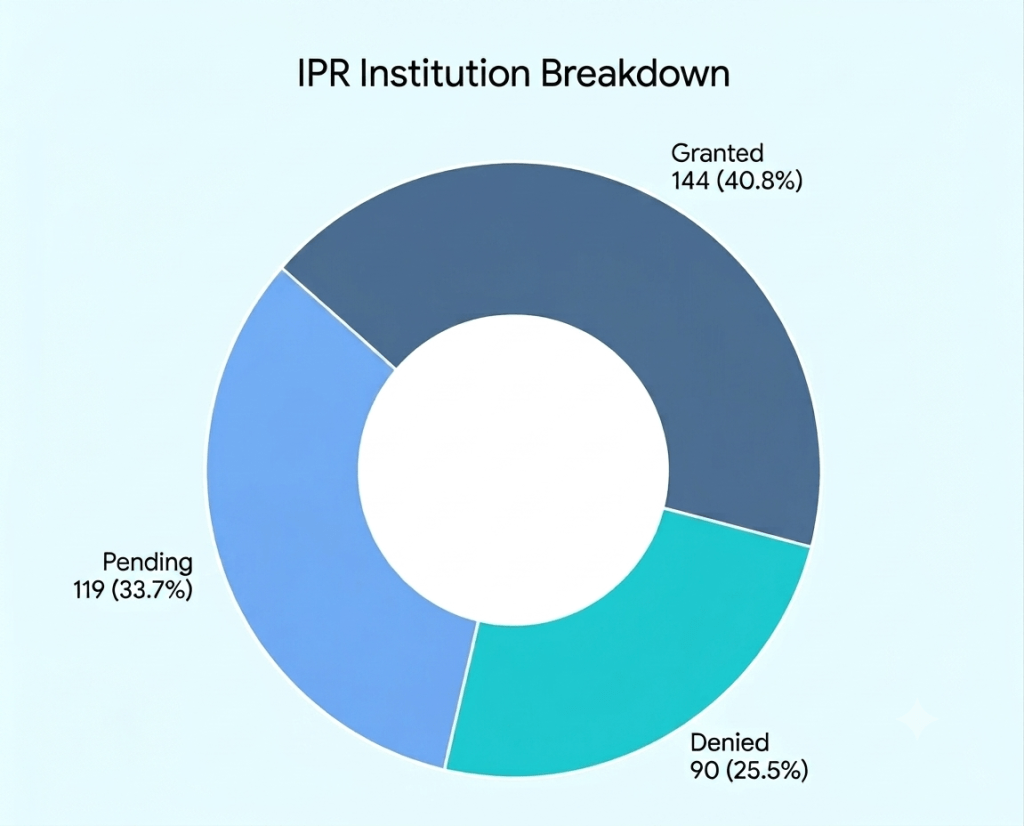
In Q1 2026, PTAB instituted 51 petitions and denied 90. The institution-to-denial ratio fell to 0.57, down from 0.69 in Q4 2025. That means fewer petitions are being filed, yet the Board is still denying more than it grants.
The question is no longer limited to whether strong prior art exists. It is whether the petition can survive the institution stage before the Board ever reaches a full trial.
That survival now depends on factors that sit outside the prior art itself. Filing timing, district court trial dates, Fintiv exposure, patent age, claim construction positions, motivation-to-combine arguments, and claim mapping quality all shape the institution outcome.
This is why Q1 2026 matters. It shows that the PTAB strategy has become less about filing an IPR and waiting for the Board to test the claims. It now starts much earlier, with a clear decision on whether the case is PTAB-fit at all. The new PTAB reality is simple.
A good reference can still lose at the gate. A clean petition, filed at the right time, with a tight technical story, now carries more value than a broad petition built around every possible ground.
61% of Denials Never Reached the Prior Art
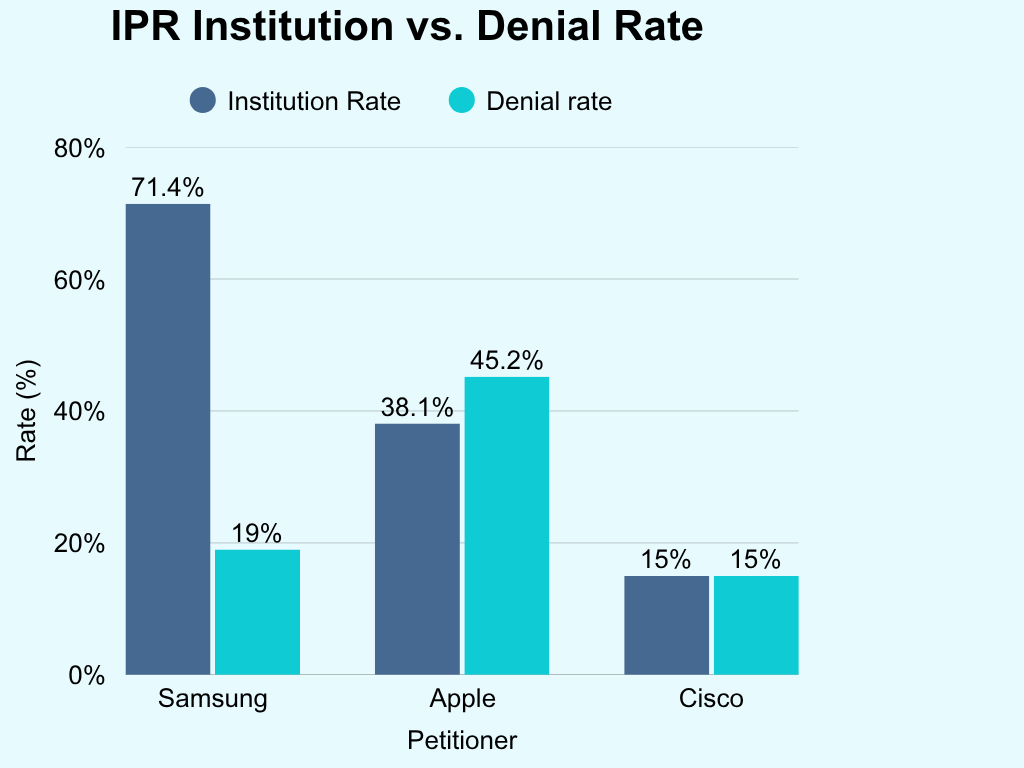
The Fintiv denial count is not distributed evenly across petitioners. Apple, with the highest denial rate among top filers at 62.1%, filed IPRs against patents already in advanced stages at E.D. Texas, W.D. Texas, and D. Delaware. The pattern is consistent across its Q1 2026 filings: reactive petitions, against dockets that had already moved.
Cisco’s 50.0% denial rate traces to filings against MeshDynamics, Damaka, and K.Mizra patents in proceedings where parallel litigation had already reached late-stage fact discovery. The art was not the issue. The docket position was.
Samsung’s institution rate of 71.1% on decided cases, the highest among volume filers, reflects a different approach: filing before parallel litigation advances. The Fintiv window stays open. The timing discipline, more than any difference in prior art quality, separates Samsung’s outcomes from Apple’s and Cisco’s.
Discretionary denial beyond Fintiv added another 17.2% of denials, split evenly between general discretion (8.6%) applied to aged patents and repeated/serial-attack denials (8.6%). The patents involved range from nine to seventeen years old. Samsung v. Massively Broadband (IPR2025-01565/94/95) involves patents issued over twelve years prior. Cisco v. Dynamic Mesh Networks (IPR2025-01569) involves a patent Cisco had known about since 2009, challenged only after litigation was filed in 2025.
No settled-expectations threshold appears in statute. The Board applies it as a discretionary consideration. What the data makes clear is the operative pattern: patents over ten years old that have been incorporated into licensing programs face a materially different institution analysis than recently issued patents.
When the Petition Does Reach Merits, Weak MTC Is the Kill Switch
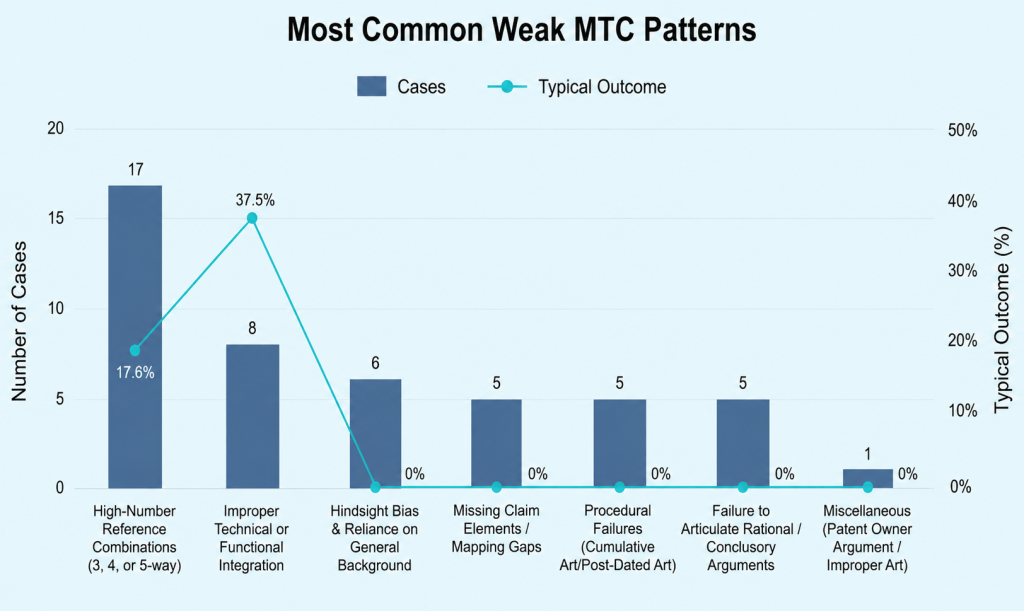
Among the merit-based denials, Motivation-to-Combine failures accounted for the majority. The institution rate differential is stark: strong-MTC petitions are granted at a 64.2% rate (115 of 179 decided), while weak-MTC petitions are granted at just 15.0% (6 of 40 decided).
The failure patterns in this dataset are specific.
High-number reference combinations (3-, 4-, or 5-way) appeared in 17 cases and carried just a 17.6% institution rate. Hindsight reconstruction, where the challenged patent is used as a blueprint to assemble references that never contemplated each other, was cited in 6 denials and carried a 100% denial rate (0% institution). Improper technical or functional integration, the next most common pattern at 8 cases, carried a 62.5% denial rate.
PGR2025-00083 (Samsung v. SnapAid) is the ceiling case. Samsung asserted nine grounds. Five involved four-reference combinations. One used six references. One used seven. The Board found that the complexity of these multi-reference combinations undermined their persuasiveness. The petition failed not because the art was wrong, but because the argument structure signaled that no single piece of art was strong enough to carry the claim alone.
The Board’s position on overloaded petitions has become consistent enough to function as a filing standard. Three-or-more-reference combinations require technical rationale grounded in the art itself, not in expert declaration alone. Expert testimony that restates the petition without independent grounding is now a cited denial basis, not just a weakness.
The petitioner-level denial breakdowns, law firm performance data, and attorney-level MTC success rates that sit behind these numbers are in the full Q1 2026 PTAB Trend Report. Access the complete PTAB 2026 Q1 Report now.
Claim Mapping Gaps: The One Factor That Predicts Failure Before Filing
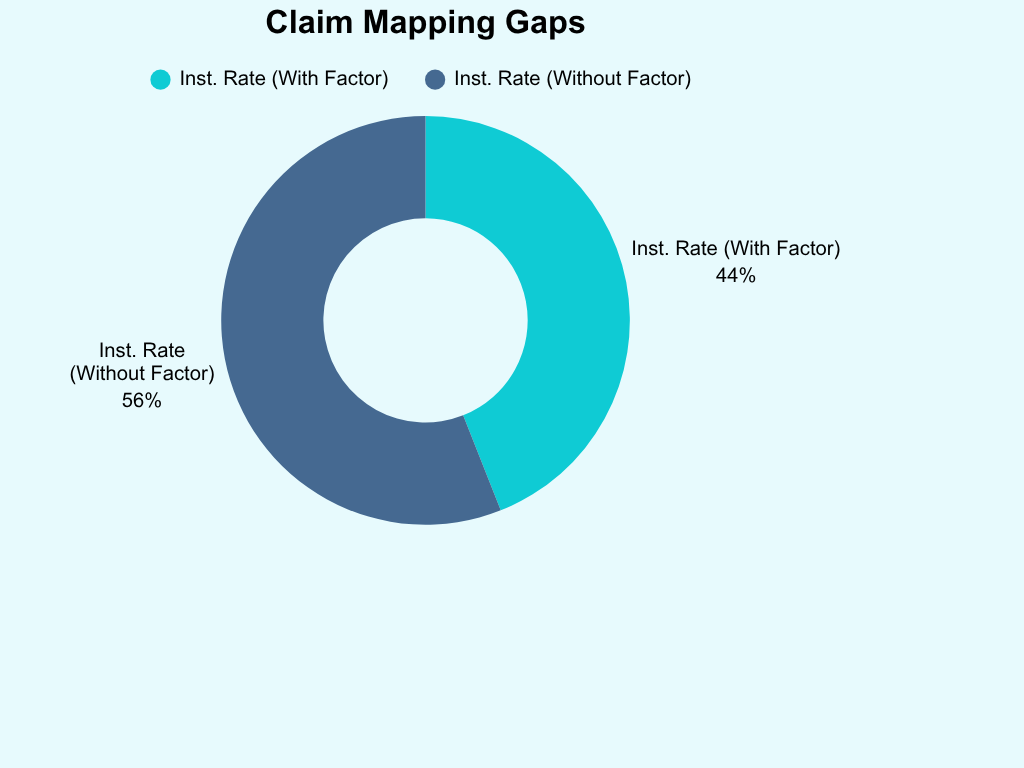
The single most predictive variable in the Q1 2026 dataset is not MTC quality, not prior art type, not petitioner identity. It is whether a claim mapping gap was identified.
Petitions with identifiable claim mapping gaps achieved a 43.8% institution rate. Petitions without mapping gaps achieved 56.0%. That gap persists across technology categories, petitioner types, and prior art configurations.
Claim mapping gaps appeared in 9.06% of cases, 32 of 353. When present, they function as a meaningful denial factor. In TSMC v. Marlin Semiconductor (IPR2025-01054), the petition was denied because the cited references failed to teach the specific FinFET structural limitations at issue. In Cruzr Saddles v. Tethrd (IPR2025-01407), the prior art lacked the specific expandable bridge geometry required, and expert testimony failed to close that structural gap.
The operational implication is direct. Claim mapping quality is one of the few major institution predictors within the petitioner’s control. Fintiv timing can be managed but not always avoided. Patent age is fixed. MTC strength depends on what the art supports. Mapping completeness is a preparation question, and it is one of the few questions where the outcome is not downstream of docket position or portfolio history.
The cases in this dataset that failed on mapping did not fail because the art was unavailable. They failed because the connection between the art and the claim elements was not fully built before filing.
The Sector Gap That Changed the Filing Math
Q1 2026 produced a sharp divergence between technology sectors that reshapes how any IPR scoping decision should begin.
Bio-Pharma achieved a 50% institution rate in Q1 2026, recovering from 43% in Q4 2025. The recovery reflects deliberate selectivity: Chemical and Bio-Pharma filings dropped to 16 petitions in Q1, the lowest volume in the dataset period, as petitioners moved forward only with cases that were technically specific and high-confidence.
Electrical and Computer came in at 33%, down from a brief recovery to 39% in Q4 2025. Despite accounting for roughly 66% of all PTAB activity, the sector faces compounding headwinds: the highest concentration of parallel E.D. Texas litigation, the most active NPE assertion programs, and the greatest exposure to Fintiv denial. The recovery observed in late 2025 did not hold.
Wireless Communication sits at 20.9% institution, among the lowest technology-specific institution rates in the dataset. The primary driver is Fintiv. Wireless 5G and WiFi patents are litigated in E.D. Texas at a rate that means parallel dockets have typically advanced past the institution window before most petitions arrive.
Samsung’s WiFi 6 strategy against Wilus Institute demonstrates the exception. Back-to-back 802.11ax IPRs granted, both with strong MTC, dual 102/103 grounds, and filed before parallel litigation advanced. The same standards-essential patent portfolio that generates Fintiv denials for a petitioner filing reactively was challenged successfully by a petitioner who moved first.
The sector-by-sector FWD outcome data, including NPL win rates broken down by technology category, is in the full Q1 2026 PTAB Trend Report.

NPEs Win at Institution. Operating Companies Win at Final Written Decision.
The NPE dynamic in Q1 2026 resolves into a two-stage pattern with direct implications for how any challenge against an NPE-owned patent should be structured.
Operating-company-owned patents experienced a higher petition denial rate in this dataset (27.2%) than NPE-owned patents (22.0%). The gap is not simply a product of portfolio quality, it reflects active management of Fintiv and other discretionary arguments on both sides, with NPE-side counsel and operating-company counsel alike leaning on parallel-litigation timing.
Fabricant LLP is a dominant firm on the patent-owner side in this dataset, with 14 cases and a 64% denial rate achieved for its clients. Parallel district court filings are timed to generate trial dates that land before projected PTAB Final Written Decisions. Petitions that would survive institution on the merits are denied before the art is evaluated.
At Final Written Decision, the pattern shifts further. Petitioners win all claims in 86.8% of FWDs against operating-company patents. Against NPE-owned patents, the petitioner’s full-win rate is 72.7%. The cases that survive institution against NPE patents are, on average, the strongest petitions in the cohort, since they had to overcome a higher discretionary bar to get there.
The critical decision window in any NPE challenge is pre-institution. Filing within three to six months of district court complaint service maximizes the Fintiv window. Filing after a trial date is set in the E.D. Texas carries near-certain denial.

At FWD, the Petitioner Has Momentum. Patent Owners Are Losing Roughly Four to One.
For cases that reach a Final Written Decision, the outcome distribution has stabilized. In Q1 2026, petitioners achieved full claim invalidation in 58.9% of FWDs, 63 of 93. Patent owners defended all claims in 15% of decisions, 14 of 93. Mixed outcomes accounted for 23.65%, 22 cases, where some claims survived, and others were invalidated.
The roughly four-to-one ratio of petitioner full wins to patent owner full wins has held across the preceding quarters. The mixed outcome rate represents a persistent strategic stalemate. Surviving claims may have sufficient scope to sustain an infringement risk and extend appellate proceedings, while the petitioner has invalidated enough to complicate enforcement.
The FWD data carries one clear implication for portfolios with active licensing programs: once a case is instituted and proceeds to trial, the outcome strongly favors the petitioner. The institution hurdle, not the trial itself, is where patent owner defense strategy must concentrate.
Filing Volume Has Fallen 66% from Early 2025. The Selectivity Isn’t Translating Yet.
New IPR filings reached a historic low of 119 petitions in Q1 2026, a 37% decline from Q4 2025’s 189 filings and a 66% contraction from Q2 2025’s 351.
The decline reflects a structural shift in filing behavior, not a reduction in contested patent activity. Petitioners have moved away from high-volume filing strategies toward selective, high-confidence filings only. The change in behavior is visible in the data. The change in outcomes is not yet proportional.
The institution-to-denial ratio dropped to 0.57 in Q1 2026, down from 0.69 in Q4 2025. Filing fewer petitions has not produced a higher institution rate, because the Board’s standards are moving at a similar pace. The Fintiv threshold is being managed more actively by NPE patent owners. The settled-expectations argument is being deployed earlier in POPR filings. The Board’s standard of compelling merits for PGR proceedings is raising the bar even for cases that would otherwise survive Fintiv.
The full-year 2026 institution rate is projected in the 30 to 32% range, with continued downward pressure as Fintiv conditions become more systematically engineered.

If Volkswagen Wins, the Fintiv Analysis Disappears
One case in the Federal Circuit’s docket has the potential to restructure the framework this dataset describes entirely.
Volkswagen is advancing a constitutional challenge to the Director’s discretionary authority over IPR institution, arguing that giving the USPTO Director effectively unchecked power to deny petitions without congressional guidance violates the Non-Delegation Doctrine. The argument does not claim the Director exercised discretion incorrectly. It claims Congress cannot constitutionally delegate authority of this breadth to an executive agency without defining its scope.
The Federal Circuit has rejected mandamus petitions from petitioners seeking to compel institution, establishing that no constitutional right to IPR institution exists and that Director discretion is sound under current doctrine. Volkswagen’s challenge operates at a different level. If successful, it would require Congress or the courts to establish clearer mandatory institution rules, which would directly affect the settled-expectations framework, the Fintiv analysis, and the current pattern of summary discretionary denials that characterize the post-October 2025 PTAB environment.
The Q1 2026 data reflects a system operating in a specific discretionary posture. That posture has a legal foundation that is, for the first time in the post-AIA era, being tested at the constitutional level.
The PTAB That Existed Two Years Ago No Longer Does
Whatever the Federal Circuit decides in Volkswagen, the framework operating today is the one in this dataset. Constitutional challenges move slowly. Docket clocks don’t.
Q1 2026 confirmed a shift that has been building since mid-2024. Strong prior art is no longer sufficient justification to file. The Board denied petitions before evaluating a single reference in 60% of cases, not because the art failed, but because the timing, patent age, and docket position had already closed the institution window. Those variables are determined weeks after a complaint is served, long before most invalidity teams begin building a reference set.
The petitioners who succeeded in Q1 2026 understood this. Samsung’s WiFi 6 grants didn’t come from stronger art than its competitors held. They came from filing before the Fintiv clock advanced. Bio-Pharma’s 50% institution rate on 16 filings came from moving forward only on cases where the technical story was complete before the docket moved. The mapping-complete petitions that held a 52% institution rate, against 22% for petitions with gaps, succeeded because the claim-element work was finished before the petition was drafted.
The scoping decision, made in the weeks immediately after a complaint is filed, is now the substantive decision. Everything downstream of it, the references, the MTC structure, the claim mapping, works only if that window was protected.
For challenges in scoping now, the question isn’t whether strong prior art exists. It’s whether the prior art covers every claim element completely enough to survive the one institution factor fully within the petitioner’s control.
A gap identified after filing is a gap that cannot be closed.
Find out whether the prior art for a specific challenge is complete before the docket advances.