
A Fortune 500 company wanted to explore functional ingredients for cognitive and mood enhancement. The objective was to identify adaptogens and nootropics that deliver measurable benefits, comply with U.S. regulatory requirements, and are supported by clinical evidence. The client wanted ingredients that can be readily incorporated into relevant food formats.
The challenge was that claims made for various ingredients were often exaggerated. Many lacked sufficient scientific evidence and consumer reviews to support their applicability to the product format.
GreyB helped the client separate promising ingredients from those less likely to deliver the desired outcomes. The assessment covered clinical evidence, US regulations, technical and commercial feasibility, sensory performance, consumer acceptability, and portfolio fit.
Phase 1: Ingredient Scanning & Validation
300+ adaptogenic and nootropic ingredients were scanned for mood and cognition benefits
The study started by building a universe of more than 300 adaptogenic and nootropic ingredients that deliver targeted endpoint benefits across relevant product formats.
The ingredient universe covered:
- Adaptogens
- Amino acids
- Vitamins
- Fibers
- Fatty acids
- Minerals
- Polyphenols
- Nootropics

Almost 50% of ingredients were eliminated during validation
The initial scan was followed by validation based on scientific evidence, human clinical evidence, USFDA approval status, and established presence in relevant food formats.
Almost 50% of the ingredients were eliminated in this validation. Another risk avoided through this step was that 2% of the total ingredients had false regulatory, therapeutic, and food safety evidence. These were removed at this stage.

Phase 2: Parametric Evaluation & Scoring
Each Ingredient Was Evaluated for Application, Clinical Evidence & More
Once the relevant ingredients were identified, each candidate was assessed across food application suitability, availability of human clinical evidence for cognitive and mood endpoints, and plausibility of compliance with U.S. regulatory requirements.
| Parameter | Details |
|---|---|
| Ingredient Name | Alpha Glycerophosphorylcholine |
| Scientific / Common Name | Alpha GPC / Choline alfoscerate |
| Ingredient Type | Nootropics |
| Sample Size | 30 adults (9 males and 21 females) |
| Effective Dosage (per day) | 200 mg |
| Study Duration | 4 weeks |
| Intervention Type | Isolated |
| Endpoint Relevancy | 1. Depression (SDS): Scores decreased significantly from 45.8 ± 7.38 to 43.2 ± 7.47 (p = 0.019) 2. Anxiety (STAI-trait): Scores decreased significantly from 51.9 ± 9.66 to 48.5 ± 10.4 (p = 0.006) |
| Side Effects | No side effects were observed |
| Funded By | Taiyo Kagaku Co., Ltd |
| Regulatory Status | GRAS |
| Maximum Safe Dose | 250 mg/day |
| Sensory Impact | Odorless with a mild sweet/umami taste |
| Stability Profile | Nearly 5% degradation within 24 hours at pH 2 | Sensitive to extreme heat, light, or moisture |
| Bioavailability/Solubility | Water-soluble (up to 20 mg/ml) |
| Synergy | Highly effective when combined with stimulants (like caffeine) or calming agents (like magnesium) |
| Cost of ingredient ($/kg) | $57.25 |
| Cost per Effective Dosage | $0.014 |
A 115-point scoring framework separated Tier I ingredients from lower-priority options
Shortlisted ingredients were further scored across multiple parameters, including cost efficiency, incorporation into food and beverage products, and commercial scalability.
The evaluation parameters included:
- Human clinical evidence
- US regulations
- Technical and commercial feasibility
- Food application suitability
- Cognitive and mood endpoint relevance
- Cost efficiency
- Commercial scalability
- Market growth
- Consumer analysis
- Technical feasibility

Phase 3: Detailed Analysis of Shortlisted Ingredients
Coffee fruit extract showed clinical relevance, but weak consumer traction as a nootropic
Coffee Fruit Extract is a polyphenol-rich nootropic that enhances BDNF and supports cognitive functions with minimal caffeine content.
The extract showed a clear neurochemical pathway. It can increase plasma levels of brain-derived neurotrophic factor (BDNF), which is involved in neuronal growth, memory formation, and learning processes. Elevation of BDNF enhances cognitive performance, particularly in memory retention, focus, and overall brain function.

However, the commercial and consumer picture was more complex.
Product launches showed a steady upward trend with significant acceleration in 2025. Most products appeared in beverage formats. Consumer perception was less clear. Consumers associated coffee with energy from caffeine, not with polyphenols or brain benefits, indicating limited awareness.

Product testing separated formulation-ready ingredients from poor-fit formats
For each shortlisted ingredient, the assessment went beyond secondary consumer review. Sensory performance was tested in final product formats. This helped filter out ingredients less likely to deliver the desired outcome from those that were promising and should be explored by the client.
The testing studied sensory properties and consumer experience to validate performance in real-final product application.
L-theanine showed a neutral, formulation-ready profile
Product testing confirmed that L-theanine showed a neutral formulation-ready profile with high repurchase intent. Color issues were brand-specific, not ingredient-driven.
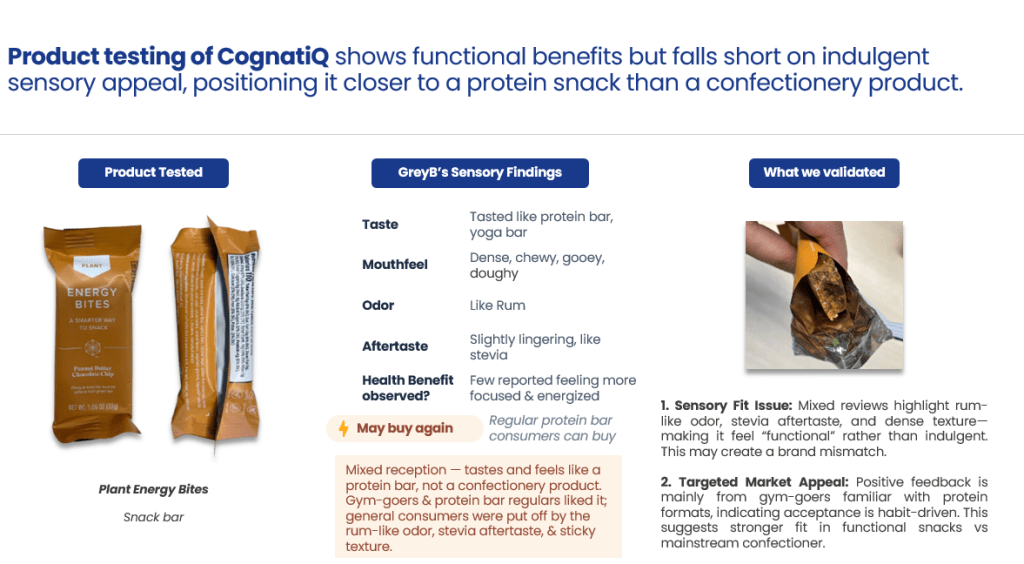
CognatiQ showed functional benefits but fell short on indulgent sensory appeal
The ingredient showed strong clinical evidence but produced an unacceptable sensory experience for the general population. It was a better fit for a targeted population, such as gym-goers.
Phase 4: Strategic Roadmap Creation
Regulatory, efficacy, and formulation insights helped prioritize Tier I ingredients
The shortlisted ingredients were analyzed across regulatory status, effective dosage, maximum safe dose, time-to-effect window, solubility, preservative activity, and key safety risks.

Effective dosages are derived from clinical trial data. Maximum safe doses follow USFDA guidelines. Where no explicit maximum safe dose exists for certain self-affirmed ingredients, safe intake levels are considered to broadly align with their effective dose range.
A strategic roadmap turned ingredient research into portfolio decisions
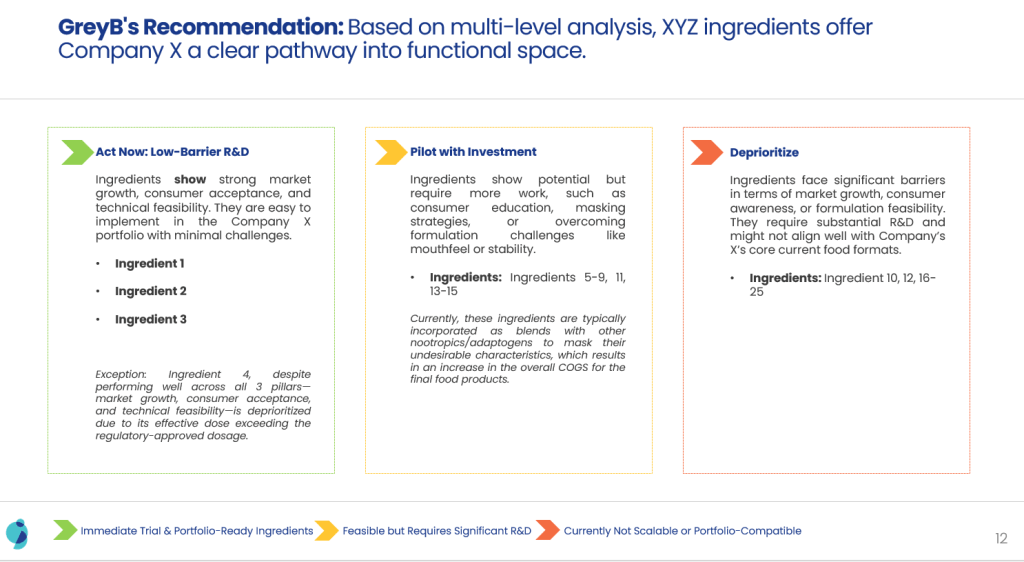
A strategic roadmap was created for Tier I ingredients with the implementation timeline. It categorized the tiered ingredients into short-term, mid-term, and long-term, helping the client prioritize based on the intersection of market growth, consumer-driven analysis, and technical feasibility.
Based on multi-level analysis, XYZ ingredients offered Company X a clear pathway into the functional space.


Exception: Ingredient 4 performed well across all 3 pillars: market growth, consumer acceptance, and technical feasibility. It was still deprioritized due to its effective dose exceeding the regulatory-approved dosage.
Currently, ingredients in the pilot category are typically incorporated as blends with other nootropics or adaptogens to mask undesirable characteristics. This increases the overall COGS for final food products.
Ingredient opportunity matrix
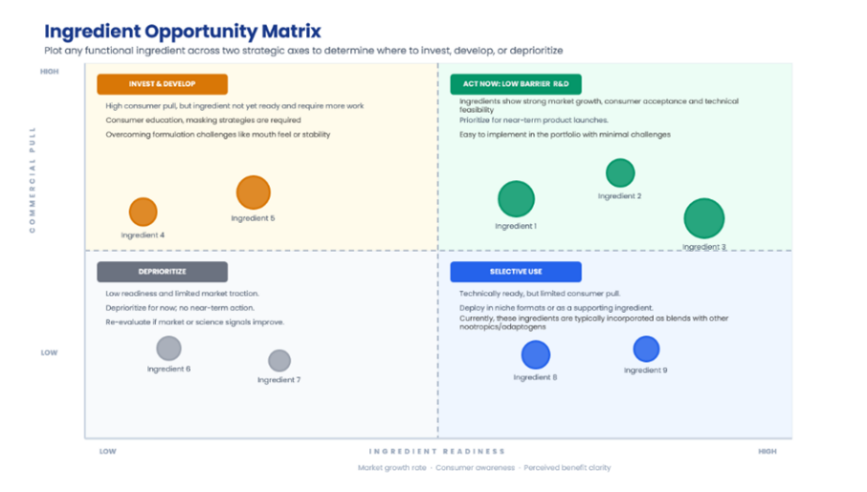
The final matrix plotted each functional ingredient across two strategic axes to determine where to invest, develop, or deprioritize.
Which cognitive and mood ingredients work best for food and beverage R&D?
The best functional ingredient is not the one with the strongest claim on paper. It is the one that can clear clinical relevance, regulatory plausibility, sensory acceptance, cost, stability, and format-fit checks before it enters product development.
For food and beverage companies, this means moving beyond broad ingredient lists and supplier claims. A structured ingredient scouting process can help teams identify feasible, cost-efficient, and regulatory-compliant options.
GreyB helps clients move from broad research, patent noise, supplier claims, and early-stage concepts to validated solutions that can be prioritized for product development.
Fill out the form below and connect with our expert today.