




A Wi-Fi 6 patent can be essential to IEEE 802.11ax and still be a weak starting point for an automotive licensing discussion.
Vehicles do not implement Wi-Fi 6 as one uniform technical stack. Infotainment systems, telematics control units, AVN systems, cockpit modules, wireless projection, passenger connectivity, and over-the-air updates draw on different parts of the standard. Much of that implementation also enters the vehicle through suppliers rather than technology designed directly by the OEM.
That creates a gap between standard relevance and automotive relevance.
GreyB tested that gap against a sample portfolio. Of 43 potential Wi-Fi 6 patent families reviewed, only 10 families, roughly 23%, combined two conditions: they were Core SEPs and mapped to features showing high commercial adoption in automotive products.
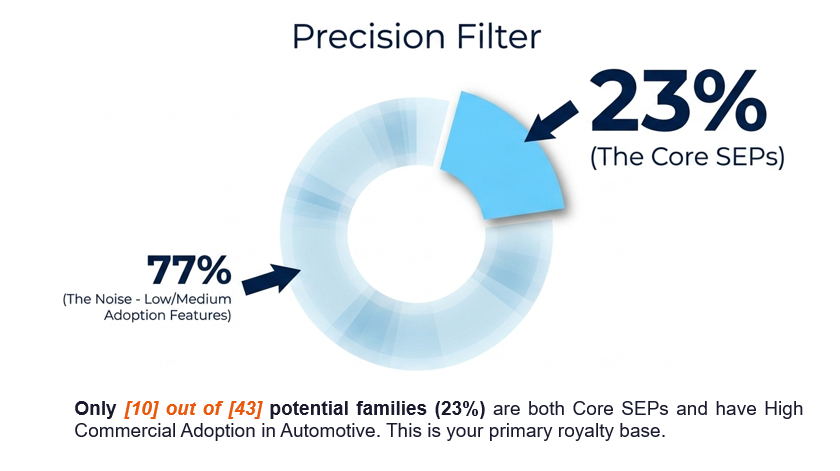
The other 77% should not automatically be called worthless or non-essential. They simply cannot carry the same automotive licensing weight without additional implementation evidence.
That distinction changes the royalty discussion.
346 Automotive Models Show How Much Narrower the Vehicle Stack Is Than Wi-Fi 6
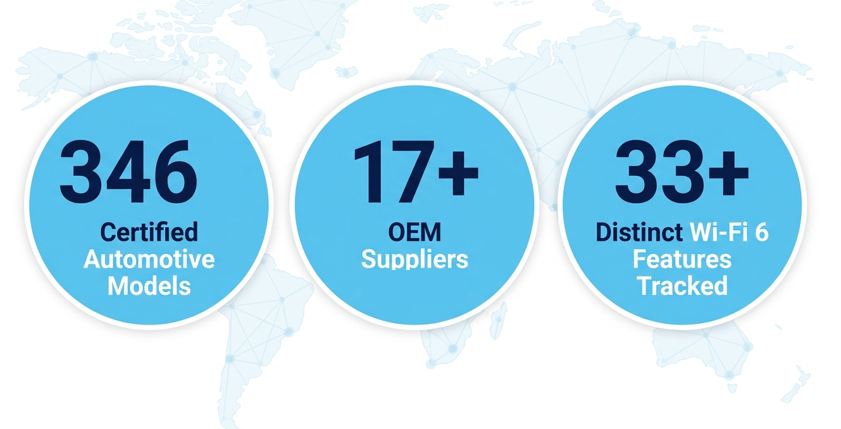
GreyB started from product implementation rather than patent declarations. The analysis covered 346+ certified automotive models across 17+ suppliers and tracked more than 33 distinct Wi-Fi 6 features. The objective was to determine which parts of the Wi-Fi 6 standard repeatedly appear inside actual automotive products.
That matters because a conventional Wi-Fi 6 patent landscape answers useful questions about who owns patents, which technical areas their portfolios cover, and where standard contributions are concentrated. GreyB’s article on using a Wi-Fi 6 patent landscape in licensing negotiations shows how such a structured view helps narrow large patent sets before deeper technical analysis.
Automotive licensing needs another layer after that. The patent may cover Wi-Fi 6. The next question is whether the automotive product uses the feature covered by that patent.
The analysis grouped implementation into three levels. High implementation refers to features that appear in more than 25% of mapped automotive models. Medium implementation covers roughly 10% to 25%. Low implementation refers to features that appear in fewer than 10%.
The high-adoption group includes technologies such as BSRP Trigger, DL MU-MIMO, MU EDCA, MU-BAR, MU-RTS, M-BSSID, SU Beamformer/Beamformee, UL/DL OFDMA, and LDPC Rx/Tx. Medium-adoption features include Wi-Fi 6E, MCS 10-11, SU-MIMO, operating-mode controls, Block Ack mechanisms, TXOP RTS, beamforming sounding, UL MU-MIMO, and A-MPDU. Individual Target Wake Time and HE NDP sit toward the lower end of automotive implementation in the analyzed dataset.
The result is not simply a ranked feature list. It gives both sides of a negotiation a way to separate the Wi-Fi 6 standard from the Wi-Fi 6 stack actually being bought, integrated, certified, and shipped in vehicles.

Essentiality Tells You Whether the Patent Reads on the Standard. Adoption Tells You Whether the Market Uses It
A portfolio review that stops after essentiality analysis answers one question: does this claim map to Wi-Fi 6?
The automotive analysis asks a second: does the mapped feature appear meaningfully in vehicles?
A strong automotive-facing asset has three things working together. The patent maps clearly to a specific Wi-Fi 6 feature. The feature appears in automotive products. And adoption is meaningful across the mapped product set.
That is why the portfolio sample narrowed so sharply. Only 10 of the 43 potential families sat at the intersection of Core SEP status and high automotive adoption.
“Essentiality is important, but implementation data is the turning point of the discussion.”— Vishesh, GreyB SEP Team
The same prioritization problem appears in other standards. In GreyB’s 5G SEP identification case study, separating non-SEPs from stronger standard-relevant assets reduced unnecessary non-SEP analysis by 40%, enabling the client to focus resources on patents with greater licensing relevance.
Automotive Wi-Fi needs an additional filter. Removing non-SEPs still leaves the question of commercial implementation. A Core SEP covering a feature that appears in almost every vehicle carries a different automotive position from a Core SEP tied to a feature rarely implemented in the target vehicle category.
Nine Wi-Fi 6 Features Form the Commercial Core of Automotive Implementation

Once GreyB mapped certified automotive products feature by feature, a much tighter cluster emerged. Nine Wi-Fi 6 features showed approximately 95% market adoption across the mapped automotive models: UL OFDMA, DL MU-MIMO, BSRP Trigger, MU EDCA, SU Beamformer, M-BSSID, LDPC Rx/Tx, A-MPDU, and MCS 8-9.
This cluster functions as the practical center of gravity for automotive Wi-Fi 6. That does not mean every patent mentioning one of these terms automatically belongs in a royalty base. Essentiality still needs to be established at the claim level.
It does mean a patent that is both essential and maps to one of these extensively deployed features starts from a much stronger commercial position. For licensors, these families are the obvious candidates to examine first when building an automotive monetization stack. For OEMs, these are the technologies worth tracing first through vehicle platforms, modules, suppliers, and asserted portfolios.
That is also why a general list of high-value Wi-Fi 6 patents still needs a product lens. GreyB’s Wi-Fi 6 high-value patent report is designed to surface patents with strong licensing potential across the broader Wi-Fi 6 ecosystem. Automotive implementation mapping adds a second question: high-value against which products?
A patent may be commercially important in Wi-Fi 6 yet have limited automotive exposure. The vehicle dataset tells you the difference.
A Patent Can Be Essential and Still Be the Wrong Patent to Lead an Automotive Negotiation
The family-level examples from the analysis make this clearer. Some sample families mapped to features such as DL MU-MIMO and UL OFDMA and were in the high-adoption group. Others were mapped to MCS 8-9 or beamforming sounding, with commercial adoption differing. Individual Target Wake Time and HE NDP sat much lower in the automotive implementation data.
This creates several different asset types inside the same Wi-Fi 6 portfolio.
| Asset position | Automotive implication |
| Essential + highly implemented | Strongest automotive candidate. Use for the first-pass royalty and claim-chart set. |
| Essential + selectively implemented | Potentially valuable, but needs product or supplier evidence. |
| Essential + minimally implemented | Technically relevant to Wi-Fi 6, but weaker as a broad automotive royalty anchor. |
| Non-essential + implemented | May still support infringement analysis, but the standard cannot establish product use. |
| Non-essential + low implementation | Low priority for an automotive-focused campaign without stronger product evidence. |
The analysis does not imply that non-SEPs have no commercial value. A non-essential patent can still cover an implementation choice made by a vehicle or module supplier. What changes is the evidence burden. The licensor must prove product use rather than relying on standards essentiality.
The reverse is also true. Patents that initially look weak against a standard should not be discarded casually. In another GreyB engagement, a patent initially viewed as non-SEP was shown to map to hidden mathematical conditions inside the 5G NR specification. That deeper technical analysis strengthened the client’s position in patent-pool and licensing discussions.
The useful lesson for automotive Wi-Fi is not to remove everything outside the top tier. It is to separate current automotive royalty strength from technical essentiality and from broader portfolio value.
Supplier Modules Can Create Wi-Fi 6 Exposure Before the OEM Designs Anything
Automotive implementation introduces another problem that is less visible in smartphone licensing. The OEM may not directly select or design every Wi-Fi 6 mechanism that enters the vehicle.
TCUs, IVI systems, AVN units, cockpit modules, and connectivity platforms often come from suppliers. Those products can determine which Wi-Fi 6 features ultimately enter the vehicle. In the mapped supplier set, Panasonic Automotive accounted for the largest certified-model footprint, followed by LG Electronics, Robert Bosch, Desay SV Automotive, and others.
That means an OEM cannot understand Wi-Fi 6 exposure simply by reading its own system architecture. It needs to trace which supplier module is included in each vehicle program, which Wi-Fi 6 features that module supports, which capabilities are activated in the final configuration, and which asserted patent families map to those mechanisms.
For licensors, the same supplier map works in reverse. A portfolio owner whose patents map strongly to UL OFDMA or DL MU-MIMO can identify which automotive suppliers deploy those features and which OEM platforms contain those modules.
The licensing conversation can then move from ‘we own a large Wi-Fi 6 portfolio’ to a much more specific proposition: these families map to these Wi-Fi 6 mechanisms, those mechanisms appear in these supplier platforms, and those platforms sit inside the vehicles being licensed.
Automotive SEP Negotiations Are Already Moving Toward Deployment Evidence
The same implementation-first principle is already visible in other automotive standards. GreyB’s analysis of automotive SEP licensing in 2026 explains how deployment-level mapping can narrow asserted scope before rate discussions by removing features that are not active in the target vehicle, are tied to future releases, or depend on infrastructure that is not deployed.
That article focuses on V2X rather than Wi-Fi 6, so the technical stacks are different. The negotiation problem is similar: the standard can contain far more technology than a vehicle actually deploys.
For Wi-Fi 6, the 10-of-43 sample shows what that filtering can look like at the patent-family level. Broad portfolio ownership may create an initial licensing narrative, but implementation determines which families deserve to carry the negotiation.
From 33 Features to the Patent Families That Matter Inside a Vehicle
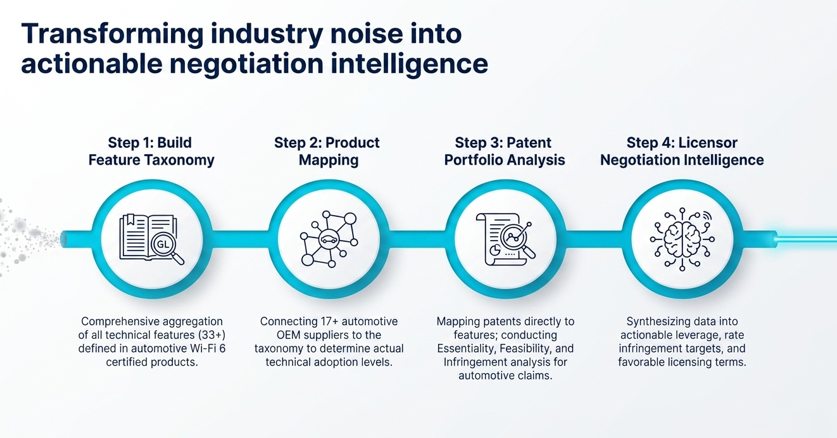
The analysis moves through four layers.
Step 1: Build the automotive Wi-Fi 6 feature taxonomy: Break the standard down into specific mechanisms rather than treating Wi-Fi 6 as a single bucket.
Step 2: Map products and suppliers: Check certified automotive products to determine which features actually appear and how frequently.
Step 3: Overlay the patent portfolio: Map patent families to those features and evaluate their essentiality, implementation relevance, and potential significance for infringement.
Step 4: Convert the analysis into negotiation intelligence: For licensors, identify automotive-facing families, claim-chart priorities, competitor positions, and acquisition targets. For OEMs, identify relevant technology areas, supplier-derived exposure, and lower-priority assertions.
This is where GreyB’s SEP Analysis capability fits naturally. It combines claim-level technical mapping with portfolio and licensing analysis to identify true essentiality, benchmark portfolios, and support licensing or litigation decisions. Automotive Wi-Fi adds product implementation and supplier evidence to that process.
For portfolio owners who need a broader view of monetization readiness before selecting assets for an automotive campaign, GreyB’s SEP Readiness Report extends the analysis to include portfolio strength, licensing strategy, pool position, litigation readiness, geographic coverage, and remaining patent life.
The result is not another patent count. It is an automotive-ready patent stack.
The Portfolio Review Both Sides Should Run Before the Royalty Discussion
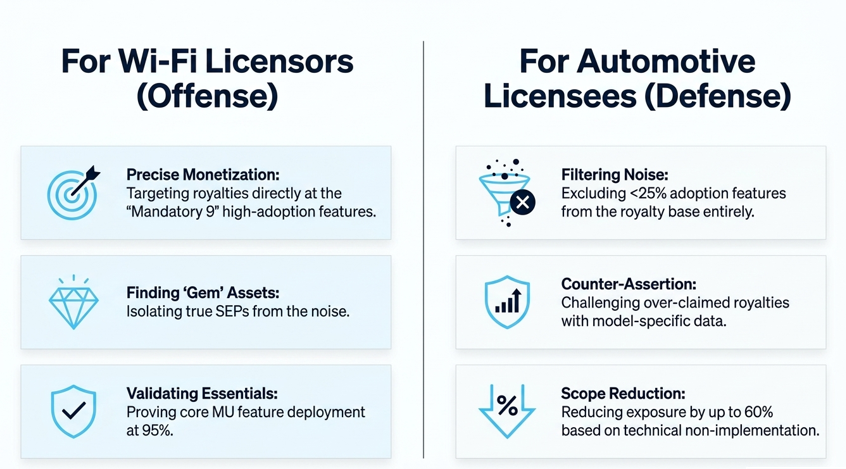
A Wi-Fi licensor may own hundreds of 802.11ax families and still discover that only a small group sits directly inside the automotive implementation core.
An OEM may see broad Wi-Fi 6 demand and discover that some asserted families include features its vehicles barely use.
Neither finding automatically determines a FRAND rate. But both change which patents deserve to drive the negotiation.
The sample makes the point particularly clearly: 10 of 43 potential families combined Core SEP status with high automotive adoption. For the licensor, those are the patents worth proving first. For the OEM, those are the patents worth understanding first. Everything else requires a different level of evidence.
“Do not evaluate a Wi-Fi 6 portfolio only by its size, and do not evaluate automotive exposure only by the Wi-Fi 6 label. Look at implementation, feature adoption, and how the patent stack fits that adoption.”— Webinar closing takeaway
Automotive Wi-Fi 6 licensing should therefore not start with the size of the declared portfolio. It should start with what is actually inside the vehicle.
The full webinar recording walks through the 346-model dataset, 33+ feature taxonomy, 10-of-43 precision filter, supplier mapping, individual family examples, and nine-feature high-adoption stack in sequence. Get the recording by filling out the form below