



SEP litigation in Wi-Fi technologies rose roughly 71 percent between 2020 and 2025. The number of litigated Wi-Fi SEPs nearly doubled over the same period, according to the 2025 SEP Litigation Report cited in LexisNexis IP’s Wi-Fi 7 Patent Report.
That growth is arriving alongside a licensing market that is actively repricing Wi-Fi 6 assets around Wi-Fi 7, not retiring them.
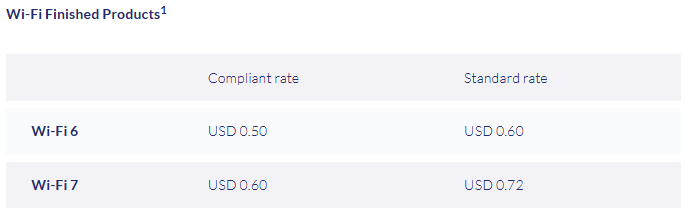
Sisvel’s Wi-Fi Multimode pool, launched in January 2026 as the successor to its Wi-Fi 6-only program, licenses ten founding patent owners under one Wi-Fi 6 and Wi-Fi 7 agreement, reportedly priced at 0.50 dollars per device for Wi-Fi 6 and 0.60 dollars per device for Wi-Fi 7. Huawei, a founding member of that pool, separately announced in June 2026 that its own Wi-Fi 7 royalty rate would be set at 0.50 dollars per unit, building on a Wi-Fi 6 licensing program that had already reached more than 1.2 billion devices by the end of 2024.
The same underlying Wi-Fi 6 portfolio that funded one generation of royalty income now underpins pricing for the next.
That pattern raises a direct question for any portfolio still filed strictly by declared generation. How much of its Wi-Fi 6 asset base already reads on Wi-Fi 7 implementations without carrying a Wi-Fi 7 declaration at all, and how much of that value is sitting unclaimed while the market prices it anyway.
Register to get the webinar recording on: Identify Wi‑Fi 7 Licensing Opportunities Within Your Wi‑Fi 6 Portfolio

Two Patents, One Undeclared Standard: What a Small Sample Check Found
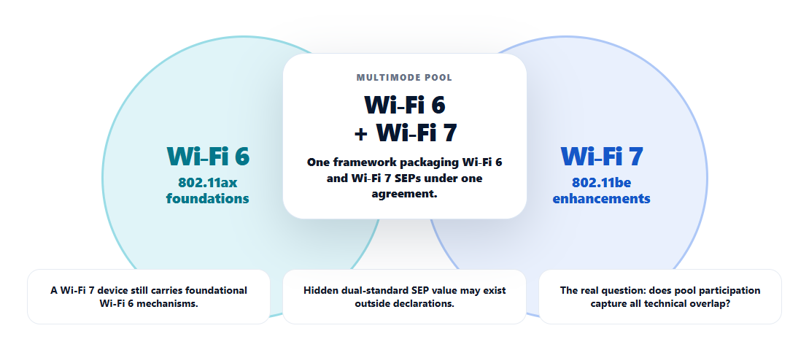
A patent declared to IEEE 802.11ax gets filed under Wi-Fi 6, and a patent declared to 802.11be gets filed under Wi-Fi 7. Portfolio teams have built monetization strategies on that split, treating each generation as a separate licensing surface with its own asset list, even though the split holds only for declaration purposes and breaks down once claims are read against the standard.
Wi-Fi 7 extends several Wi-Fi 6 mechanisms rather than replacing them. Resource unit allocation in Wi-Fi 6 becomes multi-RU allocation in Wi-Fi 7. Trigger-based uplink coordination from Wi-Fi 6 continues into EHT PPDU structures. Target wake time, originally a Wi-Fi 6 power-saving mechanism, gets repurposed in Wi-Fi 7 for deterministic latency and restricted service periods. A claim written broadly enough to cover the underlying mechanism, and not just its Wi-Fi 6 implementation, can read on the Wi-Fi 7 product line without ever being declared there.
Licensing teams usually ask which patents are declared to Wi-Fi 7. A more useful question is which Wi-Fi 6 patents map to Wi-Fi 7 implementations regardless of declaration, because that second list is what determines real licensing exposure and revenue that the declared list alone will never show.
Sisvel Prices Wi-Fi 7 Above Wi-Fi 6 Inside the Same Pool
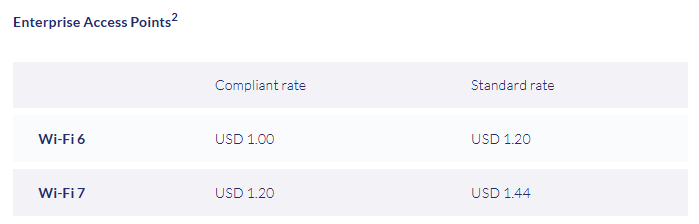
Market structure is already ahead of most individual licensing strategies on this point. The Sisvel pool packages Wi-Fi 6 and Wi-Fi 7 licensing under one program, and its rate structure sets a visible benchmark, with the rate for a Wi-Fi 7 finished product priced above the rate for a Wi-Fi 6 finished product.
Also Read:

The market is pricing Wi-Fi 7 capability at a premium inside a pool built around both generations together, not two separate ones, and that changes how a combined Wi-Fi 6 and Wi-Fi 7 portfolio should be valued going into a negotiation.
A second pool focused on automotive Wi-Fi implementations has also launched, with royalty terms not yet public. Its existence confirms that in-vehicle Wi-Fi monetization is treated as commercially active rather than speculative, and it adds a second revenue channel that a Wi-Fi 6-only view of a portfolio would miss.
Also Read:


Four product categories carry most of the exposure behind these pool structures. Smartphones, laptops, and PCs remain the highest-volume adopters, and fast device cycles make Wi-Fi 7 support a baseline competitive feature. Vehicles are moving Wi-Fi past infotainment into over-the-air updates, diagnostics, charging data exchange, and in-cabin systems. Industrial and IoT devices are adopting Wi-Fi 7’s narrower-channel implementation profiles even without full-bandwidth deployment. AR and VR remain in an earlier stage but are strategically watched, given their dependence on the latency and reliability gains Wi-Fi 7 introduces.
A multimode pool pricing two generations together, across that range of product categories, is a market signal that declaration-only portfolio reviews are built to miss, and the licensing revenue tied to that signal grows with every device category that adds Wi-Fi 7 support.
High-Adoption Wi-Fi 6 Features Carry the Most Licensing Value Into Wi-Fi 7
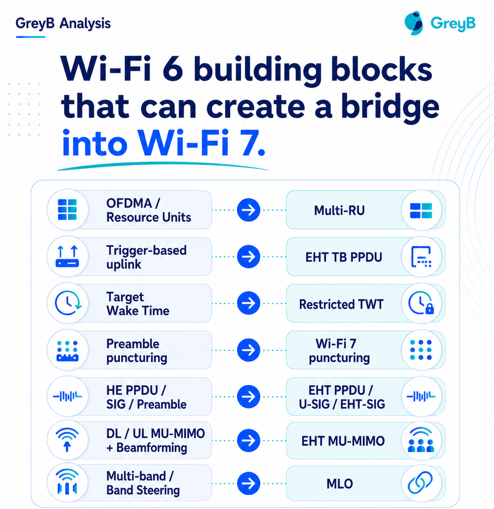
Declaration volume treats every declared feature as equivalent, but product-level adoption data does not support that assumption. When checked against certified Wi-Fi 6 products, some declared features cluster toward high adoption, including MCS-related capabilities, SU and MU beamforming modes, downlink and uplink OFDMA, operating mode indication, and LDPC. A medium adoption group includes MCS 10 and 11, compressed block ack, MU-RTS trigger frame signaling, and sounding procedures involving MIMO. A low adoption group covers narrower, more constrained cases such as SR-only MCS support, extra LTF symbols, and trigger-based SU sounding.

The features clustering into high and medium adoption are not limited to a single generation and serve as continuations or enhancements of Wi-Fi 6 mechanisms carried over into Wi-Fi 7. That makes them the strongest candidates for cross-generational essentiality review, and the strongest basis for a higher royalty claim. A portfolio weighted toward these features carries a different licensing value than one weighted toward the low-adoption group, even when both have the same declared Wi-Fi 6 count on paper.
From 100 Patents to 20 Priorities: What an 80 Percent Accurate Model Cuts From Portfolio Review
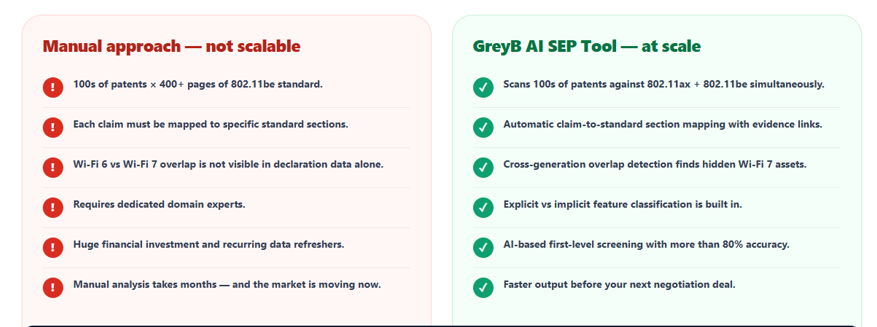
Manual claim-level review does not scale to a portfolio of hundreds or thousands of families. Each claim needs individual reading against a standard that runs thousands of pages, and that work adds directly to expert time and expert cost.
GreyB’s proprietary SEP checking AI tool addresses the scale problem directly. Given a set of patents and a target standard, it returns essentiality indicators along with claim-by-claim element mapping against that standard, tested against public pool and litigation declarations at better than 80 percent accuracy.
The same model extends beyond Wi-Fi into 5G and audio-video codec standards.
Applied to a portfolio of 100 patents, the output is a prioritized shortlist rather than a flat declared list. If 20 of those 100 map to both Wi-Fi 6 and Wi-Fi 7, that subset becomes the group worth deeper expert investment and the strongest negotiation lever, ahead of patents mapping to only one generation. The tool does not replace claim-level expert validation, but it replaces guessing about where to start, and that difference is what turns a flat portfolio audit into a ranked revenue opportunity.

The Portfolio Revaluation Most Licensing Teams Wait Too Long to Run
A portfolio audit that stops at declaration answers only one question, which is what was filed where. It does not answer which declared features actually ship in the products being licensed, and it does not answer which Wi-Fi 6 claims already read on Wi-Fi 7 implementations without ever being declared there.
Both gaps move directly into royalty exposure and negotiation leverage. A patent sitting in a portfolio labeled Wi-Fi 6, mapped to a feature carried into Wi-Fi 7 and adopted at high intensity across smartphones, vehicles, and IoT devices, is a different asset than its declaration category suggests, and that difference translates into licensing revenue that stays unclaimed until someone checks for it.
The full walkthrough of the cross-generational mapping methodology, including the sample essentiality check, the multimode pool rate analysis, and a live demonstration of the SEP checking AI tool, is covered in “Beyond the Declaration: Finding Wi-Fi 7 Value in Wi-Fi 6 Patent Portfolios.”
Portfolios built around Wi-Fi standards rarely get revalued until a licensing negotiation forces the question, and by then the side that already mapped its implementation exposure is the side setting the terms.
The full mapping methodology behind this analysis, including the sample essentiality check, the multimode pool rate breakdown, and a live demonstration of the SEP checking AI tool, is covered start to finish in the webinar recording: Identify Wi‑Fi 7 Licensing Opportunities Within Your Wi‑Fi 6 Portfolio