
Baseline and extended charging remain, while magnetic and active-alignment profiles add new ways to position devices and deliver power.
Qi 1.x relied more on placement. Qi 2.x adds magnetic attachment and active alignment to reduce misalignment.
New power modes, measurement methods, thermal controls and foreign-object checks support higher-power operation.
The certification base spans thousands of products and a long tail of manufacturers beyond the largest brands.
Pool ownership is concentrated
The Via Licensing Alliance pool chart shows a small group of licensors holding a large share of listed patents.
The next phases move from standards evolution to patent ownership and claim-level essentiality work.
Qi 1.x established interoperable wireless charging through the Baseline Power Profile and Extended Power Profile. Qi 2.x expands that base with magnetic alignment, active alignment, higher-power profiles, broader communication rules, stronger safety controls, authentication, thermal management, and support for a wider accessory ecosystem.
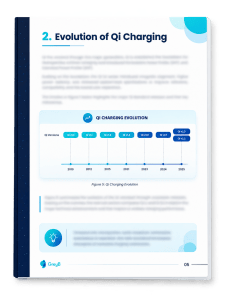
The evolution timeline gives context to when these changes entered the standard. This helps separate long-standing Qi requirements from newer technical areas that may carry greater relevance for patent portfolio analysis, licensing review, and later essentiality assessment.
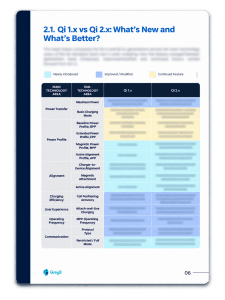
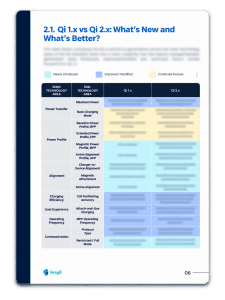
The report compares Qi 1.x and Qi 2.x across power transfer, power profiles, alignment, charging efficiency, communication, power control, safety, authentication, thermal control, accessories, compatibility, and system structure.
The comparison shows which features were carried forward, which were modified, and which entered the standard with Qi 2.x. This distinction helps narrow the technical areas that deserve closer patent review, rather than treating every part of the standard as equally important.
Qi 1.x relied on guided placement or multi-coil transmitter designs. Qi 2.x adds magnetic attachment and supports active alignment approaches that position the device or charging coil more precisely.
The alignment section explains why this matters for coupling, charging reliability, and higher-power operation.
A Three-Phase Framework for Qi Patent Intelligence
Patent analysis in Qi starts with the standard itself. Qi 2.x introduces changes across power profiles, alignment, communication, power control, safety, authentication, thermal management, accessories, and compatibility. These technical areas define the base against which relevant patents can later be identified and assessed.
Phase I establishes this foundation by tracing the evolution of Qi and comparing Qi 1.x with Qi 2.x across the main technical areas covered by the standard.
Phase II will move from the standard to the patent landscape, identifying relevant patents, major patent holders, technical contributors, and ownership patterns across the Qi ecosystem.
Phase III will assess essentiality by comparing patent claims with the Qi standard and its implementation requirements. This phase will separate patents that are relevant to Qi from those that may be essential to practising the standard.
Establish how Qi evolved from Qi 1.x to Qi 2.x across power transfer, profiles, alignment, communication, safety, authentication, thermal control, accessories, compatibility, and related technical areas.
Status: Complete
Identify patents relevant to the Qi ecosystem, map major patent owners, and examine how patent activity is distributed across the technical areas defined in Phase I.
Status: In progress
Compare patent claims with the relevant Qi requirements to assess which patents may be essential to implementing the standard.
Status: Planned
The full Phase I report contains the standards evolution, technical comparison, Qi charging architecture, patent pool analysis, product signals and the roadmap for the next two research phases.