




Japanese beauty trends offer an early view of what an older consumer market may demand over the next two decades in the US and Europe.
29% of Japan’s population is over 65. Every other developed market is on the same curve, roughly a decade behind. EU is at 22%, while the US is at 18%. Japan is therefore confronting these consumer needs earlier than most developed markets.
Its beauty industry is responding differently too.
US and European anti-aging products often focus on correcting visible signs like wrinkles. Japan takes a different approach. Regulations restrict aggressive anti-aging claims and encourage brands to treat aging as a natural biological process.
As a result, J-beauty companies now increasingly focus on maintaining skin resilience before visible deterioration becomes difficult to manage. Shiseido, Kao, and Kosé are studying mitochondrial health, developing RNA-based skin analysis, and introducing precision-fermented proteins into cosmetics.
At the same time, J-beauty brands are upgrading heritage ingredients through biotechnology. Japanese innovators are also targeting environmental aging by addressing skin damage from ultraviolet exposure, pollution, and humidity changes.
Our Asian Beauty Innovation Trends 2027 delivers deep intelligence on Korea’s, Japan’s, and China’s cosmetic landscape. It maps key clinical evidence, patent positions, biological targets, and activities of leading market players. Use these insights to strategically build, partner, license, or invest before these breakthroughs go mainstream in your home market.
Japanese Beauty Trends #1: Shifting From Treating Aging Signs to Maintaining Skin Resilience
For decades, anti-aging skincare competed at the symptom level. Products focused on improving visible outcomes such as wrinkles, firmness, and pigmentation after they appeared.
R&D teams, with Japan at the forefront, now target the biological processes that cause skin to change.
After the age of 40, skin requires not only hydration but also a ‘restart’ of regeneration mechanisms
Dr. Yukiko Nakamura, a dermatologist with 25 years of experience
| Market | Innovation Approach to Aging |
| US/European anti-aging | Correct visible aging signs through clinically validated ingredients |
| Korean beauty | Bring clinically studied actives into accessible consumer products |
| Japanese beauty | Understand aging mechanisms and maintain skin resilience |
Two major factors play a role here:
Japan’s aging population creates demand for long-term skin maintenance. It has the world’s largest aged population, with around 29% of people aged 65 years or above. This demographic shift is changing beauty preferences. Consumers are moving beyond products that only conceal aging signs. They are looking for solutions that support healthy aging and address age-related skin changes.
Mintel’s 2025 data estimates that Japan’s senior cosmetics market will exceed JPY 300 billion, and 62% of senior women explicitly state they want beauty products relevant to their age. They are not looking for “anti-aging,” but rather age-appropriate skin maintenance solutions.
Regulators are changing the anti-ageing approach towards maintenance: In Japan, companies do not market many products under the term “anti-ageing.” Instead, they fall under the category of “ageing care (エイジングケア, eijingu kea)”. Japanese cosmetic guidelines recognise ageing as a natural biological process rather than something that can be reversed. Hence, products are expected to address specific skin concerns, while avoiding claims such as: “turn back the hands of time“, “prevent ageing“, etc.
This shift from correction to maintenance is evident in the product portfolios of Japan’s largest cosmetics companies. Their “aging care” products now target specific biological pathways, such as cellular senescence, mitochondrial health, and immune-mediated tissue repair.

Shiseido Targets Cellular Aging With Fermented Camellia & Autophagy
Shiseido positions its 2025 ULTIMUNE Power Infusing Serum as an ageing care product that slows the skin ageing cycle. The product is based on Shiseido’s 30 years of research into skin resilience. Based on Shiseido’s patented Power Fermented Camellia+ technology, where Camellia seed extract undergoes bio-fermentation inspired by traditional Japanese koji fermentation. Shiseido reports that fermentation increases amino acid content in Camellia seeds by 3.4×, helping support skin’s moisture barrier function.
Clinical trials on 107 women highlighted that 98% experienced visibly reduced signs of wrinkles and dryness in 4 weeks. The product showed improvement in a total of 11 ageing signs, including firmness, radiance, and smoothness.

Shiseido is separately studying UVB-related mitochondrial damage with the Tokyo University of Science. The research examines how damaged mitochondria may contribute to inflammation and collagen-degrading activity. Researchers found a plant extract from Lamiaceae family to activate alternative autophagy, a cellular repair process that clears damaged mitochondrial material before it does any visible harm. This mechanism helps interrupt the chain reaction that leads to wrinkles.

Kao Combines Silk-based Barrier Support with Bakuchiol for Skin Aging Care
Kao’s portfolio shows that Japanese aging care is not limited to biological actives.
Kao’s SENSAI brand, particularly the ABSOLUTE SILK range, combines Japan’s traditional beauty heritage with Kao’s formulation science, using Koishimaru Silk extract, a rare Japanese silk historically reserved for the imperial family.
The flagship SENSAI ABSOLUTE SILK MICRO MOUSSE TREATMENT uses Kao’s Micro Bubble Technology, generating approximately 50-micrometer carbonated bubbles. These bubbles are 8000 times smaller than ordinary carbonated water bubbles and are able to penetrate deep into pores. The technology delivers a rich sensory experience while imparting a silky texture to the skin.
The product includes Koishimaru Silk Royal™, an anti-aging complex that Kao developed through its skin science research, and the company positions it around improving moisture, radiance, smoothness, and a youthful skin appearance.

Additionally, Kao’s affiliate NIVEA-Kao developed the Eucerin Hari Filler anti-aging care series for the Japanese market. It featuring Bakuchiol EX (99% pure bakuchiol) that stimulates skin cell activity.
Japanese Beauty Trends #2: Upgrading Heritage Ingredients With Biotechnology
Japanese companies are applying biotechnology, fermentation science, and molecular research to understand why the traditional ingredients work and convert them into proprietary cosmetic platforms. Korean beauty also does that, but there is a difference in the approach. K-beauty emphasises rapid innovation, frequent product refreshes, and visible short-term results, often layering multiple active ingredients to derive benefits.
Japanese beauty, by contrast, prioritizes long-term skin barrier health, minimalism, and reformulation stability, often perfecting a single formula over decades.
Biotechnology-derived ingredients, including recombinant growth factors and fermented lysates, represent a growing part of Japan’s cosmeceutical market. Fermentation processes are known to improve the efficacy of anti-aging products in Japan by as much as 300%. All this reflects Japan’s experience in fermentation and biological processing.
Some Notable Innovations In This Direction Include:
Peptide-Botanical Combination: Japanese formulators are developing hybrid peptide-traditional botanical complexes, combining clinically tested peptides with centuries-old botanical extracts such as green tea catechins, yuzu ceramides, and rice bran ferulic acid. These synergistic complexes address multiple concerns including tone, texture, and environmental damage, while preserving cultural authenticity. For example, J-beauty brand ILEM JAPAN provides a renewal serum that contains Japanese Rice Lees Extract in combination with peptides
Precision-Fermented Proteins into Cosmetics: Spiber’s Brewed Protein™ materials are being developed for use in cosmetics as biodegradable structural components, specifically as fibers for mascara and eyebrow products. Unlike conventional synthetic fibers and microbeads derived from petrochemicals, Brewed Protein™ materials are proteins produced through microbial fermentation using plant-derived biomass (sugarcane- and corn-derived sugars) as raw material.
In November 2022, Spiber and Shiseido jointly launched a mascara product containing sr-polypeptide-1, a type of Brewed Protein™ fiber. This marked the first time a cosmetic product containing Spiber’s material reached the market. The fiber was registered as an INCI name in October 2022, and the joint development focused on formulating it into mascara while maintaining safety, stability, functionality, and usability.

Also Read:

Cross-Industry Heritage Ingredient Research
A notable recent development is the collaboration between the total beauty company uka and Japan Tobacco’s (JT) corporate R&D organization, D-LAB, to launch the “Regenerative Lab” in 2026. The initiative aims to research and bring to market Japan’s indigenous plant ingredients, starting with Izu kuromoji and Ishigaki henna – key natural ingredients used in the uka beauty hair and scalp care product line
The collaboration brings together uka’s expertise in salon-based beauty product development and JT’s long-standing capabilities in plant research and quality management.
By connecting the experiences created in salons with the backing of research, we will re-examine the value of Japanese plant-based ingredients and raise them to a level that is recognised globally
Commented by Hiroyuki Watanabe, CEO of uka
This represents a new model in which companies outside the traditional cosmetics industry bring complementary R&D capabilities to heritage ingredient research.
Japanese Beauty Trends #3: Using RNA and Genomic Data to Personalise Skincare Via AI
Many global cosmetics brands are using AI for surface-level consumer diagnostics and product recommendation engines. What distinguishes Japan is the use of deep-level molecular biological data as an input for personalization. According to Mintel, Japan ranks among the top three globally in AI-related patent applications.. What sets Japan apart, however, is the quality of its AI patents: the country’s overall patent grant rate is approximately 75%, and for AI-specific inventions, it exceeds 80%.
For the cosmetics industry, this has a direct implication. When a country produces AI patents of this quality and durability over decades, the technologies emerging from that ecosystem are not just passing trends. They are built to last and designed to solve real problems.

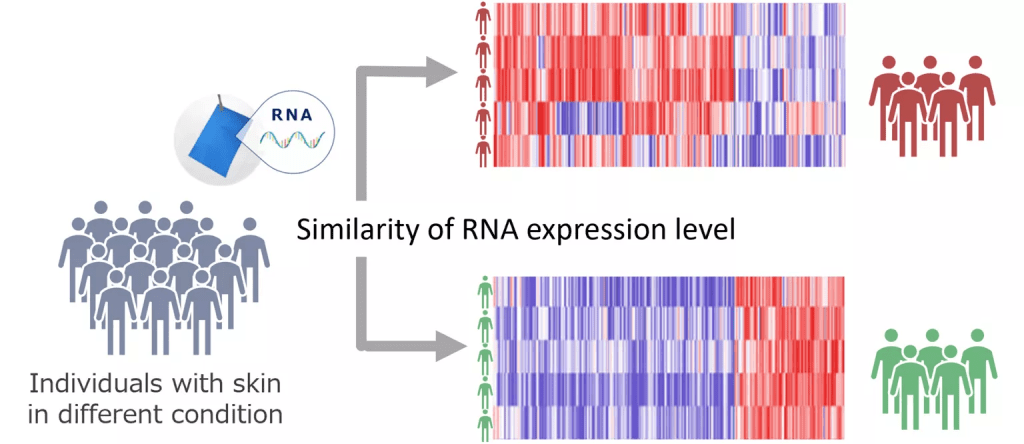
Combining AI with Sebum RNA Expression, Ingredient-induced Gene Responses & Genomic Datasets
This allows personalization to move beyond analyzing visible skin features or questionnaire responses toward identifying biologically distinct skin states and selecting products or ingredients accordingly.
Kao will officially begin developing cosmetics and beauty services using skin gene data, sharing technology with other companies to accelerate the development of products optimised for each consumer. Kao has launched skincare and haircare lines for its SOFINA and THE ANSWER brands, using RNA analysis data to determine skin type and recommend appropriate products.
Consumers photograph their face through a smartphone app, which helps infer RNA information from sebum, classify skin characteristics, and recommend suitable products. Kao was first to make this groundbreaking discovery in 2019 that sebum contains an abundance of RNA. The development process involved collecting over 10,000 facial images from more than 5,000 people, using AI to learn correlations between skin color, shape, and RNA data.
A.D.A.M. Innovations (Genesis Healthcare) launched ALUNAÉ in December 2025. This was the first genomic-based skincare line formulated to address environmental ageing unique to Japanese and Asian skin. ALUNAÉ uses Japan’s genomic population database, which has more than 2.8 million genetic tests. Genomic analysis and AI models inform how ingredients are selected, combined, and optimised to address environmental ageing factors including UV exposure, pollution, humidity shifts, and oxidative stress. The formulation includes GA-6 (Geno Active-6) , a complex of six bioactive ingredients chosen for their affinity with pathways linked to hydration, radiance, and environmental stress adaptation.
Peer-reviewed research has validated this approach for screening bioactive ingredients based on genetic impact. Dr. Tadayoshi Miyashita, the researcher behind the project, noted that through advanced DNA sequencing and bioinformatics analysis, the team identified over 60 new gene expressions previously unknown through conventional genetic analysis alone.
Regulatory & Consumer Acceptance Remain Key Challenges
The adoption of data-driven beauty solutions will depend on how companies manage privacy, regulation, and consumer trust. Under Japan’s Act on the Protection of Personal Information (APPI), medical, health, and genetic information is classified as “special care-required personal information.” Companies require explicit consent before collecting this type of data, creating a higher threshold compared with ordinary personal information. This directly impacts developing AI-personalised beauty models that rely on biological data.
Consumer acceptance is another consideration. Mintel research indicates that Japanese consumers show relatively cautious attitudes towards AI compared with some other markets, particularly when AI decisions involve personal data and trust-based decisions such as health and beauty recommendations.
The Strategic Path Ahead
To stay competitive, R&D and innovation teams must evaluate which of these innovation pathways align with their upcoming product and technology roadmaps. Next-generation aging care requires moving beyond surface-level corrections to target underlying biological pathways, including mitochondrial health, autophagy, barrier repair, and cellular resilience.
The key is acting proactively. Companies need to decide whether to build these capabilities in-house, license them, co-develop with Japanese research partners, or monitor them until stronger evidence emerges. By mapping relevant patents, biological targets, suppliers, datasets, regulatory limits, and commercial readiness today, brands can establish differentiated technology platforms well before competitors.
Slate, our R&D intelligence tool, connects patents, papers, and clinical studies in one interface so you’re the person in the room who already knows what’s coming. Just ask any question like “Which emerging technologies are Japanese beauty companies using to maintain skin resilience during ageing?“

Ask Slate: “Which technologies do J-beauty companies use to maintain skin resilience during ageing?”