
A leading food manufacturing company was exploring a new application for a specialized food texturizer.
Led by its R&D and Open Innovation team, the initiative aimed to identify external partners for ingredient supply and collaborative product development.
The need was highly specific due to stringent regulatory standards requiring extremely low impurity levels in the ingredient. It had to meet strict specifications for nitrogen content, ash levels, contaminants, purity, gel strength, and binding capacity, which significantly limited the pool of potential suppliers.
Shortlisted solutions also needed to be commercially viable and capable of supporting large-scale production. Most commercially available offerings did not align with the desired technical profile, making off-the-shelf solutions unsuitable.
GreyB helped the company evaluate relevant solutions, assess supplier capabilities, and identify partners with strong manufacturing and collaboration potential.
35 Relevant Food Texturizer Products and Manufacturers Were Identified
The assessment began with an extensive search to identify food-grade texturizer manufacturers that could potentially meet the client’s stringent technical requirements.
This research covered both commercial and pre-commercial manufacturers to capture companies with existing products as well as those developing next-generation texturizer solutions.
Supplier websites, technical literature, product catalogs, industry databases, and regional search platforms were used to build a comprehensive supplier landscape.
To expand coverage beyond English-language sources, native-language searches were also conducted using platforms such as Baidu and Naver. This enabled the identification of manufacturers in markets where technical and commercial information is often published only in local languages.
Through this process, approximately 35 relevant products and their respective manufacturers were identified.
These included suppliers offering hydrocolloids, modified starches, gums, and other functional texturizing ingredients with potential applicability to the client’s target specifications.
Public Supplier Information Was Not Enough to Validate Technical Fit
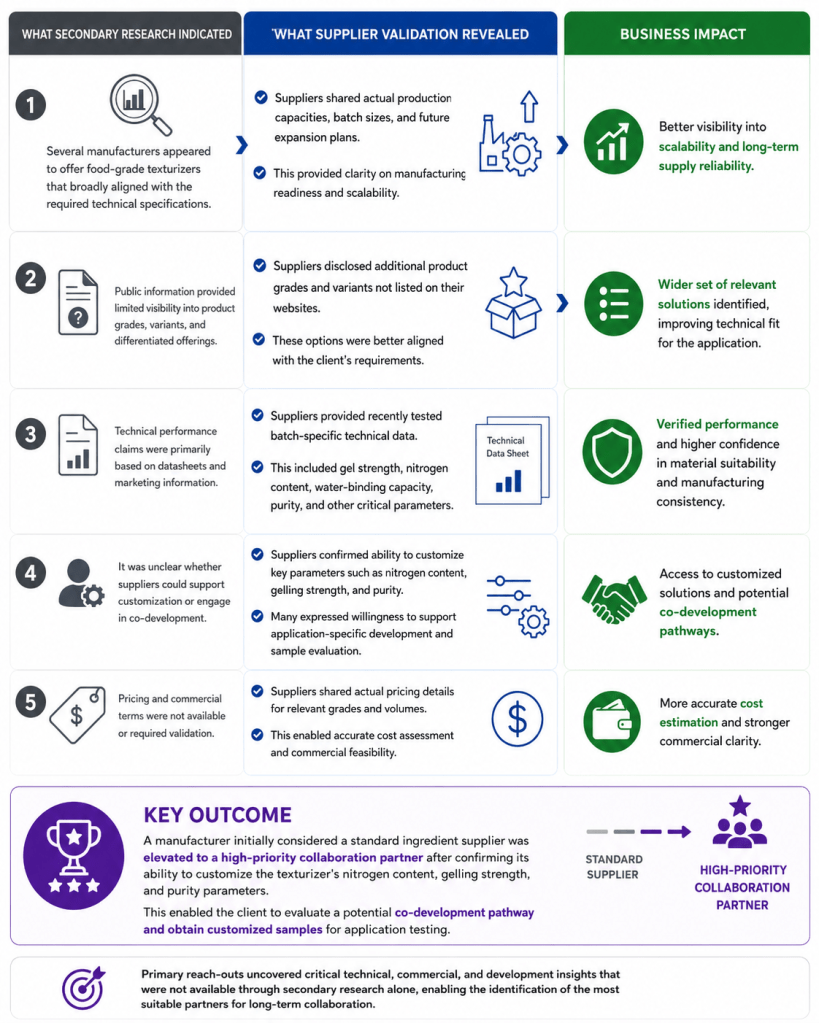
Several manufacturers appeared to offer food-grade texturizers that broadly aligned with the required technical specifications.
However, public information provided limited visibility into actual production capacity, scalability, pricing, and availability of different product grades.
Technical performance claims were primarily based on datasheets, marketing materials, and product descriptions. It was also unclear whether suppliers could support customization or engage in co-development for the target application.
Since the application area was still being explored, the company needed partners capable of adapting existing products and participating in joint development efforts. Publicly available information offered limited insight into supplier flexibility, manufacturing readiness, customization capabilities, and willingness to collaborate.
Primary Reach-Outs Revealed Non-Public Supplier Capabilities
Given the highly specialized nature of the requirement and the limited availability of suppliers meeting the desired specifications, extensive primary reach-outs were conducted with shortlisted manufacturers.
The objective was to validate supplier claims, uncover non-public information, and assess each manufacturer’s ability to support long-term collaboration.
Through direct discussions, the team gained visibility into product-specific capabilities, manufacturing readiness, scalability, commercial feasibility, and supplier flexibility that could not be determined through websites, brochures, or technical literature alone.
These interactions also revealed additional product variants, validated technical performance data, and opportunities for product customization that were not publicly disclosed.
Supplier Validation Helped Convert a Standard Supplier Into a Collaboration Partner
Direct discussions with manufacturers uncovered information that was not publicly available.
Suppliers shared actual production capacities, batch sizes, and future expansion plans. This provided clearer visibility into manufacturing readiness, scalability, and long-term supply reliability.
They also disclosed additional product grades and variants that were not listed on their websites. These options were more closely aligned with the client’s requirements.
Several suppliers provided recently tested batch-specific technical data, including gel strength, nitrogen content, water-binding capacity, purity, and other critical parameters. This enabled validation of performance claims and higher confidence in material suitability and manufacturing consistency.
Suppliers also confirmed their ability to customize key parameters such as nitrogen content, gelling strength, and purity. Many expressed willingness to support application-specific development and sample evaluation.
In one instance, a supplier agreed to develop a higher-specification variant tailored to the client’s requirements. This transformed the opportunity from a standard sourcing exercise into a potential long-term development partnership.
Food Additive and Functional Ingredient Suppliers Were Assessed for Application Fit
The supplier landscape included food-grade hydrocolloid and functional ingredient manufacturers with potential relevance to the client’s target specifications.
Zibo Alchemist Biotechnology is a China-based supplier of food-grade hydrocolloids and functional ingredients, including xanthan gum, modified starch, carrageenan, gellan gum, and agar.
The company supports food, beverage, meat, and industrial applications through dedicated manufacturing facilities, quality management systems, and application development capabilities.
Newgreen Herb is a China-based supplier of food additives, plant extracts, and functional ingredients used across food, beverage, and nutritional applications.
Zibo offers customized formulations, technical support, and a broad portfolio of ingredients designed to improve texture, stability, and functional performance.
Assessment Approach
1. Identifying Relevant Food-Grade Texturizer Manufacturers
The first step focused on broad supplier discovery to ensure comprehensive coverage before narrowing the landscape based on technical suitability, manufacturing capabilities, and potential for collaboration.
This search covered:
- Supplier websites
- Technical literature
- Product catalogs
- Industry databases
- Regional search platforms
- Native-language sources, including Baidu and Naver
It helped identify approximately 35 relevant products and their respective manufacturers across hydrocolloids, modified starches, gums, and other functional texturizing ingredients.
2. Ranking and Evaluation Through Supplier Reach-Outs
Once potential manufacturers were identified, they were evaluated across multiple parameters to determine their suitability for the client’s application.
The evaluation parameters included:
- Technical feasibility: Assessing key performance parameters such as gel strength, nitrogen content, purity, and water-binding capacity.
- Commercial viability: Evaluating product pricing, production capacity, and scalability to support future commercialization.
- Operational viability: Reviewing food-grade compliance, manufacturing readiness, and supply reliability.
- Strategic fit: Assessing customization capabilities, geographic relevance, responsiveness, and willingness to engage in collaborative development.
Because the requirement was highly specialized, publicly available information alone was insufficient to validate supplier suitability.
Extensive primary reach-outs and direct discussions with shortlisted manufacturers were conducted to obtain information that was unavailable through secondary research.
3. Validating Supplier Claims and Commercial Readiness
Supplier discussions provided visibility into actual production capacities, product-specific technical performance, commercial terms, additional product grades, and customization capabilities.
They also helped assess each supplier’s willingness and ability to adapt existing products to meet the client’s application-specific requirements.
Following this evaluation, the manufacturers were ranked and prioritized based on their overall fit.
The resulting shortlist provided the client with validated sourcing and co-development options, ultimately enabling the procurement of a customized texturizer for pilot-scale testing in the target application.
The Client Received a Validated Shortlist for Sourcing and Co-Development
The supplier validation process significantly reduced technical and commercial uncertainty.
It enabled more informed supplier prioritization and shortlisting.
The pool of viable solutions expanded by uncovering relevant product variants that were not publicly disclosed, thereby providing greater confidence in supplier scalability and manufacturing readiness.
Most importantly, primary reach-outs identified manufacturers willing to support customization and co-development.
In one instance, a supplier initially considered a standard ingredient supplier was elevated to a high-priority collaboration partner after confirming its ability to customize the texturizer’s nitrogen content, gelling strength, and purity parameters.
This enabled the client to evaluate a potential co-development pathway and obtain customized samples for application testing.
How Can Food Companies Identify the Right Texturizer Partner for Co-Development?
Food companies evaluating specialized texturizers need more than a supplier list. They need to validate whether a manufacturer can meet strict purity, gel strength, nitrogen content, binding capacity, and scalability requirements before committing to samples, pilots, or co-development.
A focused ingredient scouting approach can help R&D and Open Innovation teams identify relevant functional ingredients and supplier options. For specialized requirements, supplier scouting helps compare manufacturers across technical fit, commercial feasibility, and collaboration readiness.
Supplier claims also need structured validation, especially when datasheets, brochures, and public descriptions do not show actual batch-level performance or customization capability. Supplier claim validation helps teams stress-test technical and commercial claims before supplier shortlisting. For broader food and beverage teams, food and beverage R&D support can help connect ingredient discovery, partner identification, and development decisions.
GreyB helps clients move from broad research, supplier claims, and early-stage possibilities to validated, commercially viable solutions with clear co-development potential.
Fill out the form below and connect with our expert today.