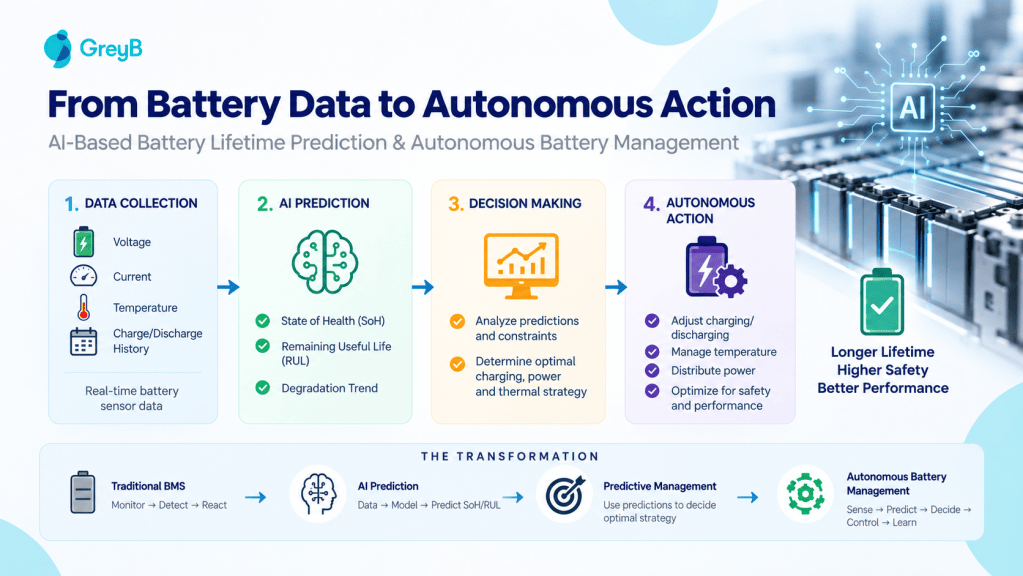
Conventional battery-management systems largely react to voltage, current, temperature, and predefined thresholds. The innovations in this report point to a different model: AI systems that estimate battery health, predict future degradation and remaining useful life, and use those predictions to change how batteries are charged, cooled, operated, and loaded.
GreyB analyzed 900+ patents and products across the US, EP, and CN, focusing on 2025–2026 innovations shaping predictive and autonomous battery management.
Key Takeaways
- Battery health is becoming a control input. AI-generated State of Health and lifetime predictions are increasingly being used to influence charging and operating decisions.
- Prediction and control are closing the loop. Emerging systems move from sensing battery conditions to predicting future health, optimizing operation, executing changes, and learning from the result.
- Battery intelligence is extending beyond individual packs. Health and remaining-life predictions are also being used to distribute power across larger energy-storage systems.
- Commercial platforms are already linking battery prediction with charging and thermal management, rather than treating health analytics as a separate monitoring layer.
Battery Prediction Is Moving Into the Control Loop
One of the patents highlighted in the report predicts current and future SOH across multiple charging cycles, converts that forecast into a life-loss target, and then dynamically determines charging parameters under safety and efficiency constraints.
The resulting loop is:
Sense → Predict Future SOH → Estimate Life Loss → Optimize Charging → Execute → Learn
That shift is at the center of the report: battery lifetime prediction is becoming part of autonomous battery control.
Five Innovations Show How Predictive Battery Management Is Taking Shape
ELECTRA AI Turns the BMS Into an Intelligence Layer
ELECTRA AI applies AI/ML and physics-informed battery models to telemetry data to estimate SoC and SoH, predict degradation and faults, and support adaptive battery operation. The difference is that prediction doesn’t remain an analytical output. It can become part of how the BMS responds to changing battery conditions.
EMO Energy Connects Battery Prediction With Charging and Thermal Management
EMO Energy’s SENS platform analyzes voltage, current, temperature, charging behavior, and historical operating data to predict battery degradation and health. It then combines battery intelligence with charging and thermal-management technologies, connecting prediction directly to battery operation.
MaxVolt Brings Predictive Diagnostics Into the BMS
MaxVolt Energy uses AI/ML algorithms to estimate SoC and SoH from operating data while providing predictive diagnostics, real-time monitoring, and alerts. The approach moves battery-health estimation beyond fixed methods and thresholds toward continuous prediction.
YUNZHI Uses Future Battery Health to Change Charging Decisions
A YUNZHI patent combines CNN, BiLSTM, and attention-based deep learning to predict current SoH and its future evolution over multiple charging cycles. It converts that predicted health trajectory into a life-loss target and uses it, along with safety and efficiency constraints, to determine charging parameters through a closed-loop control process.
Shanghai Zunli Makes Battery Health a Power-Allocation Variable
Shanghai Zunli’s patent estimates SoH and remaining useful life for individual battery units and feeds those predictions into a two-level power-distribution optimization system. Healthier batteries can receive more load while aging batteries operate at reduced levels, creating a health-aware energy-management system.
Battery Lifetime Intelligence Is Expanding From the Pack to the System
The same principle is beginning to appear at a larger scale.
In the Shanghai Zunli example, online SOH estimation and remaining-useful-life prediction feed a two-level power-distribution optimization system. Healthier batteries can take more load, while aging batteries operate at reduced levels. Instead of managing every battery uniformly, predicted health becomes a real-time variable for deciding how an entire energy-storage system should operate.
The report therefore captures two connected shifts:
- Predict the battery’s future condition.
- Use that prediction to change how the system operates.
What the Report Covers
Battery health and lifetime prediction
AI/ML approaches for estimating SoH, degradation, faults, and remaining useful life.
Predictive charging
Systems that use future battery-health forecasts to dynamically change charging parameters.
Autonomous battery management
Closed-loop systems connecting sensing, prediction, optimization, execution, and continuous learning.
Charging and thermal optimization
Battery-intelligence platforms integrating health prediction with charging and thermal-management decisions.
Health-aware energy storage
Power-management systems that distribute workload according to the predicted health and remaining life of individual batteries.

From Knowing Battery Health to Managing Around It
The innovations highlighted in the report point toward a broader change in battery management. AI is moving beyond estimating a battery’s condition. Predicted degradation and remaining lifetime are beginning to determine how batteries are charged, cooled, loaded, and managed across larger energy systems. The full report examines the products and patent approaches behind that transition.