




When the Unified Patent Court came into force in June 2023, the questions were procedural: how the court would operate, what unitary patent coverage would mean in practice, and how the opt-out mechanism would function. Nearly three years on, the market has answered those questions through use. Patent holders have filed opt-outs, withdrawn them to re-enter UPC jurisdiction, and, in confirmed cases, followed that withdrawal with an infringement filing.
That pattern is now visible in the data.
412 opt-out withdrawals sit in the UPC system today. Patent holders have followed only 171 of them with infringement filings, leaving a 241-patent gap that is not a sign of missing lawsuits but a pre-litigation pipeline. Each patent in it represents a case being prepared for assertion in a court that covers 18 European countries in a single filing, and the time before that filing is the only window in which the other side can still set the pace.
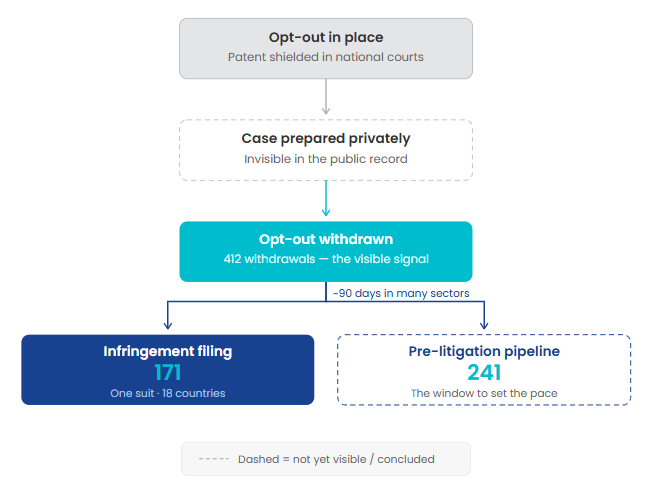
That gap between what is visible and what is in motion points to one question: Which of the 241 withdrawn patents sitting unfiled right now are being prepared for assertion against your product line?
The data answers it through three signals:
- Which sectors carry the largest unfiled withdrawal backlogs and are farthest along the conversion curve
- Which companies have re-entered UPC jurisdiction without filing yet, and what sector-level timing patterns say about when they will
- What a cluster withdrawal signals about enforcement intent when a patent holder withdraws multiple related patents at once, compared to a single-patent withdrawal
Also Read:

This article works through those signals across the four most active non-SEP sectors in the UPC system: Mechanical and Industrial Systems, Medical Devices and Diagnostics, Consumer Electronics, and Chemicals and Materials. Based on the current withdrawal pipeline and sector-specific filing timelines, it also projects what the next 18 months are likely to produce.
In two of the four sectors, the enforcement wave has started. In the other two, the pipeline is still accumulating. That difference is measurable, and it determines how much time remains before monitoring becomes reactive.
1,597 Patent-Level Events: How the Data Was Built
The UPC case management system records three distinct types of activity for every patent that enters the system: infringement filings, revocation filings, and opt-out withdrawals.
An infringement filing means a patent holder is suing. A revocation filing means someone is challenging a patent’s validity, most commonly a defendant responding to a lawsuit, though standalone revocation actions exist. An opt-out withdrawal means a patent holder has pulled a previously opted-out patent back into UPC jurisdiction, accepting the risk of central revocation in exchange for pan-European enforcement reach across all 18 member states in a single action.
All figures are extracted manually from the UPC case management system and reviewed individually by our teams, not scraped from secondary databases or sourced from law firm reports.
The year-by-year breakdown shows where the structural shift actually occurred:
| Year | Infringement | Revocation | Withdrawal | Total Filings |
| 2023 (June onwards) | 31 | 39 | 55 | 125 |
| 2024 | 70 | 74 | 253 | 397 |
| 2025 | 69 | 40 | 104 | 213 |
| 2026 (till 13 Jan) | 2 | 0 | 0 | 2 |
2024 was the inflection year. Withdrawals more than quadrupled from 55 in the second half of 2023 to 253 in 2024, a single-year repositioning of declared intent that the system is still working through. The 2025 figures reflect the natural transition from accumulation to conversion: withdrawals slowing, infringement filings holding steady.
The column that carries the most forward-looking weight is the withdrawal column. The infringement column records what has already happened. The withdrawal column records what is in preparation.
The Withdrawal Is the Last Administrative Step, Not the First Signal
Withdrawing an opt-out is an active decision, not a passive event in managing a portfolio. In every confirmed case of withdrawal leading to infringement in the dataset, the withdrawal occurred first. Out of 412 recorded withdrawals, 50 patents later resulted in infringement filings on the same patent. Of those 50, 33 converted within three months of the withdrawal.
How fast does a withdrawal convert to a filed case?
In every sector, teams prepare the case before submitting the withdrawal. The timing breakdown by sector is shown in the chart below, but the pattern is consistent: most conversions occur either within the first 90 days or much later, with very few in between.
The overall conversion rate across sectors is 11% of withdrawals that result in an infringement filing within 12 months.
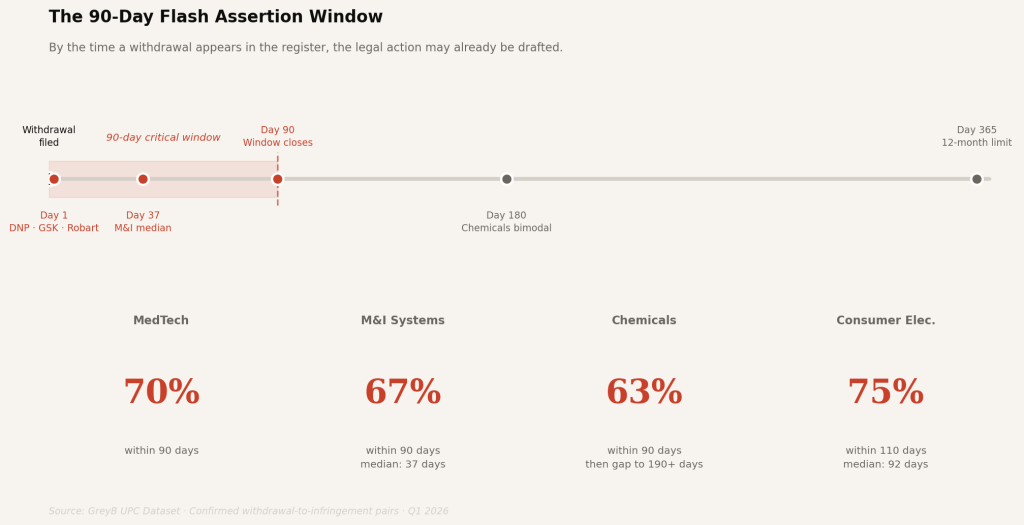
By the time a withdrawal appears in the register, the legal action may already be drafted.
There are two anomalies worth noting.
In Chemicals & Materials, the 91-to-180-day window is empty. Three cases were all filed between 190 and 338 days, indicating delayed campaigns in which the withdrawal serves as a credible threat before filing.
In Mechanical & Industrial Systems, the known Bosch-Lidl case sits over 200 days beyond the next furthest filing and reflects a negotiation strategy rather than a typical timeline. Neither anomaly should set general expectations.
Most competitor monitoring programs track filings. By the time an infringement filing appears, preparation on the other side has been complete for weeks. The withdrawal register signals earlier, but understanding it requires detailed analysis of what was withdrawn, not just the withdrawal itself.
If a competitor in these sectors has re-entered UPC jurisdiction, a patent landscape analysis against the current withdrawal register shows which withdrawals indicate genuine pre-litigation positioning and which reflect routine portfolio management.
Mechanical & Industrial Systems · 350 Filings · 220 Withdrawals · The Conversion Wave Already in Motion
Mechanical and Industrial is the largest non-SEP sector in the UPC dataset. This sector also shows a significant gap between declared intent and executed enforcement. It has a 3:1 withdrawal-to-infringement ratio. In every other sector tracked, this ratio compresses over time as the withdrawal pipeline matures. However, in Mechanical and Industrial, that compression has not yet occurred at scale.
142 Withdrawals Filed in 2024 Alone
Infringement filings remained steady across all three periods. The withdrawal column saw significant movement, with a 4.7 times increase in just one year. Out of the 101 companies from the 2024 group, none have filed any infringement cases yet. The effects are still unfolding in the system.
| Period | Infringement | Revocation | Withdrawal | Total |
| 2023 (H2) | 10 | 5 | 30 | 45 |
| 2024 | 34 | 31 | 142 | 207 |
| 2025 | 28 | 22 | 48 | 98 |
Who Are the 101 Non-Filed Companies
The 101 companies that withdrew opt-outs in 2024 without filing a single infringement case are Schaeffler, Kärcher, Krones, Wirtgen, Trelleborg, Nordson, and Parker. Their sub-sector concentration: Material Handling (9 companies), Food Processing and Metallurgy (5 each), Fluid Control, Manufacturing Machinery, and Metrology (4 each), Robotics (2).
Material Handling: The Sub-Sector With the Widest Gap
Material Handling carries the widest withdrawal-to-infringement gap of any sub-sector in the entire dataset, at 11:1. It also accounts for the largest single cluster of non-filed companies among the 101, with 9 companies, more than any other sub-sector.
Both factors point to the same conclusion: Material Handling is the most likely source of the sector’s next wave of patent enforcement.
Timing: Most Cases File Fast, and a few take long
Excluding one same-day filing, 10 of the remaining 27 withdrawal-to-infringement cases converted within 30 days, three of them within 48 hours.
The median is 37 days, with 67% of cases filed within 90 days. Eight companies in this sector filed within eight days of withdrawal. The case was prepared before the withdrawal was submitted.
Three Active Rivalries, Three Different Enforcement Approaches
Three rivalries already underway each illustrate a different way companies are using the UPC.
Ocado versus AutoStore in warehouse robotics: 24 entity appearances across 8 European countries, all filed in a coordinated single-week sweep. This is the UPC used to pursue a wide network of related parties across borders in one action, something that would have required separate national filings before.
Fujifilm versus Kodak in printing technology: Kodak responded to two infringement actions with ten revocation counter-filings, the most aggressive defendant counter-attack in the entire dataset. This shows how a defendant can use the UPC’s centralized system to challenge the validity of an opponent’s patents at scale, rather than defending one case at a time.
Valeo versus Magna in EV motors: 32 to 35 days from withdrawal to infringement filing on the same patents, indicating preparation that pre-dated the withdrawal entirely. This is the clearest example in the sector of a case that was ready before the opt-out was formally reversed.
All three share the same structural element: the withdrawal came first, the litigation was planned in advance, and the UPC’s pan-European reach was used deliberately rather than reactively.
Pan-European Retailers: A New Defendant Category
One pattern specific to this sector is worth tracking separately: pan-European retailers are emerging as a distinct defendant category. Lidl alone has been named in four separate M&I cases.
Before the UPC, a manufacturer pursuing a retailer selling competing own-brand products across Europe had to file separate national proceedings in each country, each with its own procedures, costs, and timelines. The UPC collapses that to a single filing. Actions that were previously too costly to pursue across multiple jurisdictions are now viable in one step.
The Bosch–Lidl case established this commercial logic. Several of the 101 non-filed companies operate in categories where pan-European retailers sell competing own-brand ranges: power tools, outdoor equipment, cleaning products, and kitchen appliances. They face the same structural situation Bosch faced before that first filing.
Medical Devices & Diagnostics · 207 Filings · 78 Withdrawals · The 90-Day Window Is the Operational Signal
In the medical domain, infringement cases account for 28% of all UPC case types, that is, 58 infringement cases out of a total of 207 (Infringement, Revocation, Withdrawal combined). This places the sector in the top half by enforcement intensity. But the figure that defines MedTech’s UPC profile isn’t the infringement count.
It’s the revocation count: 71 active revocation proceedings running alongside those 58 infringement cases. In other words, for almost every patent being enforced in MedTech, there’s another one being challenged and asked to be struck down. Attack and defense are happening at nearly the same scale.
On top of that, the UPC can issue preliminary injunctions that block sales across Europe within weeks, not the years such cases used to take. That combination makes UPC enforcement in MedTech a real, immediate business risk, not a distant legal possibility.
Three patterns in the MedTech data are specific to this sector and carry direct forward-looking implications.
The cluster withdrawal as a pre-litigation signal. On 11 November 2025, Roche Diabetes Care simultaneously withdrew opt-outs from eight related patents. EP4241683, EP3954288, EP4233720, and five further patents covering glucose monitoring technology. Cluster withdrawals at the portfolio level are a consistently stronger pre-enforcement signal than isolated single-patent withdrawals. A company withdrawing a single patent may be running routine portfolio management. A company withdrawing eight structurally related patents covering a coherent technology area is preparing a litigation campaign.
As of Q1 2026, six months out from the cluster withdrawal, none of the eight Roche patents have converted to an infringement filing. The 90-day flash-assertion window has closed. The 12-month conversion window remains open through November 2026. Given the timing pattern this sector shows, Roche appears to be positioning toward the longer tail of the distribution, a deliberate, broader campaign rather than a fast single-target strike. The campaign is in preparation, not yet in motion.
The 90-day flash assertion window. 70% of MedTech infringement suits are filed within 90 days of opt-out withdrawal. In specific cases, the gap has been shorter: DNP and GSK have both been tracked in withdrawal-to-filing sequences of 1 to 3 days. This flash-assertion pattern, where the case is fully prepared before the withdrawal is filed, is more prevalent in MedTech than in any other sector. The practical implication is that by the time a withdrawal appears in the register, the legal action may already be drafted.
The post-settlement competitive reorientation. In late 2024 and early 2025, Abbott and Dexcom signed a 10-year patent peace agreement, removing each other from their respective enforcement targets. Both companies now carry substantial, battle-tested patent portfolios and legal infrastructure that is no longer directed at each other. Early data suggests that capacity is being reoriented toward mid-tier and smaller players in the CGM and diabetes monitoring space, companies that previously operated in the gap between the two dominant portfolios and had structured their IP risk assumptions around a two-player competitive dynamic that no longer exists.
Edwards Lifesciences’ withdrawal activity in 2025 points to enforcement in structural heart and transcatheter delivery technology within the same 12-month window.
The forward-looking position in MedTech is this: the sector’s pre-enforcement pipeline is smaller in absolute volume than Mechanical & Industrial’s, but it converts faster, with less warning, and against a revocation counter-response that is already structurally embedded in how this sector litigates. A cluster withdrawal followed by 90 days of silence is not a signal that enforcement has been abandoned; it is a signal that a broader campaign is being prepared.
The Abbott-Dexcom settlement didn’t reduce enforcement activity in CGM; it redirected it.
Mid-tier players whose IP risk assumptions were calibrated against a two-player dynamic are now operating against two independently active, battle-tested portfolios. Whether the current FTO position holds against those portfolios, and whether it covers the enforcement vectors the UPC now makes viable, is not a question most teams have re-run since the settlement closed.
A Freedom to Operate analysis built against the current UPC withdrawal register is the right starting point for teams in this space.
Consumer Electronics · 106 Filings · 65 Withdrawals · FTO Built Before 2025 Is Built Against the Wrong Competitive Set
Consumer Electronics has 65 opt-out withdrawals against 26 infringement cases. 66% of those withdrawals arrived in 2024 alone, the same single-year concentration pattern seen in Mechanical & Industrial, on a smaller absolute base and arriving approximately one year later in the adoption curve. The sector is in the early stages of conversion. Specific subdomain dynamics are already prompting active enforcement, and the competitive landscape has shifted quickly enough that prior clearance work is no longer reliable.
The two sub-domains with the most distinct UPC signatures are floor care and robotics, and personal care and hair styling.
Floor care and robotics.
Two shifts are now compounding. The first, the inversion of patent ownership in European floor care (with Roborock and Ecovacs replacing iRobot and Dyson as the dominant blocking-portfolio holders), has been visible in filing data since 2022. The second emerged in 2025-26: the enforcement infrastructure built around that inverted landscape.
The UPC’s pan-European single-action capability is being used directly (Ecovacs against Roborock on EP 3 808 512). NPE acquirers are positioning into the same space (Papst Licensing’s actions against both Ecovacs and Roborock on EP 3 494 446). And the Robart case against Roborock, filed one day after the opt-out withdrawal on EP3030943B1, demonstrates that even smaller players in this market are now running prepared-enforcement strategies.
An FTO built before 2025 is not just stale on who holds the relevant patents. It also doesn’t show how those patents can now be enforced.
In September 2025, Ecovacs used the UPC’s evidence-preservation mechanism to obtain an ex parte order permitting inspection of Roborock’s products at IFA Berlin before the main proceedings were filed. In March 2026, the UPC Court of Appeal revoked that order. The court found that Ecovacs had failed to disclose that the targeted products were already commercially available on Amazon EU, a material fact under the Duty of Candor established by Rule 192.3. The ruling’s practical consequence extends beyond this case: commercial availability is now a legally material fact in UPC enforcement proceedings. Patent monitoring and commercial market tracking are no longer separable activities for teams managing UPC exposure in this sector.
Personal care and hair styling.
Dyson’s foundational European patents covering the Supersonic hair dryer’s motor and airflow technology, originally filed in the early-to-mid 2000s and granted ahead of the product’s 2016 launch, reached the end of their 20-year EP term and began to expire in 2024. That expiry removed the primary blocking structure that had shaped European hair care IP for a decade. New entrants, primarily Chinese brands (Dreame, Laifen, and Airfly), scaled European distribution fast. Enforcement at the utility layer followed soon after.
In Dyson v Dreame (UPC_CFI_387/2025), Dyson asserted EP 3 119 235 against Dreame’s Airstyle and Pocket products, also naming Eurep GmbH and Teqphone as distributors. This used the pan-European single-filing capability to target the entire commercial chain in one action. On 14 August 2025, the UPC Hamburg Local Division issued a final order granting a preliminary injunction against Dreame covering UPC territories and, for specified defendants, Spain.
On 6 March 2026, the UPC Court of Appeal (UPC_CoA_789/2025 and UPC_CoA_813/2025) partially stayed the Spain and Eurep aspects. It referred four jurisdiction questions to the CJEU, one of the first CJEU referrals under the UPC framework, while the UPC-territory infringement aspects were resolved separately on appeal.
This is the first major UPC enforcement of Dyson’s foundational hair-styling patent family against a Chinese-brand entrant at commercial scale in Europe. For operations that built FTO positions around the design layer, the question the case reopens is whether the utility and method patents, covering motor architecture, sensor-driven heat control, and attachment interfaces, were ever cleared against the current competitive set. The expiry of the dominant blocking patents did not retire the underlying technology claims. It moved enforcement activity from one layer to another.
The inversion of blocking-portfolio ownership in European floor care happened in the filing data before it was visible in the market. FTO positions built against the pre-2022 landscape are not just partially stale; they were built against a competitive set that no longer holds the relevant patents. If your FTO coverage in this space predates 2024, the question isn’t whether it needs updating. It’s whether the enforcement infrastructure now sitting behind those newly dominant portfolios was ever part of the analysis.
Chemicals & Materials · 73 Filings · 49 Withdrawals · The Earliest Pre-Conversion Stage in the Dataset
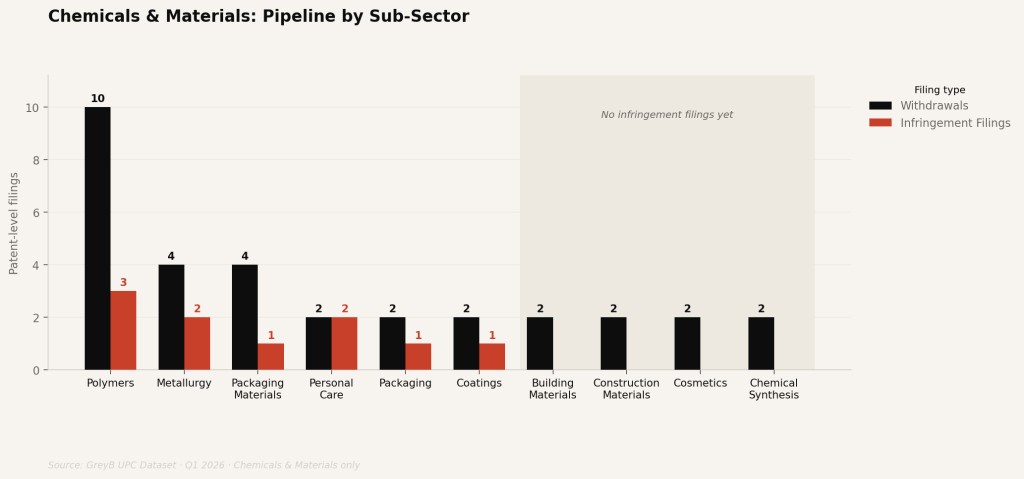
Chemicals & Materials is the smallest sector by filing volume and the earliest by conversion stage. The withdrawal-to-infringement ratio is 3.3:1 overall, but the sub-sector breakdown reveals a more differentiated picture.
Four Sub-Sectors With Declared Intent and No Filed Cases Yet
The shaded zone marks sub-sectors with withdrawals on record but zero infringement filings. Polymers (3.3:1 ratio) and Packaging Materials (4:1) carry the widest gaps and are the highest-probability origin points for the sector’s first enforcement wave.
Three Structural Features That Hold Across Every Sector
The sector analyses above show different stories about volume, timing, and competition. Three features consistently appear across all four sectors, indicating universal trends in UPC enforcement rather than sector-specific observations.
The cluster withdrawal has become the strongest pre-litigation signal available
A single patent withdrawal may involve portfolio management or ongoing licensing negotiations. A cluster withdrawal, in which multiple related patents in a technology area are withdrawn simultaneously, signals a portfolio-level decision made during the litigation-planning stage. Monitoring at the patent family level distinguishes early warnings from late detection.
Revocation has become the structurally expected counter-response to infringement, not a tactical surprise
Significant UPC disputes have resulted not from the strength of individual patents, but from the overall portfolio strength of both parties. For instance, Magna filed four revocations against Valeo’s asserted patents, while Kodak filed ten against Fujifilm. In MedTech, there are 71 revocation proceedings alongside 58 infringement cases. The strength of an individual patent does not determine the outcome of a UPC enforcement campaign. Instead, success hinges on the resilience of each party’s full portfolio after both sides enter the revocation phase. Conducting a vulnerability assessment of the asserted patent family, related families, and patents likely to face counter-revocation is crucial for determining if an offensive campaign will yield defensible results or lead to unfavorable settlement terms. The pre-conversion period offers the lowest-cost opportunity for such analysis.
The effectiveness of a UPC campaign relies more on the survival of the surrounding portfolio during the defendant’s revocation efforts than on the lead patent’s strength. Cases where enforcement has stalled, such as Magna against Valeo and Kodak’s counter-filings against Fujifilm, were decided by the relative strength of the portfolios, not the initial patent claims. Conducting these assessments before filing is more cost-effective and impactful.
Prior art searches and invalidity assessments for UPC-asserted patent families must keep pace with the evolving structure of enforcement.
The pan-European single-action capability
Before the UPC, multi-country coverage required parallel national proceedings, which were costly and time-consuming. The UPC streamlines this process. Ocado filed against entities in eight countries in one coordinated week.
ArcelorMittal named 17 defendants across three countries in one action. Dyson included distributors and manufacturers in a single filing. The enforcement exposure in a UPC action extends beyond the primary target to any part of the commercial chain, whether manufacturers, regional distributors, licensed processors, or retail partners. Many organizations have yet to fully assess the implications of their supply chain in relation to UPC litigation risks.
What the Pipeline Says Is Coming: 2026 to 2027
The withdrawal data, combined with the sector-specific timing distributions established earlier, support a more precise forward view than what has traditionally been offered in European patent litigation. The following analysis is centered around the most probable outcomes rather than the full range of possibilities.
In the Mechanical & Industrial sector, Material Handling emerges as the most likely origin point for the first significant wave of activity, primarily due to the concentration of un-filed companies and the largest sub-sector withdrawal gap identified in the dataset. The retailer-targeting model showcased by the Bosch-Lidl proceedings can be applied to any pan-European retailer with own-brand product ranges in the relevant categories; both Aldi and Decathlon exhibit a similar exposure profile to Lidl prior to the first filing.
In the Medical Devices sector, there are two active enforcement windows that will persist through the end of 2026: one encompasses Roche’s eight-patent glucose monitoring cluster, which falls within its 12-month conversion window set to close in November 2026, while the other relates to Edwards Lifesciences’ withdrawal activities in structural heart and transcatheter delivery technology, suggesting a concurrent campaign is likely during this timeframe. Additionally, the Abbott-Dexcom post-settlement shift represents a less visible but more impactful development, as two major portfolio holders with established legal structures now operate in a market where mid-tier players have yet to adjust their IP risk assessments.
The Consumer Electronics sector is nearing the conversion stage that Mechanical & Industrial reached in 2023. Notably, the acquisition of European navigation and motor patents by non-practicing entities (NPEs) is a trend to monitor; the filings made by Papst Licensing against Ecovacs and Roborock serve as a leading indicator rather than an isolated incident. The Duty of Candor ruling from March 2026 is expected to influence how teams compile evidence-preservation applications in future consumer electronics cases.
Chemicals & Materials is currently about 18 months behind Mechanical & Industrial regarding the adoption curve, with Polymers identified as the most probable sub-sector based on its pipeline structure. The enforcement model ArcelorMittal has demonstrated will likely serve as the blueprint for Polymers and Packaging Materials as they undergo conversion. A key consideration for operations in these sub-sectors is not whether this model will apply, but rather where in the supply chain they will be situated when it does.
Three cross-sector developments are anticipated to become standard practice: firstly, cluster withdrawals at the portfolio level are likely to become the default approach for patentees with cohesive technology coverage. Secondly, enforcement planning will begin to factor in defendant counter-revocation rather than treating it as a tactical escalation. Lastly, multi-defendant, multi-country actions that include the entire commercial chain in a single filing will likely become the norm for European enforcement, moving beyond being just an exception for larger disputes.
The Data Is Available. The Interpretation Is Where the Exposure Sits.
The opt-out withdrawal register is public. You can calculate timing distributions from the case management system. The register does not show which withdrawals are genuine pre-litigation actions and which are for portfolio maintenance. It also does not indicate which sub-sectors are at which stage of the conversion curve or what the details of a competitor’s withdrawal cluster mean for enforcement targets.
To understand these aspects, you need to analyze patent-level details. This includes examining prosecution history, EPO opposition status, the scope of the claims relative to current market products, and the relationships between withdrawn patents and the broader portfolio. You also need to analyze timing patterns at the sub-sector level, where sector differences become actionable.
The pre-conversion period is the most cost-effective time to perform this analysis. The enforcement wave will not announce itself beyond the withdrawal register. By the time a case is filed, the other side has likely prepared for weeks or months.
GreyB’s UPC research team has tracked every withdrawal, infringement filing, and revocation action across all 18 contracting member states since the court began. They provide patent-level analysis of specific competitor withdrawal clusters, including claim scope, EPO opposition history, and timing-pattern assessment against sector-specific conversion distributions. The team that created this dataset can help you understand what a specific competitor’s withdrawal activity means for your technology area.
You can contact GreyB’s UPC research team for a patent-level overview of the current withdrawal register in any area of interest.