


Today, roughly 75% of the EU building stock is energy inefficient, wasting a significant portion of the total consumption. Renovating existing buildings can reduce the EU’s energy consumption and minimize losses. Yet, on average, less than 1% of the national building stock is renovated yearly.
The biggest hurdle here is a critical information gap. Relevant stakeholders don’t know which buildings most urgently need retrofitting. It’s unclear what specific interventions are required and how to allocate limited resources efficiently across entire neighborhoods or cities.
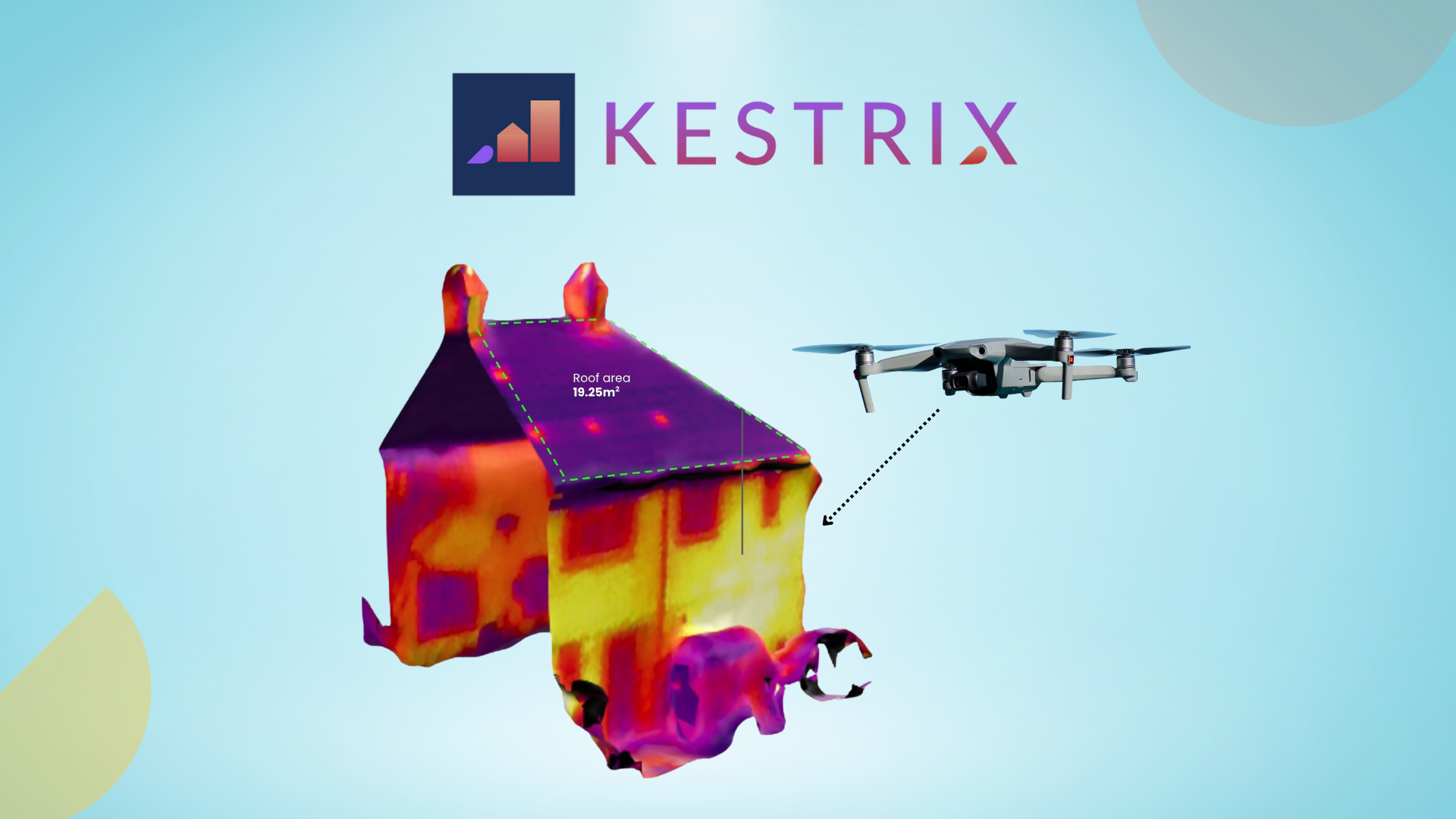
A startup named Kestrix has risen to solve this problem. It deploys thermal imaging drones to capture heat loss data across thousands of homes simultaneously. Their processed data allows housing providers and utility companies to identify retrofitting priorities and optimize resource allocation. It helps coordinate neighborhood-scale energy efficiency projects that would be impossible to plan effectively without their aerial perspective.
To better understand their technology and its commercial feasibility, we spoke to Lucy Lyons, Co-founder and CEO of Kestrix. This article is a brief overview of the whole conversation.
This interview is part of our exclusive Scouted By GreyB series. Here, we talk to the founder of innovative startups to understand how their solutions address critical industry challenges and help ensure compliance with industry and government regulations. (Know more about startups scouted by GreyB!)
“Kestrix is like the Google Maps of heat loss, mapping and quantifying exactly how heat is escaping from buildings to generate indicative retrofit plans.”
– Lucy Lyons

Lucy Lyons is the Co-founder and CEO of Kestrix. Lucy has a background in carbon accounting and ESG reporting. Her expertise in decarbonization strategies aligns with Kestrix’s mission to improve energy efficiency. Lucy heads Kestrix alongside co-founder Matt Goodridge, who was previously a product manager at Google.
How Kestrix’s Aerial Heat Maps Can Reduce Europe’s Carbon Emissions
Lucy: Kestrix is an innovative startup that uses thermal imaging drones to create detailed heat loss maps of buildings. Flying drones at 30-60 meters above neighborhoods identify and quantify how heat escapes from buildings and generates indicative retrofit plans. Their technology serves as an “automated energy survey from the sky,” helping housing providers and utilities make informed decisions about where to allocate retrofit resources most effectively. By providing this critical data, Kestrix aims to address the significant challenge of building-related emissions, which account for 20% of CO2 emissions in Europe.
How exactly does Kestrix’s technology work, and what impact have you achieved?
Lucy: We’ve flown our drones over several thousand houses for social housing providers and utilities that deliver retrofit programs underfunded schemes like the Energy Company Obligation (ECO). Our thermal imaging technology exposes heat loss at scale, allowing customers to make more informed decisions about allocating scarce retrofit resources.
When organizations have limited funding for insulation, we help them determine how to spend it most effectively—whether by targeting the homes with the greatest need or by concentrating measures on one street to optimize contractor costs. While retrofit programs unfold over several years, we already see how our data helps customers save money and improve decision-making.
What technological challenges have you faced in developing this solution?
Lucy: We’ve faced two main challenges. First is operational—flying drones at low altitudes over urban areas isn’t trivial. We’ve had to develop in-house capabilities to organize drone pilots effectively while adhering to high data protection and privacy standards. We participated in the Information Commissioner’s Office’s sandbox program to stress-test our approach to data privacy and ensure we’re using the captured data solely for driving retrofit outcomes.
The second challenge involves our core algorithms. We’re developing some of the first technology in the world to estimate quantitative heat loss rates through building fabric without internal temperature readings. We use machine learning and computer vision to tackle this in a way few companies have attempted. Our methodology is patent-pending, and building out these algorithms and the necessary training datasets has taken significant time, supported by Innovate UK funding.
What scalability challenges have you overcome to bring this technology to market?
Lucy: To build the “Google Maps of heat loss,” we needed to develop robust 3D reconstruction pipelines. We’ve been bootstrapping a dataset that enables us to be the first company to build this pipeline. In previous years, we’ve had caps on the number of homes we could reasonably process, but this coming year will be the first where we no longer have these constraints.
We’re now positioned to deploy drones at the scale of tens of thousands of homes rather than just thousands at a time. This scaling capability comes from years of collecting data, optimizing our processes, working through operational challenges like weather constraints (as we need to capture images during cold weather), and coordinating drone operations. After three years of work, we’ve reached the point where our solution is truly scalable.
What are Kestrix’s expansion plans for the next few years?
Lucy: We plan to land and expand within our existing customer base in the next two to three years. We’re already working with some of the largest utilities in the UK, like EON, and partnering with EDF will be a great scaling partner. We’ll also continue working with significant housing providers like Clarion Housing Group, Peabody Trust, and Places for People—we’ve only scanned small subsets of their portfolios so far.
Beyond the UK market, we’re planning European expansion in about two years. We’re already conducting our first pilots with one of Portugal’s largest utilities, and we’re looking to expand into the Netherlands and Scandinavia next. We’ll focus on pilots next year with a full rollout the following year. We aim to create a comprehensive heat loss map to drive European retrofitting decisions.
As a founder tackling a new approach, how do you stay motivated when facing challenges?
Lucy: I’m building a company because it’s an effective way to address climate change holistically. This is how I can best impact this problem. I stay motivated by remembering why I’m here and what our team is trying to accomplish—most of our team joined for this exact reason.
We believe our time is best spent solving this challenge because when you have a blueprint for retrofit at a national or pan-European scale, you can better allocate scarce resources, get projects financed, and complete more work. Nobody has previously mapped entire cities with drones, but we’re driven by imagining the future we want to create. Even when things get tough, that vision keeps us going.
Meet our Interviewer – Shabaz Khan, Marketing Manager at GreyB

Shabaz Khan, Marketing Manager
Want to find other scalable startups working on urban thermography and heat mapping solutions? Consult our experts by filling out the form below: