


Fresh & Ready Foods recalled ready-to-eat sandwiches and snack products in 2025 after FDA investigators detected Listeria monocytogenes at its manufacturing facility. The outbreak was linked to 10 hospitalizations and one death. The FDA later cited serious violations of its preventive-controls requirements and raised concerns about the company’s ability to control Listeria in the processing environment.
For food manufacturers, incidents like this underline a difficult reality. Having food-safety procedures is not enough. Checks need to happen consistently, records must stay complete, and problems need to be caught and traced quickly.
Yet much of this work is still managed through paper forms, Word files, and spreadsheets.
Canadian food-tech company IONI is trying to change that. Its AI software reads existing HACCP plans, SOPs, recipes, and supplier documents and converts them into digital workflows. Operators can complete checks on phones or tablets. The system then tracks records, flags compliance gaps, and links food-safety information with batch, lot, and inventory data.
This helps manufacturers spot food-safety and compliance problems earlier, before they become much more expensive problems.
To better understand how they are doing it, we spoke to Alex Uspenskyi, Co-founder of IONI. This article contains notable highlights from our entire conversation.
This interview is part of our exclusive Scouted By GreyB series. Here, we speak with the founders of innovative startups to understand how their solutions address critical industry challenges and help ensure compliance with industry and government regulations.
“Food companies still run critical safety processes through spreadsheets, Word documents, and paper. We turn that into a digital system.”
— Alex

Alex Uspenskyi co-founded IONI in May 2025 and is based in Vancouver. He holds a master’s in computer science from Kyiv Polytechnic Institute.
In 2016, he founded a web and mobile software agency and grew it to 50 employees.
He later co-founded Elai.io, an AI video platform that Panopto acquired in 2024. His work focuses on using generative AI, including large language models and AI agents, to improve business processes
IONI Uses Large Language Models to Turn Food Safety Documents into Digital Checklists and Records
IONI is a Canadian company that makes AI software for food and beverage manufacturers. It is built mainly for smaller companies that still manage food safety and production on paper and spreadsheets.

Manufacturers upload their existing documents, such as SOPs, HACCP plans, recipes and supplier certificates. IONI’s AI reads them and sets up a digital system from them, so the data does not have to be entered by hand.
The system handles daily food safety tasks. Operators complete checklists on a tablet or phone. Supplier certificates are tracked for expiry. When a problem is logged, the system drafts a corrective action. It also checks records against standards such as SQF, BRCGS and FSSC 22000 and flags gaps before an audit. Food safety records are linked to batch, lot and inventory data.
The AI does not make final decisions. A qualified person at the company has to approve its suggestions.
For someone in R&D who understands the compliance problem but has never seen IONI, what does the platform actually do?
Alex: I would describe IONI as a platform for food safety and productivity. We mainly work with smaller food companies that are still running many of their processes through spreadsheets, Word documents, and paper. We help turn their food safety management system into a digital system while also collecting operational information from the production floor.
The important part is that these things do not have to remain separate. A company can have its food safety information, batch and lot data, inventory, and production records in one place. That makes information available much faster and makes audit preparation easier.
AI helps us make that transition practical. Most food safety systems are already described in documents, so our software can read those documents and convert the information into digital workflows instead of requiring somebody to configure everything manually.
Many food software platforms already exist. What does AI allow IONI to do differently?
Alex: One of our biggest advantages is onboarding. Companies often know they need a better system, but moving away from spreadsheets can look like a months long consulting project. Somebody has to understand the existing processes, enter the information, configure the software, and then teach the plant how to use it.
With IONI, a company can upload the documents it already has. AI reads them and helps configure the relevant processes. We can start with something relatively small, such as receiving lots and completing the QA checks associated with them, and employees can then use tablets on the production or warehouse floor.
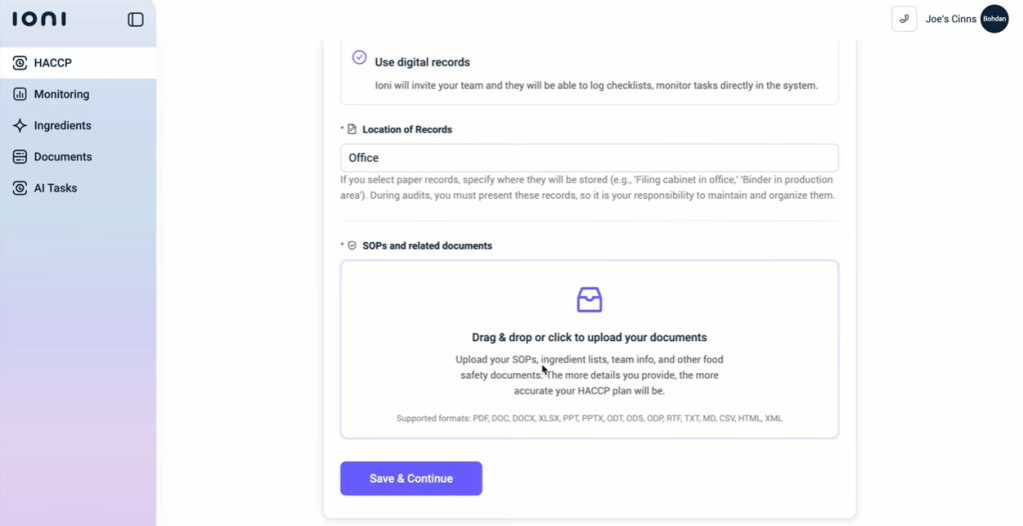
AI also supports ongoing compliance work. It can examine a HACCP plan, understand process steps, compare them with defined hazards or requirements, and highlight potential gaps. The goal is not to replace the person responsible for food safety. It is to remove the repetitive work around that person.
What problems are food manufacturers typically trying to solve when they come to you?
Alex: I normally see two connected problems. The first is digitalization and productivity. QA (Quality Assurance) employees may be collecting forms for every batch or lot and then manually transferring that information somewhere else. Plant managers may also have information split between systems such as QuickBooks, spreadsheets, and paper records. There is a lot of repetitive work just to understand what is happening.
The second problem is audit preparation. A company may have an audit coming up or may want to comply with a framework such as SQF. We can review the existing process, organize the information, and identify gaps. If the company works with a food-safety consultant, IONI can also act as the common software environment for both sides.
These problems become easier once the same system supports day-to-day production and compliance. Instead of preparing everything again when the next audit arrives, the records are already being created as part of normal operations.
Food plants can have highly specific SOPs and production processes. How far can you customize IONI?
Alex: Customization is essential because every food company operates differently. An SOP may have many checks, steps, and exceptions, but we can still convert it into a digital workflow. The food safety system, production process, and individual requirements can all be structured differently for each customer.
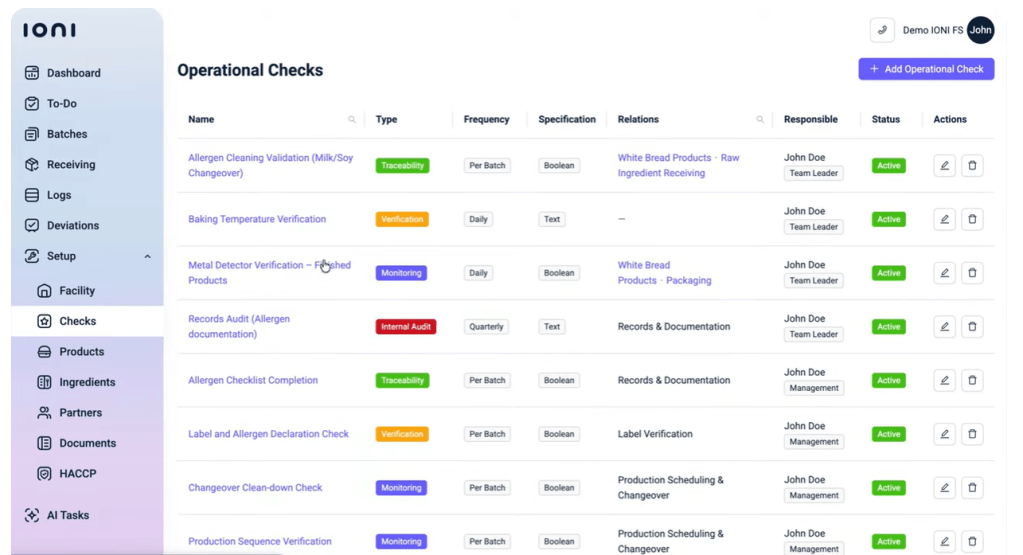
This used to make implementations expensive because every customer effectively became a small custom software project. AI changes that. It gives us a way to keep the underlying product standardized while adapting the workflow to how an individual facility actually operates.
That flexibility also lets us support more complicated cases. A company may manufacture some SKUs itself and use co-packers for others, for example. Those are the kinds of workflows that have traditionally required much larger enterprise systems, but we want to make them accessible to smaller manufacturers as well.
R&D-focused manufacturers may come to you with incomplete or badly organized documentation. What can the AI realistically do in that situation?
Alex: We can identify gaps and suggest ways to address them. For example, we can review a HACCP plan or requirements from standards such as SQF or BRC and show that a particular requirement is not covered by the company’s current process. We can also suggest which document may need to be created or which existing procedure may need to be updated.
What we do not want is for AI to make the final food-safety decision. If a business does not have somebody who understands food safety, I would still recommend working with a qualified consultant. Someone on the company or consulting side needs to decide whether a proposed process is appropriate and compliant.
I see AI as a way to speed up expert work rather than replace accountability. It can find missing requirements and organize the information much faster, but a knowledgeable person should review and approve what ultimately gets implemented.
Regulations and certification requirements keep changing. How can IONI help manufacturers respond to a new version of a standard?
Alex: This is an area where I think AI can become especially useful. If a customer was compliant with one version of a framework and a new version comes out, we can load the updated requirements and compare them with the company’s existing system. The platform can then show which new requirements create gaps.
Today, parts of this process already work, although updating and monitoring everything is not yet fully automated. The longer-term idea is for the platform to continually monitor relevant updates based on factors such as a customer’s location and operating requirements and then flag changes that affect that facility.
That would connect external regulations directly with what is actually happening on the production floor. Instead of discovering a change shortly before an audit, a manufacturer could see what has changed and what part of its process needs attention much earlier.
Which food and beverage companies are the best fit for IONI?
Alex: We are fairly agnostic about the type of food being produced. A snack manufacturer, meat processor, ingredient business, or another food company can use the same underlying approach because we do not hard-code the platform around one product category.
The bigger factor is operational complexity. A small farm with relatively simple requirements may be perfectly comfortable using spreadsheets. The value becomes much greater when a manufacturer has more SKUs, batches, process steps, quality checks, or compliance requirements but is still managing them through spreadsheets and Word documents.
That is the point where disconnected information and manual administration start becoming a serious burden. IONI is intended to give those companies a more sophisticated system without forcing them into an enterprise implementation.
Could the same approach eventually expand into pharma, cosmetics, or other compliance-heavy industries?
Alex: The same basic principles could apply to industries such as cosmetics, pharma, and other regulated manufacturing sectors. They also have complex documentation and compliance requirements, so technically there is a clear opportunity.
But every vertical has its own details. Pharma, for example, is much stricter in certain areas, and compliance requirements can affect operations before production even starts. Supporting another industry properly would require us to understand those workflows at the same depth that we are developing for food.
For now, food is our primary focus. There is still a lot we can do around compliance, productivity, traceability, and potentially even R&D workflows. We want to solve those problems well before deciding how far to expand into other industries.
What has been the most difficult part of building a product for food manufacturers, and how did you overcome it?
Alex: The biggest challenge has been understanding the market deeply enough. I came from software rather than spending ten years inside the food industry, so I had to learn how food companies actually manufacture products, manage food safety, prepare for audits, and make decisions on the floor.
That meant spending a lot of time understanding customer processes instead of assuming that a technically advanced product would automatically solve the right problem. For me, that learning process was challenging but also one of the most interesting parts of building IONI.
Technology itself is not the bottleneck I worry about most. The technology is already far ahead of many of the systems people use today. The real challenge is turning that capability into something manufacturers can actually adopt and use every day.
What product developments are you working on next?
Alex: One of the major areas we are working on is closing the traceability loop across the entire operation. That includes shipments and forward traceability rather than stopping once a batch has been produced.
We are also connecting invoices and orders with batch creation. The idea is to link incoming materials, production, compliance records, customer orders, shipments, suppliers, and customers rather than keeping those pieces separate.
Ultimately, I want the system to provide an end-to-end view from the supplier through production and all the way to the customer, with as much of the repetitive data handling automated as possible.
Meet our Interviewer – Raveena Singh, Senior Research Analyst at GreyB

Raveena Singh, Senior Research Anlayst
Want to find other scalable startups working on AI solutions? Please fill out the form below to contact our experts.