

Value Delivered
The research identified a strong Japanese patent reference that brought together the key features missing from earlier results. The reference disclosed recipient selection on a wireless device, selection of a stored image message, inclusion of identifier codes, and transmission of the actual image data. This gave the client a stronger basis to challenge the novelty of a high-value image messaging patent.
The client could use the findings to:
- Build a stronger invalidity position around the combined transmission of an image and its corresponding identifier.
- Show that image-based non-verbal messaging existed in earlier Japanese telecom systems.
- Support claim mapping with a reference that disclosed the required features together, rather than relying on separate references for individual elements.
- Reduce dependence on weak keyword-based results and strengthen the technical basis for litigation, negotiation, or settlement discussions.
Problem Solved
The target patent covered a mobile non-verbal messaging system in which a user selected a categorized image message, such as a mood, location, or action, and transmitted both the selected image and a corresponding identifier to a recipient device. The identifier could then be used to retrieve or display the image locally or through a server.
The main challenge was that the initial search results disclosed only part of the claimed concept. Some systems transmitted an image, while others transmitted an identifier or numeric code. However, they did not clearly disclose both together. Several references also lacked the graphical messaging aspect or failed to combine recipient selection with image-message selection in the same communication flow.
A conventional keyword search around cameras, pictures, image messages, and mobile communication produced limited results. The terminology used in the target patent did not match the language used in older telecom systems. The research team therefore faced two core issues:
- Older systems described the same concept using terms such as symbols, icons, emojis, numeric codes, picture mail, or pager messages.
- Much of the relevant development had taken place in Japan and was not visible through a broad English-language patent search.
The key challenge was not finding isolated features. It was finding an earlier reference that disclosed the missing combination in one system.


Solution Offered
The research team reframed the search around the technical problem instead of repeating the claim language. Rather than focusing only on cameras and image transmission, the team explored older graphical communication technologies, including pagers, picture mail, NTT DoCoMo’s i-mode services, emojis, and Personal Handy-phone System devices.
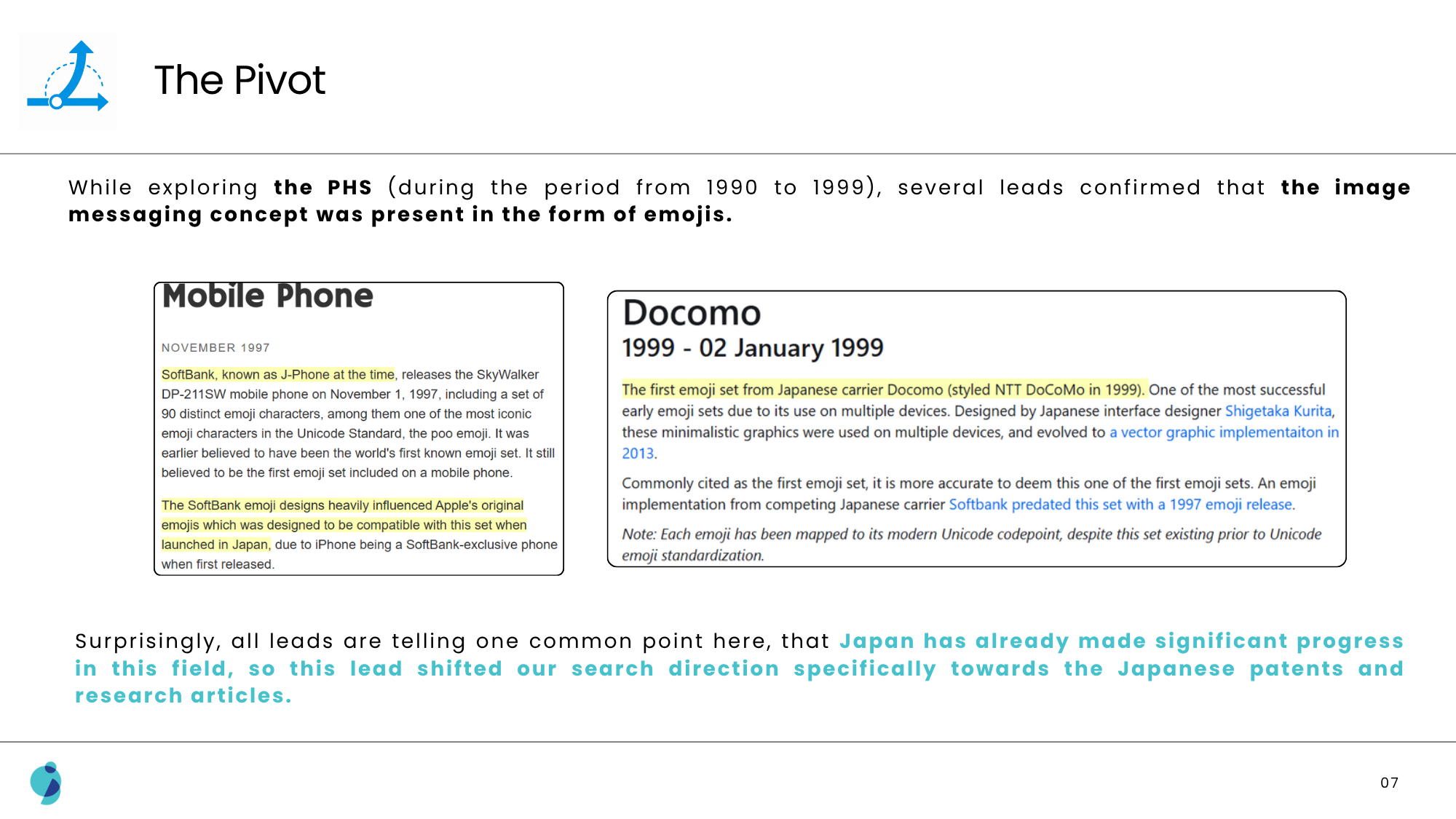
Blogs and historical articles were first used as directional sources. These materials showed that emojis and numeric-code-based graphical messaging were already used in Japanese pagers and mobile communication systems during the 1990s. The research did not treat these secondary sources as final prior art. Instead, they helped identify the relevant companies, products, terminology, geography, and time period.
This insight shifted the patent search toward Japanese patents and research publications. During the Japanese patent screening, one handheld communication system stood out. It allowed a user to select both a recipient and an image message. Its transmission packet included text identifiers, bitmap identifiers, action identifiers, and actual image data. This was the first strong reference that brought the missing elements together in a single communication system.
The case showed that the strongest result did not come from a direct keyword match. It came from:
- Reframing the claimed feature as a broader communication problem.
- Studying the historical development of pagers, emojis, picture mail, and Japanese mobile systems.
- Using secondary sources to identify primary patent-search directions.
- Focusing on the missing combination rather than isolated claim elements.
- Conducting geography-specific patent screening in Japan.
Get the full case study to discover how a geography-focused search in Japanese telecom patents uncovered strong prior art for a multi-million-dollar image messaging patent.