

Value Delivered
The client received a strong prior-art candidate for a patent claim covering the parallel analysis of genetic-sequencing data.
The identified software release disclosed the three central processing functions in a single pre-cutoff package:
- Dividing sequencing data into chromosome-based subsets;
- Separately identifying read pairs or structural variations spanning different chromosome subsets; and
- Processing the sequencing data using multiple parallel threads.
The findings enabled the client to:
- Address the complete technical combination: Identify one software package containing all three claimed processing functions rather than relying on separate references.
- Strengthen the invalidity analysis: Provide a dated technical disclosure that could be evaluated against the subject claim.
- Resolve a publication-date problem: Trace technical information from a later manual to an earlier publicly released software package.
- Expand the prior-art universe: Move beyond patents and academic papers to source-code repositories, archived software releases, configuration files, and accompanying documentation.
- Preserve a highly relevant lead: Avoid discarding a near-perfect technical match merely because the accessible version of its user manual appeared after the cut-off date.
Problem Solved
The subject patent claimed a computing system that accelerated genetic-sequence analysis through parallel processing. The relevant claim required three connected operations:
- Dividing sequencing data into subsets associated with individual chromosomes, groups of chromosomes, or mitochondrial DNA;
- Identifying read pairs whose respective mates mapped to different subsets; and
- Independently processing the subsets across multiple processor cores or threads.
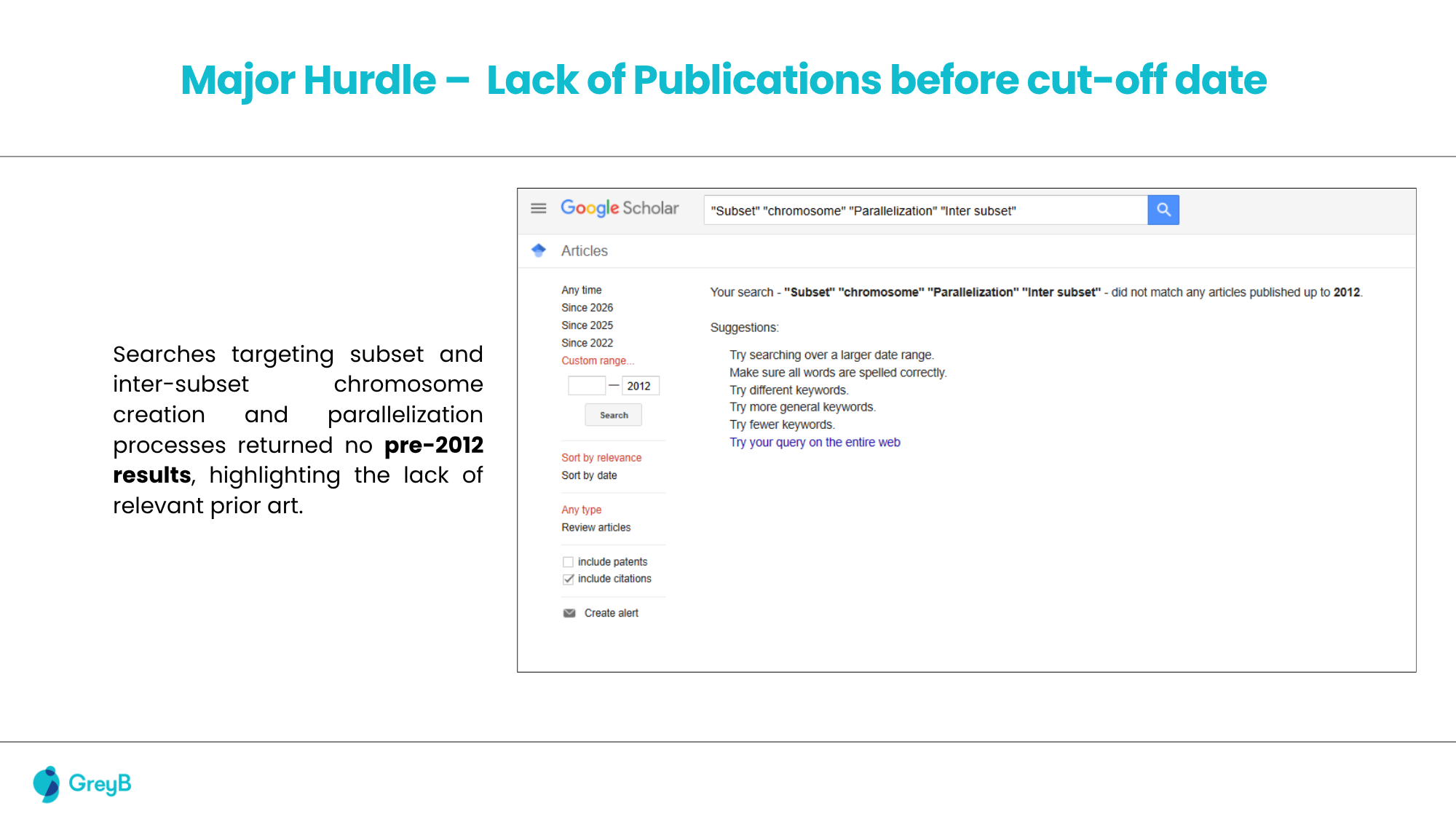
Conventional searches directed to biotechnology patents, genetic-sequencing literature, and academic publications did not identify a pre-cutoff reference expressly disclosing the complete combination.
The closest publication described a sequencing pipeline that divided genomic data by chromosome and processed the resulting portions in parallel. However, the publication expressly acknowledged that its pipeline could not parallelize the detection of inter-chromosomal read pairs. It therefore lacked a central part of the claimed workflow.
A separate academic publication introduced a potentially relevant bioinformatics tool for detecting intra- and inter-chromosomal structural variations. However, the paper focused on the biological application and did not provide sufficient implementation details regarding data splitting or multithreaded processing.
The tool’s later user manual disclosed configuration options corresponding closely to all three claim features. However, the earliest verifiable archived copy of that manual appeared after the applicable cut-off date. The manual therefore could not independently establish a complete pre-cutoff disclosure.


Solution Offered
The research considered technical evidence beyond conventional patent and journal sources. The relevant bioinformatics tool was traced to an earlier publicly distributed software package hosted in an open-source repository.
The dated release archive contained documentation and configuration files describing:
- An option for splitting the original sequencing file by chromosome for parallel computation;
- An option for producing separate outputs for intra- and inter-chromosomal structural variations; and
- An option for selecting the number of processing threads used for parallel computation.
These functions corresponded to the three principal mechanics of the claimed system: creating chromosome-based subsets, handling data spanning different chromosome subsets, and performing the analysis in parallel.
The release package predated the relevant cut-off and contained substantially the same technical instructions that later appeared in the user manual. This established a pre-cutoff technical disclosure for information that initially appeared usable only through a later-dated document.
The client ultimately received:
- A pre-cutoff software release disclosing the three relevant processing functions;
- Technical documentation from the release archive supporting the chromosome splitting, inter-chromosomal handling, and parallel-processing features;
- A date-supported disclosure trail connecting the later manual to the earlier software package;
- A consolidated prior-art position based on a single technical implementation rather than disconnected references; and
- A broader evidentiary foundation showing how publicly available software documentation may provide relevant prior art for a biotechnology-related computing claim.
The result demonstrated that the strongest prior art for a biotechnology patent may not always appear in a patent database or scientific journal. When the claimed contribution concerns computational implementation, dated software releases and their supporting files can contain the most relevant technical disclosure.
Get the full case study to discover how a dated open-source software release supplied the missing disclosure for a genetic-sequence analysis claim.