

Value Delivered
The analysis provided the client with a structured obviousness argument showing that the claimed 5G frequency-hopping method was not an independent technical breakthrough, but a foreseeable adaptation of established LTE mechanisms to Bandwidth Parts (BWPs).
By reconstructing the development of BWP-based frequency hopping through dated 3GPP contributions, the client could demonstrate that the claimed solution followed directly from known LTE principles, recognized problems in applying those principles to 5G, and contemporaneous proposals pointing toward hopping within the assigned BWP.
Problem Solved
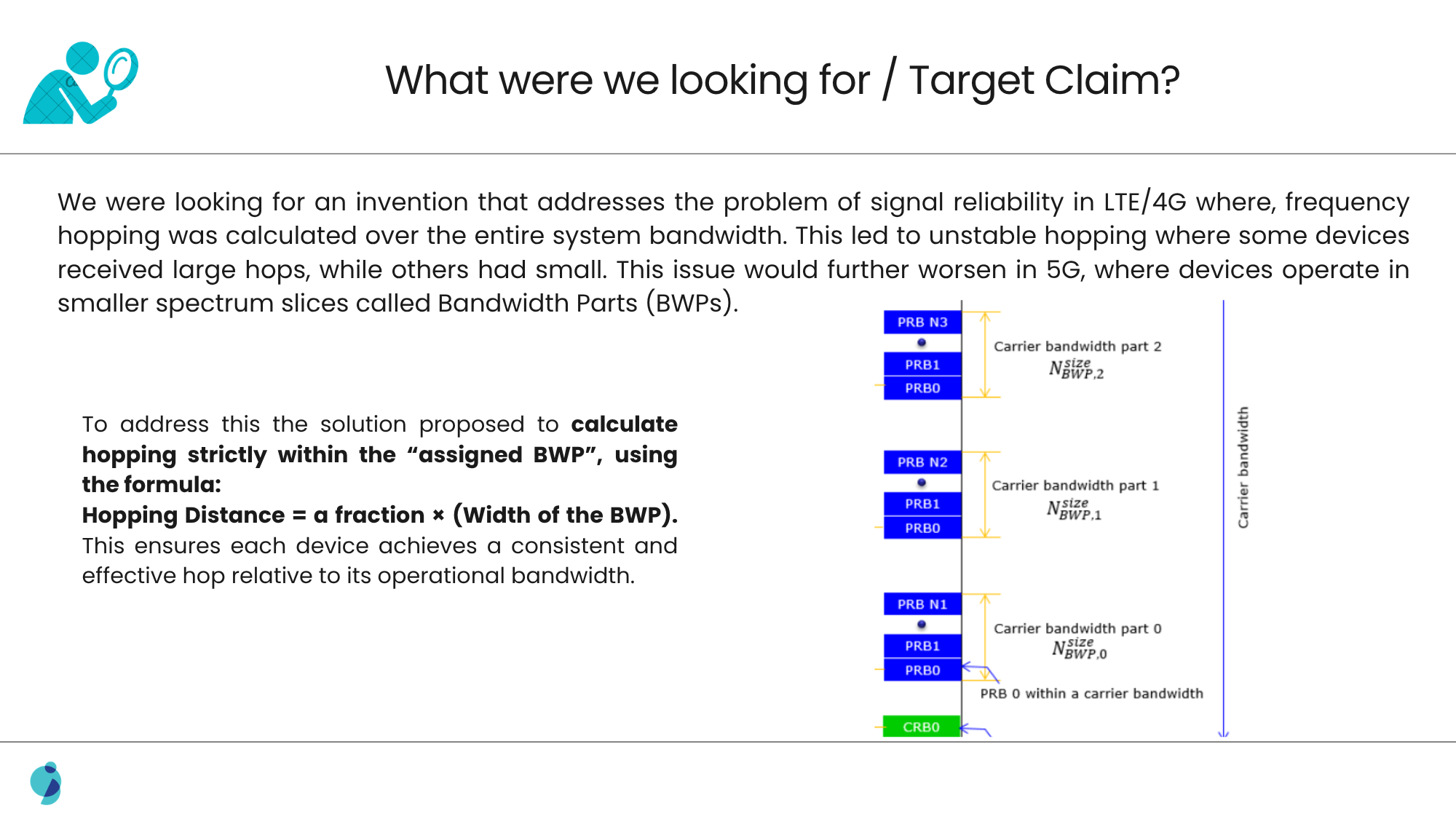
The target claim addressed inconsistent frequency-hopping distances by calculating the hopping offset as a fraction of the width of the device’s assigned BWP, rather than the entire system bandwidth.
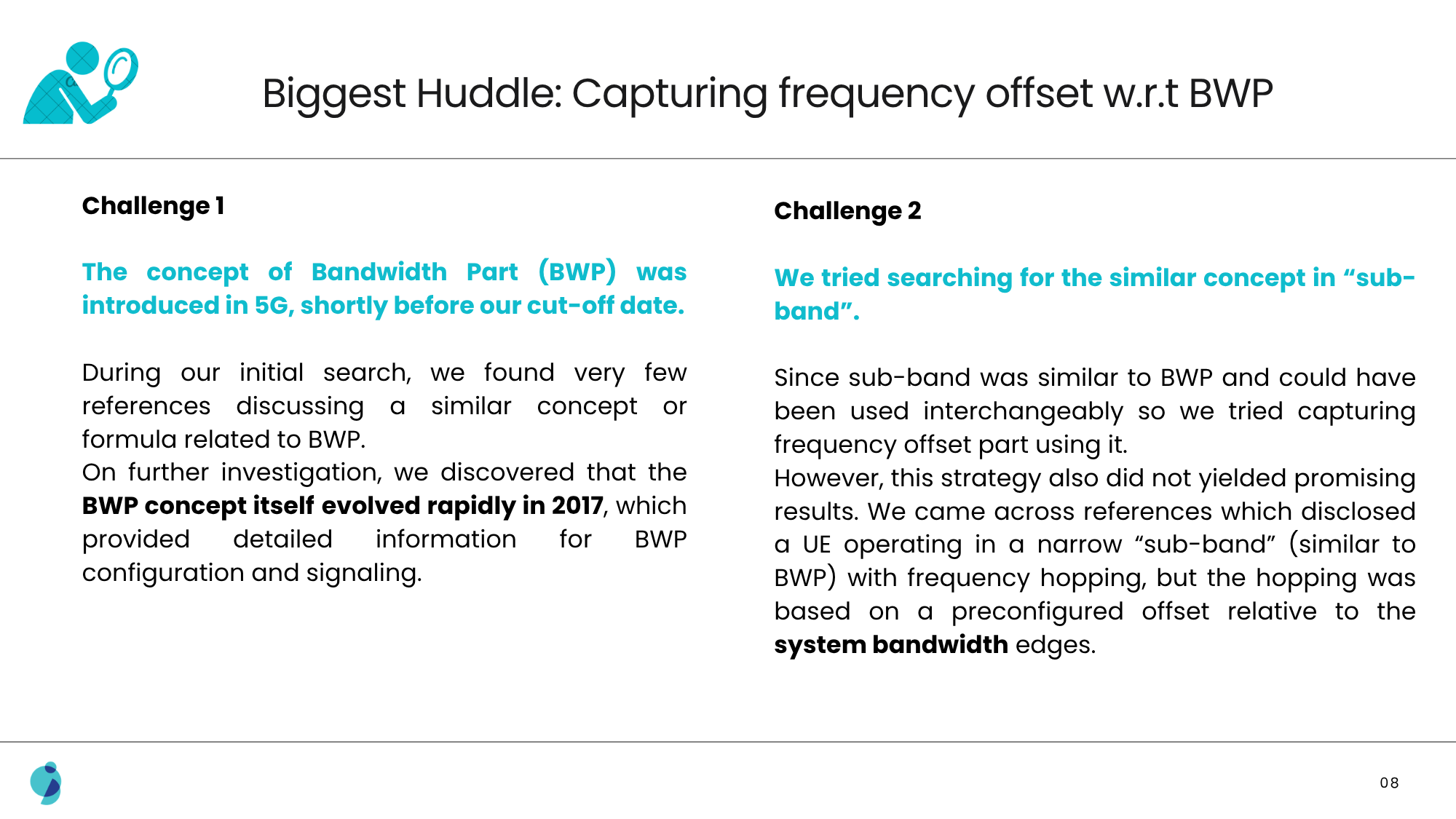
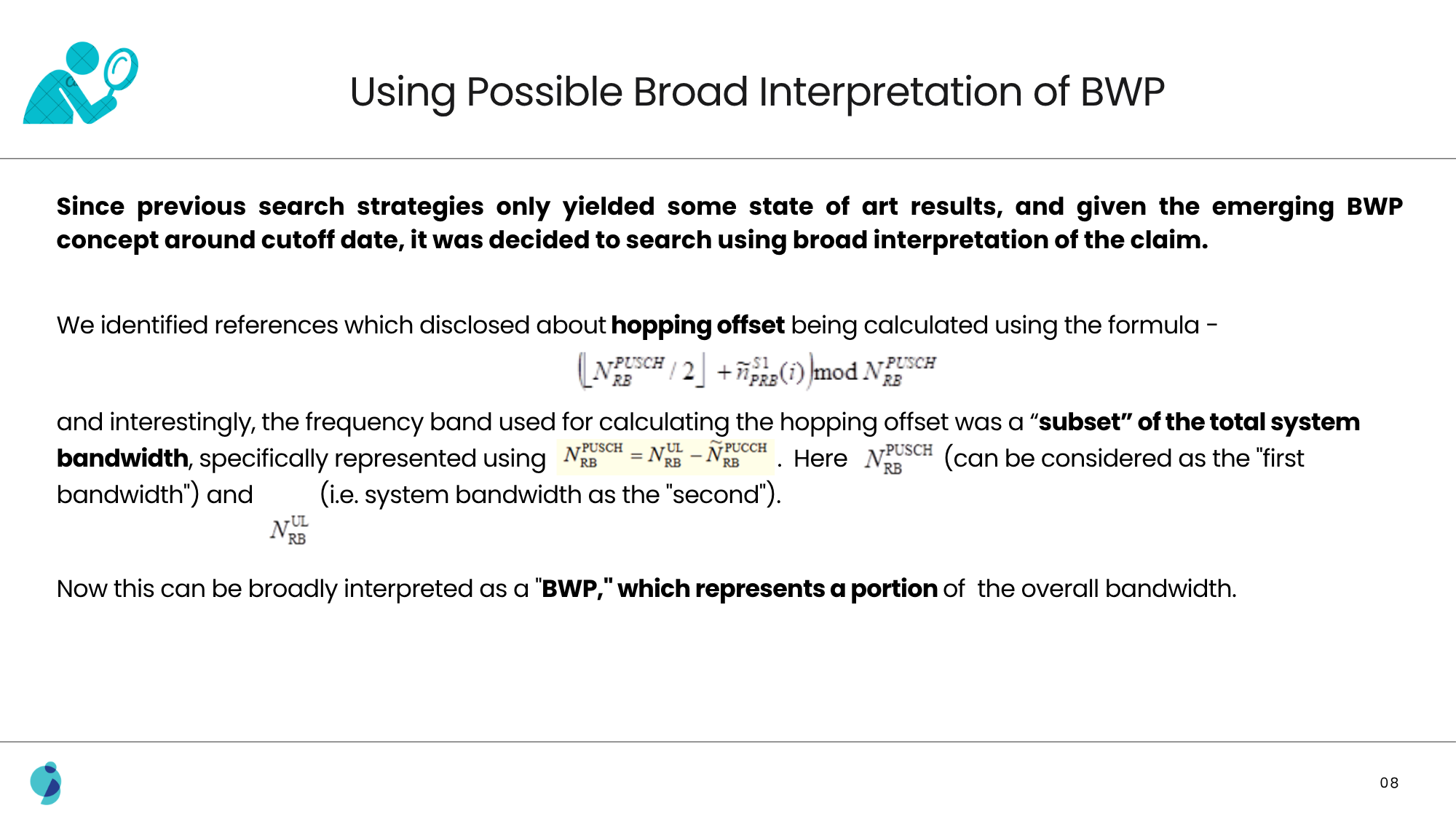
The principal research challenge was that the BWP concept had emerged shortly before the relevant cutoff date. Consequently, only a limited number of references discussed both BWPs and frequency hopping. Searches based on analogous terms such as “sub-band” identified devices operating within narrower bandwidth portions, but their hopping offsets were generally calculated relative to the complete PUSCH or system bandwidth—not the individual sub-band.
Although some references could support a broad interpretation of BWP, they did not fully capture the claim’s purpose of maintaining a consistent hopping distance within a flexible, UE-specific operating bandwidth.
Solution Offered
Instead of relying solely on an exact claim match, the research examined whether the claimed method was an obvious progression from LTE to 5G NR. A chronological body of 3GPP evidence was developed:
- R1-1612439 (Samsung) introduced the concept of a smaller, UE-specific operating bandwidth in November 2016.
- R1-1705411 (Samsung) used BWP terminology and proposed reusing LTE DCI principles for NR.
- R1-1706900 (Huawei) provided more detailed BWP proposals by May 2017.
- R1-1714475 (KT) identified problems and resource collisions arising from LTE-style hopping in an NR BWP environment.
- R1-1712589 (Intel) proposed performing frequency hopping within the BWP.
The LTE and NR standards were also compared. This showed that the underlying hopping mechanism remained substantially the same, while the reference bandwidth changed from the system-level bandwidth in LTE to the applicable BWP in NR.
Together, the references established the technological foundation, identified the problem with retaining the LTE approach, and pointed toward confining frequency hopping within the BWP. This supported the position that the claimed method was a predictable adaptation of known LTE principles rather than an inventive 5G solution.
Get the full case study to discover how we built a strong obviousness case to counter a 5G patent claim