





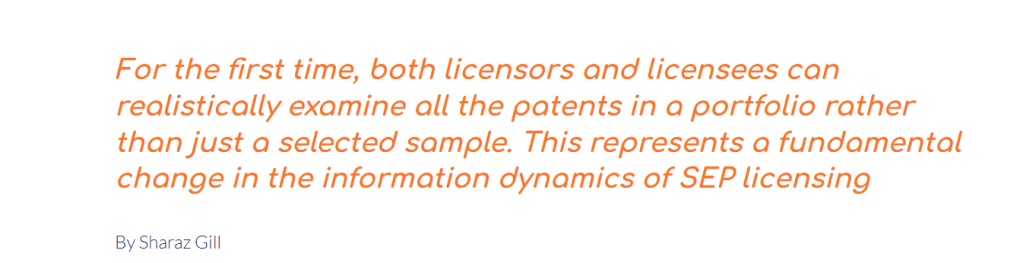
AI is changing the cost of obtaining that evidence. Both licensors and implementers can now use AI-assisted systems to screen much larger parts of a patent portfolio, identify relevant standard provisions, and prepare first-pass claim mappings. Sharaz Gill, Head of Portfolio Management at Sisvel, wrote in July 2026 that both sides can now realistically examine an entire portfolio rather than rely only on selected samples. He also described the emerging use of AI-generated portfolio analyses and competing claim charts by implementers.
That change was the starting point for GreyB’s September 2026 webinar, “If Everyone Has AI, Who Wins SEP Licensing?”
Dhruva Sood moderated a discussion with Aman Kumar of GreyB and Claims Evidence co-founders Konstantinos Poulinakis and Christoph Hewel. The panel examined what happens when portfolio-scale analysis becomes available to both sides, where AI-assisted essentiality work still fails, and what evidence needs to look like before it can support a negotiation or court proceeding.
The important change is not simply that claim charts can be produced faster. When both parties can generate large amounts of technical analysis, the harder question becomes whether they can check, reproduce, and defend it.
Samsung v. ZTE shows why the scale question matters
The 2026 Samsung v. ZTE FRAND judgment provides a useful starting point because the dispute required the court to assess the value of large patent portfolios while dealing with competing evidence about licensing rates and portfolio strength.
Mr Justice Meade ultimately determined a US$392 million lump-sum balancing payment for the court-determined global cross-license. The judgment considered comparable licenses and rejected ZTE’s top-down cross-check as unreliable in those circumstances. It also dealt with the difficulty of using patent counts and essentiality studies as direct measures of portfolio value.
The lesson for AI-assisted analysis is not that one valuation method has replaced another. A court still needs to understand the evidence behind the parties’ positions. A large portfolio cannot become persuasive simply because a system can process it. The relevant claims, standard requirements, licensing evidence, and assumptions still have to be connected in a way that another party can examine.
This is where the old scale problem becomes important. A detailed claim review can give a licensing team a much better view of a patent than a declaration count. The difficulty has been the cost of applying that review across hundreds or thousands of families. AI reduces that cost, so portfolio-wide evidence can start influencing negotiations before the parties select the smaller group of patents that will receive detailed human attention.
When both sides have AI, the first licensing meeting can change
If only one side adopted AI, the main effect would be a research advantage. That is not the direction the market is taking. Both sides can use the same class of tools, resulting in a different negotiation starting point.
An implementer can respond to a licensor’s selected patents with its own broader review, rather than limiting its response to the examples the licensor presents. The licensor can then run the same type of analysis against its own portfolio and the implementer’s objections.
That changes what happens before the first serious commercial discussion. A licensee may already have a view of which families appear essential, which depend on optional standard features, and which require a different claim construction. A licensor can identify the same issues before presenting its position. The conversation can therefore move more quickly from whether a portfolio has valuable patents to why the parties reached different technical conclusions.
This does not guarantee faster agreement. It can create more material for both sides to review.
The market is also changing how SEP information is labeled
A useful external signal appeared in WIPO’s PATENTSCOPE system during 2026. WIPO now distinguishes between patents declared essential by patent holders and patent information verified through patent-pool essentiality assessments. In July, WIPO also expanded its ETSI family-extension data, taking the number of distinct patent records in its SEP collection from more than 206,000 to more than 450,000.
WIPO’s June update said its database contained more than 9,000 distinct patent applications identified as pool-verified SEPs across eleven licensing programs. The distinction matters because a declaration is a statement by the patent holder, while pool-verified information has gone through an essentiality assessment by independent experts working for the pool administrator.
This does not establish that pool verification is a final legal finding of essentiality. It does show that the SEP market is placing more value on the provenance of essentiality information. As AI increases the volume of privately generated analysis, the same question will become harder to avoid: what process produced the conclusion, and how much confidence should another party place in it?
Patent counts become less useful when deeper questions become affordable
SEP declarations remain an important way to map the standards landscape, but AI makes it practical to look beyond the declaration itself. The next questions are more specific: how many declared families map to relevant standard requirements, which claims cover mandatory or optional features, which patents relate to the implementation being licensed, and which families carry forward technology from earlier generations?
These questions are not new. What is changing is how much it costs to answer them. A portfolio-wide review can now serve as a first filter, instead of asking experts to start with a small sample and expand only when a negotiation requires it.
Aman Kumar described this change during the GreyB webinar. He expects licensing discussions to move toward quality-weighted questions, including how many patents actually apply to a particular implementer, how much of the portfolio covers mandatory or optional features, and how much foundational technology carries into later generations. The value of the analysis therefore shifts from the size of the declared portfolio to the quality and relevance of the underlying patent set.
For a licensor, this can identify the families that deserve the strongest technical support before making a demand. For an implementer, it can separate broad declarations from patents that have a credible connection to the product. In both cases, the analysis is more useful when it explains why a patent matters, not just how many patents exist.
A technically plausible claim chart can still reach the wrong conclusion
The next issue is claim construction. SEP essentiality is not simply a comparison between words in a patent and words in a standard. The meaning assigned to a claim term can change whether the claim reads on the standard, and the same construction can affect a later validity analysis.
During the GreyB webinar, Christoph Hewel described the relationship between essentiality and validity as a “squeeze”. A broad construction may make the essentiality case stronger while creating a prior-art problem. A narrow construction may help preserve validity while taking the claim outside the standard requirement. An AI workflow that performs the two analyses separately can miss this relationship if it uses different constructions at different stages.
The better approach is to keep the construction consistent while testing both questions. The analysis should move from the claim to the standard, from the same claim construction to the prior art, and then back to the construction if the evidence creates a problem. The purpose is not to force one result. It is to make clear how the result changes when the legal and technical assumptions change.
This is one area where expert review remains important. The expert is not needed simply because a machine cannot read the documents. The expert is needed because interpreting a claim can change the technical mapping and the legal position at the same time.
Accuracy is not enough
More than 70% of the GreyB webinar audience identified accuracy and error rates as their biggest concern with AI-assisted SEP analysis. That concern is understandable, but a single accuracy score does not answer the questions that matter when the analysis is challenged.
Konstantinos Poulinakis proposed three practical tests. The first is repeatability. Run the same analysis more than once and check whether the essentiality conclusion, citations, and reasoning remain consistent. The second is claim-construction sensitivity. Change a legally important construction and see whether the result changes in the way the new construction should cause. The third is traceability. Another person should be able to follow the conclusion back to the patent, the standard, and the reasoning used to connect them.
These tests also explain why private benchmarking may become more important. A published benchmark can become a target for system optimization without showing how the workflow performs on new matters. A private test set based on manually reviewed patents, court decisions, pool evaluations, and difficult technical cases can provide a more useful comparison between systems.
Courts are starting to ask where AI can reduce the work without moving responsibility
The legal response to AI is moving beyond whether lawyers may use it. Courts are beginning to consider where AI can help with large evidence sets while keeping responsibility for the final work with lawyers, experts, and judges.
In Ayinde v. London Borough of Haringey and Al-Haroun v. Qatar National Bank, the English High Court dealt with AI-assisted legal research that produced false authorities and quotations. The court accepted that AI can be useful in litigation but stressed that lawyers must check AI-generated research against authoritative sources.
Justice Michael Lee’s August 2026 Sir Harry Gibbs Memorial Oration took the discussion further. He distinguished work that requires human judgment from work that mainly involves organizing and processing information, and argued that courts should consider using AI to reduce the cost and complexity of litigation while preserving human responsibility for decisions.
That distinction fits SEP analysis closely. Searching thousands of patents and standard documents is different from deciding how a claim should be construed. Organizing evidence is different from deciding what it means for a FRAND position. AI can take on more of the first group without removing the need for human judgment in the second.
Rogers v. McDonald’s shows how courts may test AI-assisted evidence
The Federal Court of Australia then moved from principle to a live case. In Rogers v. McDonald’s Australia Ltd, Justice Lee directed the parties to investigate whether AI could help collect, analyze, and synthesize a large evidentiary record. The process included consultation with technology experts and safeguards around source traceability, correction, confidentiality, and human supervision.
The case does not approve AI-generated essentiality analysis, and it does not create a general rule for SEP disputes. Its importance is more practical. A court is considering whether AI should be used for information-heavy work when manual review would impose a substantial cost, while requiring the resulting process to remain open to checking and correction.
A similar order followed in R&B Investments Pty Ltd v. Blue Sky Alternative Investments Ltd, where the Federal Court also examined AI-assisted document synthesis. Taken together, these developments suggest that the legal question is becoming less about whether AI was used and more about whether the process can be explained, tested, and supervised.
Munich’s FRAND guidelines make the timing more important
The same issue is emerging from the economics of FRAND litigation. On 13 August 2026, the 7th Civil Chamber of the Munich Regional Court I issued detailed FRAND guidelines. The guidance introduces the option of an early “FRAND FIRST” hearing, with submissions limited to 25 pages plus exhibits. It places comparable licenses first in the valuation process and treats top-down analysis as a cross-check, with a larger role where suitable comparables are unavailable.
The guidelines are not binding on other chambers or courts, but they are important because the 7th Civil Chamber handles a large volume of German SEP disputes and has set out a more structured approach to FRAND evidence. The practical effect is to encourage the parties to develop and present their economic positions earlier.
That makes large-scale preparation more valuable. A party does not need to put thousands of AI-generated charts before the court. It can use portfolio-wide analysis to identify which patents, technical assumptions, comparable licenses, and economic inputs actually affect the position, then present a shorter submission supported by a deeper evidence record.
This is a more credible path for AI into SEP litigation than treating an AI report as a replacement for expert evidence. AI can expand the analysis behind the submission while the final position remains tied to evidence that a professional can explain and the other side can challenge.
The difficult 10 to 20% is where the workflow needs to become smarter
Aman Kumar described several areas where current AI-assisted analysis can still fail or differ from expert work, including mathematical claims, diagrams, images, large tables, and claims where construction changes the result. He estimated that around 10% to 20% of cases can still require deeper expert attention.
That figure should not be treated as a universal error rate. It is an observation from the GreyB workflow, and it shows why a useful system needs to recognize difficult cases rather than hide them inside a single accuracy number.
A claim may depend on an equation that is only clear from a figure. Another may require several cross-references across 3GPP specifications. A third may depend on prosecution history that changes a term’s meaning. These are not all the same type of problem, but they share one feature: a small change in the underlying evidence can change the conclusion.
The better workflow therefore does not ask an expert to redo every AI-generated chart. It identifies the patents where expert review is most likely to change the outcome and records what the expert changed, confirmed, or rejected. That creates a more useful evidence trail than simply attaching a human approval label to an AI output.
The real change may be in what experts spend their time doing
Konstantinos expects claim charting itself to become increasingly routine as AI systems improve. He sees the harder problem moving toward the complete licensing process, where technical evidence must be combined with legal and financial judgment to produce a negotiation position. Christoph expects portfolio-wide AI analysis to become a normal part of serious SEP negotiations within the next one to two years, with experts spending more time on difficult claim construction and the patents that matter most.
That points to a change in the value of expert work. The important question becomes less about how many patents one expert can review and more about which patents require that expert’s judgment. If a system can screen thousands of families, the expert can focus on the smaller group where claim construction, validity, implementation, or standard interpretation can materially change the licensing position.
This also changes how we should compare AI systems. A system that produces more charts is not necessarily better. A stronger system may be the one that identifies the cases where its own uncertainty matters, provides the evidence needed to review those cases, and allows an expert to change the analysis without rebuilding the entire workflow.
What changes in SEP negotiations over the next two years?
The experts in the GreyB webinar were aligned on the direction, even though they approached it from different parts of the SEP process. Christoph expects portfolio-wide AI analysis to become normal in serious negotiations, especially before litigation, because both sides will have a fuller view of portfolio quality before deciding how far to escalate. Aman expects negotiation questions to become more specific, moving from declaration counts toward product relevance, mandatory and optional features, and foundational technology carried into later standards generations. Konstantinos expects claim charting to become less differentiated and sees the larger opportunity in connecting technical analysis to the legal and financial work that determines the final negotiation position.
The first change will be the baseline amount of analysis expected before a serious negotiation begins. A selected patent list may remain useful for discussion, but it will be easier to test against the wider portfolio.
The second change will likely be greater attention to why the two analyses disagree. Differences may stem from claim construction, standard interpretation, product implementation, prior art, or how an optional feature is treated. AI can help locate the disagreement, but the parties will still need to decide which interpretation is legally and technically supportable.
The third change will involve greater use of quality-weighted portfolio analysis. A declaration count can show a portfolio’s size. It does not show how much of that portfolio is relevant to a particular implementer or how much value is concentrated in the patents that matter to the product.
The fourth change may appear in litigation. Courts are unlikely to treat raw AI output as a substitute for evidence or expert opinion. They may become more comfortable with AI-assisted processes when the sources are clear, the method is testable, and a responsible professional can explain the result.
The fifth change is likely to be in the role of patent pools and independent evaluators. WIPO’s decision to place declared SEP information alongside pool-verified essentiality data shows that the market already distinguishes between a patent owner’s declaration and a separate essentiality assessment. As private AI analyses become more common, that distinction is likely to matter more, not less.
The next SEP advantage may be the ability to defend the analysis
AI is making large-scale SEP analysis more affordable. That does not mean that every SEP question can be automated, and it does not remove the need for technical or legal judgment. It changes what can be investigated before a negotiation and where experts spend their effort.
A licensee can examine more of a portfolio before responding. A licensor can test the strength of its own position before making a demand. Experts can focus on the patents where their judgment can change the result. Courts can consider whether AI can reduce the cost of organizing large evidence sets without giving up human responsibility for the final decision.
The result is likely to be more analysis on both sides. The important difference will be whether that analysis can be separated into conclusions that are well supported, conclusions that need more evidence, and conclusions where reasonable experts can disagree.
This is close to the point Sharaz Gill makes in his 2026 analysis. Once both sides can generate large amounts of technical evidence, the competitive advantage is less likely to come from producing the most claim charts. It is more likely to come from having a method that another party can understand, test, and challenge.
That is also where the GreyB webinar experts converged. Konstantinos focused on repeatability, claim-construction sensitivity, and traceability. Aman focused on expert review, failure detection, and quality-weighted portfolio analysis. Christoph focused on human responsibility, source verification, and the need to explain the analysis. Their emphasis differed, but the standard they described was similar: AI can perform more of the work, but the final evidence must remain understandable and defensible.
The next stage of AI in SEP licensing will therefore be less about whether a system can generate a claim chart and more about whether the entire analysis can withstand scrutiny from the other side, an expert, or a court.
Explore the full discussion
These questions were discussed in GreyB’s webinar, “If Everyone Has AI, Who Wins SEP Licensing?”, with Dhruva Sood, Aman Kumar, Christoph Hewel, and Konstantinos Poulinakis.
The panel covered AI-assisted essentiality analysis, claim construction, validity, FRAND valuation, courts’ use of AI, evidence standards, and expected changes in SEP licensing over the next one to two years.